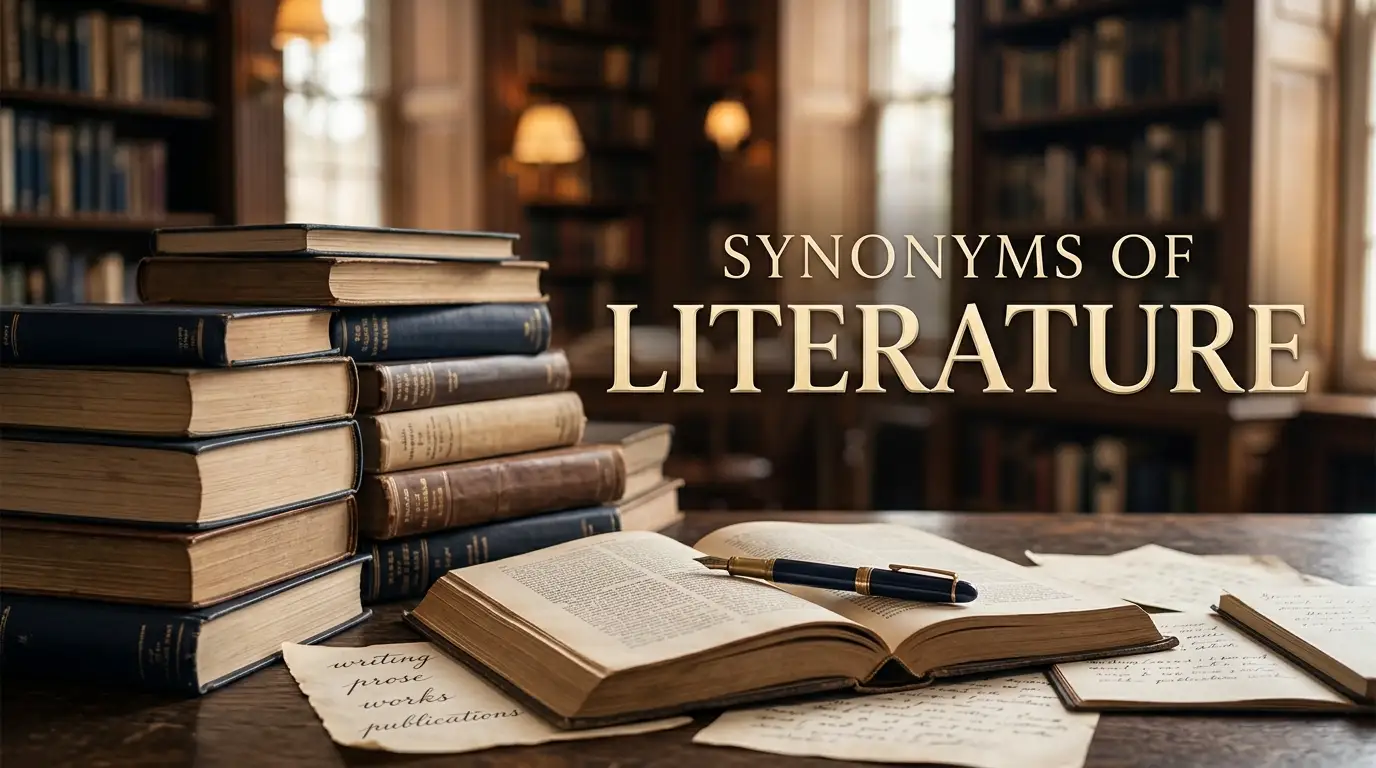
Synonyms of literature can help you describe books, written works, creative writing, and the study of literary texts more precisely. Imagine writing an essay about novels and poems. Repeating the word literature in every paragraph can make your writing feel dull.
The right alternative can make your meaning clearer. You might use written works when discussing published texts, fiction when referring to invented stories, or literary works when discussing poems, plays, and novels.
Learning synonyms of literature is useful for students, bloggers, content writers, and everyday English users. It helps you avoid unnecessary repetition while understanding how different words relate to reading, writing, and literary study.
However, not every related word means exactly the same thing. Some alternatives describe written material, while others refer to a particular genre or academic subject. Understanding these differences helps you choose the most accurate expression.
What Does “Literature” Really Mean?
Literature is a noun that commonly refers to written works valued for their artistic, intellectual, cultural, or informational qualities. It can include novels, poems, plays, essays, and other forms of writing.
The word also has a broader meaning. In academic, scientific, and professional contexts, literature can refer to published research and existing written information about a subject.
For example, English literature often refers to literary works written in English. By contrast, medical literature means published medical research and professional writing.
Simple Definition
Literature means written works, especially those valued for their artistic, cultural, intellectual, or scholarly importance.
Native English speakers understand the word through its context. In a school lesson, it may refer to novels and poetry. In a research paper, it may mean previously published studies.
Common Contexts
- Education: Studying novels, poems, plays, and literary traditions.
- Research: Reviewing published studies and academic writing.
- Culture: Discussing stories, ideas, and written works from a particular society.
- Creative writing: Exploring fiction, poetry, drama, and other artistic forms.
- Professional communication: Referring to documents and publications about a specific field.
Connotative Meaning of Literature
Connotation means the feelings, ideas, or associations a word suggests beyond its basic definition.
- Positive tone: Literature may suggest imagination, knowledge, cultural heritage, creativity, and intellectual growth.
- Negative tone: In some contexts, people may associate the word with difficult reading, complicated academic analysis, or dense writing.
- Neutral tone: In academic and professional contexts, the word often describes a body of published material without expressing an emotional judgment.
The word itself is generally neutral or positive. Its meaning depends on the subject being discussed.
Etymology of Literature
The word literature comes through French and Latin from the Latin word litteratura, meaning writing, learning, or instruction in letters. It is related to littera, meaning “letter.”
The word originally had a strong connection to letters, written language, and learning. Its meaning gradually expanded to include written works, literary art, and the body of published writing on a subject.
Historical Development
Old English (450–1100): The modern English word literature was not established in its current form. English speakers used other words to discuss writing, books, learning, and written records.
Middle English (1100–1500): French and Latin influenced English vocabulary, especially in education and scholarship. Words related to letters, books, and learning became increasingly important.
Modern English (1500–present): Literature developed into a broad term for written learning and published works. It became strongly associated with poetry, drama, fiction, literary criticism, and academic research.
Pronunciation of Literature
- US: /ˈlɪtərətʃər/
- UK: /ˈlɪtərətʃə/
Pronunciation can vary slightly by accent. Some British speakers pronounce the final syllables with a sound closer to “chuh.”
Syllables
Lit-er-a-ture — commonly divided into four syllables.
Affixation Pattern
- Root: Latin littera, meaning “letter.”
- Prefix: None in the modern English word.
- Suffix: -ature, part of the word’s historical development rather than a freely added suffix in everyday English.
40 Synonyms and Alternatives for Literature
The following alternatives cover the main meanings of literature, including literary writing, published material, academic research, and creative forms.
Some are close synonyms, while others apply only in particular contexts. Always check the intended meaning before replacing the original word.
Literary Writing and Written Works
1. Written Works
US: /ˈrɪtən wɜːrks/ | UK: /ˈrɪtən wɜːks/
Meaning: Written works are texts created and recorded in written form.
Examples:
- The library contains written works from many countries.
- Her written works explore family and identity.
2. Literary Works
US: /ˈlɪtəreri wɜːrks/ | UK: /ˈlɪtərəri wɜːks/
Meaning: Literary works are texts valued for their artistic, cultural, or expressive qualities.
Examples:
- Students studied several literary works this semester.
- The exhibition celebrated important literary works.
3. Writings
US: /ˈraɪtɪŋz/ | UK: /ˈraɪtɪŋz/
Meaning: Writings are texts produced by a person or group.
Examples:
- Her early writings reveal a strong interest in nature.
- The professor collected the author’s published writings.
4. Written Material
US: /ˈrɪtən məˈtɪriəl/ | UK: /ˈrɪtən məˈtɪəriəl/
Meaning: Written material refers to information or content presented in writing.
Examples:
- The course includes written material about poetry.
- Please review the written material before class.
5. Texts
US: /teksts/ | UK: /teksts/
Meaning: Texts are written or printed pieces of language that people read or analyze.
Examples:
- The class compared two historical texts.
- These texts reveal different cultural values.
6. Publications
US: /ˌpʌblɪˈkeɪʃənz/ | UK: /ˌpʌblɪˈkeɪʃənz/
Meaning: Publications are written works made available to readers.
Examples:
- The university maintains a list of academic publications.
- Her publications focus on modern poetry.
7. Books
US: /bʊks/ | UK: /bʊks/
Meaning: Books are written or printed works collected in a bound or digital format.
Examples:
- The school library has books about world literature.
- He enjoys reading books by contemporary authors.
8. Prose
US: /proʊz/ | UK: /prəʊz/
Meaning: Prose is ordinary written or spoken language that does not follow the regular structure of poetry.
Examples:
- The novel is written in clear, simple prose.
- She prefers prose to traditional verse.
9. Poetry
US: /ˈpoʊətri/ | UK: /ˈpəʊɪtri/
Meaning: Poetry is writing that often uses rhythm, imagery, sound, and carefully chosen language.
Examples:
- The course explores poetry from different periods.
- Her poetry reflects her experiences of growing up.
10. Verse
US: /vɜːrs/ | UK: /vɜːs/
Meaning: Verse refers to writing arranged in lines, especially poetry.
Examples:
- The students memorized a short verse.
- The play includes passages written in verse.
Fiction, Drama, and Creative Forms
11. Fiction
US: /ˈfɪkʃən/ | UK: /ˈfɪkʃən/
Meaning: Fiction is imaginative writing that presents invented characters, events, or worlds.
Examples:
- She reads historical fiction every weekend.
- The library has a large fiction collection.
12. Nonfiction
US: /ˌnɑːnˈfɪkʃən/ | UK: /ˌnɒnˈfɪkʃən/
Meaning: Nonfiction is writing based on real people, events, facts, or information.
Examples:
- He prefers nonfiction about science and history.
- The assignment requires a nonfiction book.
13. Drama
US: /ˈdrɑːmə/ | UK: /ˈdrɑːmə/
Meaning: Drama is writing intended for performance or a story involving serious conflict and emotion.
Examples:
- The class studied drama from the Elizabethan period.
- She wrote a short drama for the school festival.
14. Plays
US: /pleɪz/ | UK: /pleɪz/
Meaning: Plays are dramatic works written to be performed by actors.
Examples:
- The theater group performs classic plays.
- We read two plays by the same writer.
15. Novels
US: /ˈnɑːvəlz/ | UK: /ˈnɒvəlz/
Meaning: Novels are long works of fiction that develop characters and events through a sustained narrative.
Examples:
- The course includes novels from the nineteenth century.
- Her novels often explore social change.
16. Short Stories
US: /ˌʃɔːrt ˈstɔːriz/ | UK: /ˌʃɔːt ˈstɔːriz/
Meaning: Short stories are brief works of fiction that usually focus on a limited set of events or characters.
Examples:
- He writes short stories in his free time.
- The anthology includes short stories by emerging authors.
17. Narratives
US: /ˈnærətɪvz/ | UK: /ˈnærətɪvz/
Meaning: Narratives are accounts of events presented as a story.
Examples:
- The book contains narratives from different generations.
- Students compared the narratives in two novels.
18. Storytelling
US: /ˈstɔːriˌtelɪŋ/ | UK: /ˈstɔːriˌtelɪŋ/
Meaning: Storytelling is the act or art of communicating events through a story.
Examples:
- The author uses storytelling to explain historical events.
- Oral storytelling remains important in many cultures.
19. Creative Writing
US: /kriˈeɪtɪv ˈraɪtɪŋ/ | UK: /kriˈeɪtɪv ˈraɪtɪŋ/
Meaning: Creative writing uses imagination and expressive language to produce literary or artistic texts.
Examples:
- She joined a creative writing class.
- Creative writing helped him develop his own style.
20. Literary Fiction
US: /ˈlɪtəreri ˈfɪkʃən/ | UK: /ˈlɪtərəri ˈfɪkʃən/
Meaning: Literary fiction is fiction that often emphasizes language, character development, themes, or artistic expression.
Examples:
- The book club selected a work of literary fiction.
- Literary fiction often explores complex human experiences.
Academic and Scholarly Alternatives
21. Scholarship
US: /ˈskɑːlərʃɪp/ | UK: /ˈskɒləʃɪp/
Meaning: Scholarship is advanced study, research, or academic knowledge about a subject.
Examples:
- Her scholarship focuses on medieval poetry.
- The conference highlighted recent literary scholarship.
22. Literary Studies
US: /ˈlɪtəreri ˈstʌdiz/ | UK: /ˈlɪtərəri ˈstʌdiz/
Meaning: Literary studies is the academic examination of literary texts, traditions, and interpretations.
Examples:
- He plans to pursue literary studies at university.
- Literary studies can include history and cultural analysis.
23. Literary Criticism
US: /ˈlɪtəreri ˈkrɪtɪˌsɪzəm/ | UK: /ˈlɪtərəri ˈkrɪtɪˌsɪzəm/
Meaning: Literary criticism is the analysis and interpretation of literary works.
Examples:
- The essay introduces feminist literary criticism.
- She reads literary criticism to understand the novel’s themes.
24. Literary Canon
US: /ˈlɪtəreri ˈkænən/ | UK: /ˈlɪtərəri ˈkænən/
Meaning: A literary canon is a collection of works widely recognized as influential or important.
Examples:
- The course questions which authors belong in the literary canon.
- Many schools teach works from the traditional literary canon.
25. Literary Tradition
US: /ˈlɪtəreri trəˈdɪʃən/ | UK: /ˈlɪtərəri trəˈdɪʃən/
Meaning: A literary tradition is a pattern of writing, themes, or forms passed through generations.
Examples:
- The poem draws on a long literary tradition.
- The class explored the literary traditions of South Asia.
26. Literary Heritage
US: /ˈlɪtəreri ˈherɪtɪdʒ/ | UK: /ˈlɪtərəri ˈherɪtɪdʒ/
Meaning: Literary heritage refers to the writings and traditions inherited from earlier generations.
Examples:
- The museum celebrates the country’s literary heritage.
- Translators help preserve literary heritage across languages.
27. Body of Work
US: /ˈbɑːdi əv wɜːrk/ | UK: /ˈbɒdi əv wɜːk/
Meaning: A body of work is the complete or substantial collection of works produced by a person or group.
Examples:
- Her body of work includes novels and essays.
- Researchers examined the author’s body of work.
28. Corpus
US: /ˈkɔːrpəs/ | UK: /ˈkɔːpəs/
Meaning: A corpus is a collected body of texts used for study, analysis, or reference.
Examples:
- The researchers created a corpus of historical letters.
- The corpus contains texts from several centuries.
29. Bibliography
US: /ˌbɪbliˈɑːɡrəfi/ | UK: /ˌbɪbliˈɒɡrəfi/
Meaning: A bibliography is a list of books and other sources relevant to a subject or piece of research.
Examples:
- Add a bibliography to the end of your essay.
- The bibliography includes several important literary studies.
30. Research Literature
US: /rɪˈsɜːrtʃ ˈlɪtərətʃər/ | UK: /rɪˈsɜːtʃ ˈlɪtərətʃə/
Meaning: Research literature is the published scholarship and evidence available on a particular topic.
Examples:
- The paper reviews the existing research literature.
- She found a gap in the research literature.
Published Information and Reference Material
31. Documentation
US: /ˌdɑːkjəmenˈteɪʃən/ | UK: /ˌdɒkjumenˈteɪʃən/
Meaning: Documentation is written material that records, explains, or supports information about a subject.
Examples:
- The project documentation describes the process.
- Please read the documentation before using the equipment.
32. Records
US: /ˈrekərdz/ | UK: /ˈrekɔːdz/
Meaning: Records are documents or stored information that preserve facts or events.
Examples:
- The archive holds records from the early twentieth century.
- Researchers reviewed historical records for the study.
33. Archives
US: /ˈɑːrkaɪvz/ | UK: /ˈɑːkaɪvz/
Meaning: Archives are collections of historical documents, records, and other preserved materials.
Examples:
- The university archives contain old manuscripts.
- She explored the newspaper archives for her project.
34. Reference Material
US: /ˈrefərəns məˈtɪriəl/ | UK: /ˈrefərəns məˈtɪəriəl/
Meaning: Reference material provides information that readers consult for facts or explanations.
Examples:
- The teacher shared reference material about Shakespeare.
- Use reliable reference material when preparing your essay.
35. Source Material
US: /ˈsɔːrs məˈtɪriəl/ | UK: /ˈsɔːs məˈtɪəriəl/
Meaning: Source material is the original or supporting information used for research, analysis, or creative work.
Examples:
- The historian examined source material from the period.
- The writer used letters as source material for the novel.
36. Documents
US: /ˈdɑːkjəmənts/ | UK: /ˈdɒkjəmənts/
Meaning: Documents are written, printed, or digital items that record or communicate information.
Examples:
- The folder contains important historical documents.
- Students analyzed the documents for their assignment.
37. Reports
US: /rɪˈpɔːrts/ | UK: /rɪˈpɔːts/
Meaning: Reports are written accounts that present information, findings, or conclusions.
Examples:
- The organization published reports on education.
- She reviewed the reports before writing her summary.
38. Essays
US: /ˈeseɪz/ | UK: /ˈeseɪz/
Meaning: Essays are pieces of writing that develop an argument, explore a topic, or present an interpretation.
Examples:
- The collection contains essays on modern poetry.
- He wrote an essay about the novel’s central theme.
39. Manuscripts
US: /ˈmænjəskrɪpts/ | UK: /ˈmænjuskrɪpts/
Meaning: Manuscripts are handwritten or unpublished versions of written works.
Examples:
- The library preserves medieval manuscripts.
- The editor reviewed the author’s latest manuscript.
40. Publications on a Subject
US: /ˌpʌblɪˈkeɪʃənz ɑːn ə ˈsʌbdʒɪkt/ | UK: /ˌpʌblɪˈkeɪʃənz ɒn ə ˈsʌbdʒɪkt/
Meaning: Publications on a subject are books, articles, and other written materials that discuss a particular area of knowledge.
Examples:
- The researcher reviewed publications on climate policy.
- Her report summarizes publications on language learning.
Important note: Several items in this list are related terms rather than exact synonyms. For example, poetry is one form of literature, while bibliography is a list of sources. These terms are useful alternatives only when their specific meanings fit the sentence.
Synonyms of Literature by Context and Tone
The word you choose depends on what you want to describe. Organizing alternatives by context helps you avoid awkward substitutions.
Artistic and Creative Contexts
Use these words when discussing imaginative or expressive writing:
- Literary works
- Fiction
- Poetry
- Prose
- Drama
- Novels
- Short stories
- Creative writing
For example, “The course explores literature from different cultures” could become “The course explores literary works from different cultures.”
However, if the course covers research articles as well as fiction, literary works may be too narrow.
Academic and Research Contexts
Use these alternatives when discussing published scholarship or formal study:
- Research literature
- Literary studies
- Literary criticism
- Scholarship
- Corpus
- Published research
- Reference material
For example, “The literature on language acquisition is extensive” means there is a large body of published research about language acquisition.
In this sentence, fiction or poetry would not be an appropriate replacement.
General Written Material
Use these expressions when referring broadly to documents or written information:
- Written works
- Texts
- Writings
- Publications
- Documents
- Written material
- Source material
These terms are especially useful in professional and educational settings. Choose the one that accurately describes the material being discussed.
Cultural and Historical Contexts
Use literary heritage, literary tradition, literary canon, or archives when discussing the preservation and influence of written works.
These expressions emphasize different ideas. A literary tradition describes a continuing pattern of writing, while a literary canon refers to works regarded as especially influential.
Literature vs. Close Alternatives
| Word or phrase | Meaning difference | When to use it |
|---|---|---|
| Literature | A broad body of literary writing or published material | General or academic discussion |
| Literary works | Works valued for artistic or cultural qualities | Novels, poems, plays, and similar texts |
| Written material | Any information presented in writing | General instructions and documents |
| Fiction | Imaginative writing about invented events or characters | Novels and short stories |
| Research literature | Published scholarship about a topic | Academic papers and literature reviews |
| Literary studies | The academic study of literary texts | University courses and research |
Literature vs. Literary Works
The term Literature can refer to an entire field or body of writing. Literary works usually refers to individual works or a collection of artistic texts.
Example: “She studies English literature” describes an academic subject. “She studies literary works by women writers” emphasizes the texts themselves.
Literature vs. Fiction
Fiction is one category of literature, not a complete replacement for the word. Literature can also include poetry, drama, essays, and other forms of writing.
Example: “The library has a fiction section” refers specifically to imaginative stories. “The library offers literature courses” can cover several genres and traditions.
Literature vs. Research Literature
Research literature refers to published studies and scholarship on a particular topic. It does not necessarily mean novels or poetry.
Example: “The researcher reviewed the literature on bilingual education” means the researcher examined relevant studies and publications.
How to Use Literature and Its Alternatives Naturally
Daily Conversation
In casual conversation, people often use books, stories, poetry, or writing instead of literature when the meaning is clear.
For example, “I love reading literature” sounds broad and somewhat formal. “I love reading novels” is more specific if novels are what the speaker means.
Writing and Blogging
Writers can use alternatives to avoid repetition, but they should preserve the meaning. A blog post about novels might alternate between novels, fiction, and literary works when each term fits.
Do not replace every occurrence of literature simply to make the vocabulary look varied. Repeating a precise word is better than using an inaccurate alternative.
Professional and Academic Writing
In research, literature often means the published knowledge about a subject. Expressions such as existing research, published studies, and research literature can clarify the intended meaning.
For example, “The existing research suggests a connection” is often clearer than “The literature suggests a connection” for general readers.
Creative and Informal Writing
In creative writing, alternatives such as storytelling, fiction, verse, and prose can describe a particular style or form.
A writer discussing a poem should use poetry or verse where appropriate. Someone discussing the process of telling a story may prefer storytelling.
Common Mistakes When Choosing Synonyms of Literature
1. Treating Every Related Word as a Direct Synonym
Fiction, poetry, and drama are forms of literature. They do not represent every type of literature.
Similarly, bibliography means a list of sources, not a body of literary writing.
2. Confusing Literature With Literary Studies
Literature can refer to the written works themselves. Literary studies refers to the academic examination of those works.
The distinction matters when describing a university course, research project, or field of study.
3. Using “Books” When You Mean All Written Material
Books are only one form of written material. Academic articles, reports, manuscripts, and digital documents may also be part of the literature on a subject.
Choose publications or written material when the scope extends beyond books.
4. Using “Fiction” for Factual Research
Fiction describes imaginative writing. It is not an appropriate replacement for literature when discussing published medical, scientific, or historical research.
For those contexts, use research literature, published studies, or academic publications.
5. Choosing Formal Words Without a Reason
Words such as corpus, literary canon, and scholarship have specialized meanings. They should not be inserted simply to make a sentence sound more academic.
Use familiar words when they express the intended idea accurately.
Register Notes: Formal vs. Informal
Formal: Literary scholarship, literary criticism, research literature, and literary canon are common in academic discussion.
Neutral: Written works, publications, texts, and books work in many everyday and professional contexts.
Creative: Fiction, prose, poetry, verse, and storytelling are useful when discussing artistic forms.
Spoken English: People often say books, stories, or writing in everyday conversation.
Written English: Literature is especially common in academic papers, literary criticism, research reviews, and formal descriptions.
For related vocabulary practice, you can also explore synonyms for writing to distinguish general written communication from artistic or scholarly texts.
Real-Life Mini Scenarios
At School
A student is writing an essay about Shakespeare. Instead of repeating literature in every paragraph, the student uses plays, dramatic works, and literary works where each expression fits.
In Academic Research
A researcher writes a literature review about language learning. In this context, research literature and published studies are useful alternatives because the researcher is discussing existing evidence.
In a Library
A librarian organizes novels, poetry collections, plays, and reference books. The word books describes physical or digital volumes, while literature may refer to a broader category of artistic writing.
In Blogging
A blogger discusses popular novels and wants to avoid repetition. The blogger uses fiction, novels, and storytelling carefully, depending on whether the sentence concerns a genre, a book, or a writing technique.
These scenarios show why context matters. A good synonym should clarify the meaning, not simply replace a word.
Practice Exercise: Test Your Understanding
Choose the best answer for each situation. Focus on the meaning of the word in context.
Part 1: Identify Literary Forms
1. A student is discussing imaginative stories with invented characters. Which term fits best?
- A. Fiction
- B. Bibliography
- C. Documentation
- D. Records
2. A writer creates a text arranged in lines with rhythm and imagery. Which form is most likely?
- A. Poetry
- B. Report
- C. Archive
- D. Research literature
3. A class reads a dramatic work intended for actors to perform. What is it called?
- A. Play
- B. Bibliography
- C. Corpus
- D. Reference material
Part 2: Choose the Best Academic Alternative
4. A researcher examines published studies about bilingual education. Which expression fits best?
- A. Research literature
- B. Short stories
- C. Fiction
- D. Storytelling
5. A student lists the books and articles used in an essay. What is this list called?
- A. Bibliography
- B. Drama
- C. Prose
- D. Literary tradition
6. A university course examines and interprets novels, poems, and plays. Which term best describes the subject?
- A. Literary studies
- B. Source material
- C. Archives
- D. Nonfiction
Part 3: Match the Meaning to the Word
7. A collection of texts used for linguistic analysis is called what?
- A. Corpus
- B. Novel
- C. Verse
- D. Play
8. The complete collection of works produced by a particular author is known as what?
- A. Body of work
- B. Single document
- C. Short story
- D. Bibliography
9. A collection of historical documents preserved for research is called what?
- A. Archives
- B. Fiction
- C. Poetry
- D. Creative writing
Part 4: Apply the Correct Alternative
10. You are describing a book based on real events and factual information. Which term fits best?
- A. Nonfiction
- B. Fiction
- C. Fantasy
- D. Drama
11. You want to describe writing that uses ordinary sentences rather than poetic lines. Which term is most appropriate?
- A. Prose
- B. Verse
- C. Poetry
- D. Literary canon
12. You are discussing the writing traditions passed from one generation to another. Which expression fits best?
- A. Literary tradition
- B. Bibliography
- C. Report
- D. Documentation
Part 5: Context and Usage
13. A writer wants a broad term for books, articles, and other published material on a scientific topic. Which expression is most useful?
- A. Research literature
- B. Poetry
- C. Drama
- D. Fiction
14. A museum celebrates important writings inherited from earlier generations. Which phrase best fits?
- A. Literary heritage
- B. Source document
- C. Short story
- D. Creative writing
15. A student analyzes how a novel uses language, characters, and themes. Which activity is being performed?
- A. Literary criticism
- B. Bibliography
- C. Archiving
- D. Documentation
Reflection Task
Choose three alternatives from this article, such as literary works, fiction, research literature, or written material. Write one original sentence with each term. Explain why the word fits its context.
Answer Key
1-A, 2-A, 3-A, 4-A, 5-A, 6-A, 7-A, 8-A, 9-A, 10-A, 11-A, 12-A, 13-A, 14-A, 15-A.
Conclusion
Learning synonyms of literature helps you describe books, creative writing, and published research with greater precision. The best alternative depends on the type of material you mean.
Students can use these words in essays and assignments. Bloggers and content writers can improve clarity, while everyday readers can discuss books and ideas more confidently.
Remember that related terms are not always exact synonyms. Understanding the difference between fiction, literary works, and research literature helps you communicate accurately.
Practice these alternatives in your reading notes, essays, and daily conversations. Choose a few words, create your own examples, and keep building a vocabulary that makes your writing clearer and more expressive.

Evelyn Hartwell is an English vocabulary writer who focuses on clear, practical language for learners and everyday readers. Her writing explores synonyms, word meanings, pronunciation, tone, and natural usage. She believes that learning vocabulary should be simple, useful, and enjoyable. Her articles are designed to help students, bloggers, and English learners choose the right words with greater confidence.