Synonyms for tangent can help you explain when a conversation moves away from its main subject. Imagine discussing a school project with a friend. Suddenly, your friend starts talking about a funny experience from last summer. The conversation has taken a tangent.
You may hear the word tangent in classrooms, meetings, books, and everyday conversations. It often describes a shift toward a different subject. However, its meaning can change in mathematics and other technical contexts.
Learning synonyms for tangent helps you describe these shifts more precisely. Words such as digression, detour, and aside can express similar ideas, but each carries a slightly different meaning.
Students, bloggers, content writers, and everyday English users can all benefit from this vocabulary. The right alternative makes explanations clearer and helps readers understand exactly what happened.
What Does “Tangent” Really Mean?
The word tangent has several meanings. Its intended meaning depends on the subject and context.
In everyday English, a tangent usually refers to a sudden departure from the main topic of a conversation, discussion, or piece of writing.
For example, someone might say, “Sorry, I went off on a tangent.” This means the speaker moved away from the original subject.
Tangent as a Noun
In conversational English, tangent is a noun.
Simple definition: A tangent is a temporary shift away from the main topic toward a different subject.
Example: “The teacher went on a tangent about her college days.”
Tangent in Mathematics
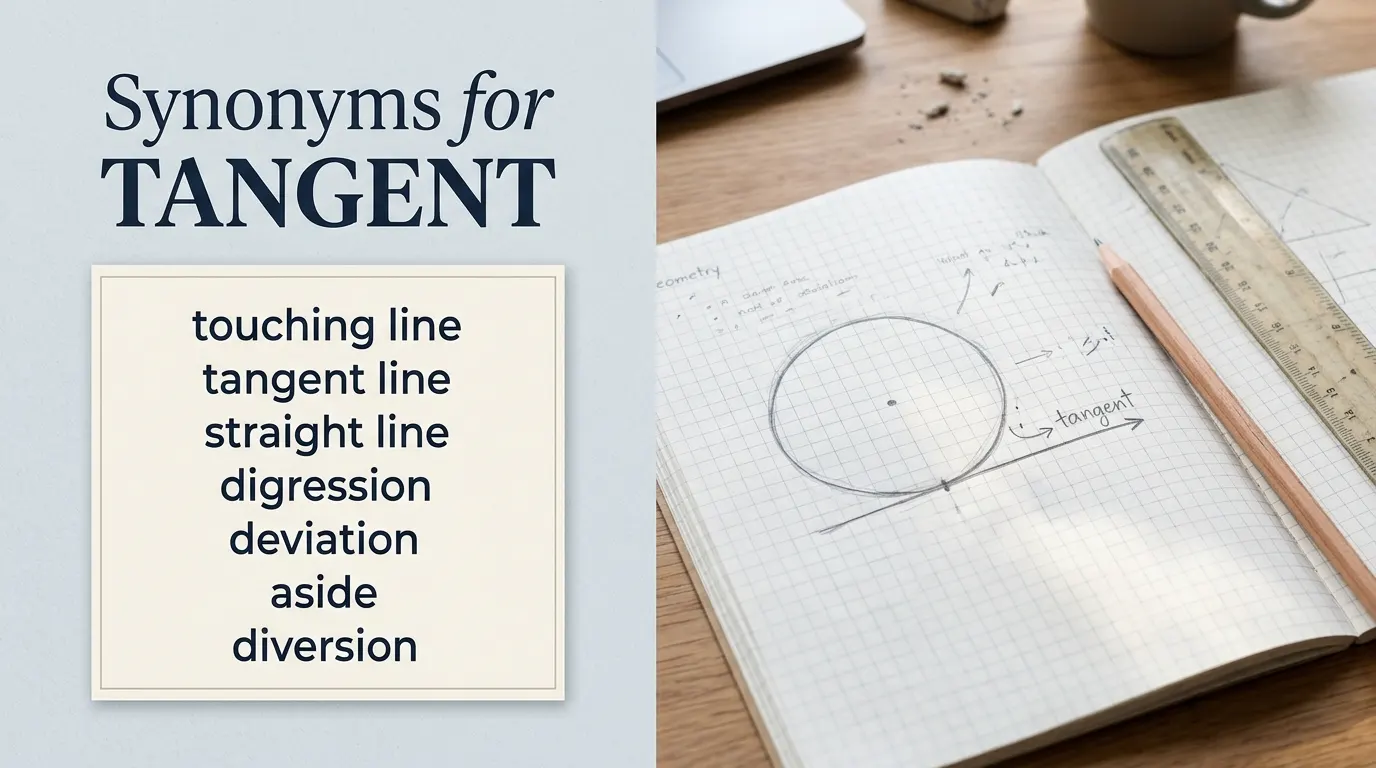
In geometry, a tangent is a line that touches a curve at a particular point without crossing it at that point under the usual elementary-circle definition.
For a circle, the tangent line is perpendicular to the radius drawn to the point of contact.
In trigonometry, tangent also names a mathematical function, commonly abbreviated as tan.
These mathematical meanings are different from the conversational meaning. Words such as digression and detour generally cannot replace tangent in a mathematical formula.
How Native English Speakers Use “Tangent”
Native speakers commonly use phrases such as:
- Go off on a tangent.
- Go on a tangent.
- Take a tangent.
- Return to the main topic.
The phrase go off on a tangent is especially common when someone starts discussing something unrelated to the original subject.
Connotative Meaning of “Tangent”
(Connotation is the feeling or association a word carries beyond its basic dictionary meaning.)
Positive Tone
A tangent can introduce an interesting story, a creative idea, or an unexpected connection.
For example, a speaker might briefly leave the main topic to share a useful personal experience.
Negative Tone
A tangent can suggest distraction or wasted time.
During a business meeting, an unrelated discussion may prevent the team from finishing its agenda.
Neutral Tone
Sometimes, a tangent simply describes a change in direction. The speaker does not necessarily intend to criticize or praise the shift.
Etymology of “Tangent”
The word tangent comes from Latin tangens, meaning “touching.” It is related to the Latin verb tangere, meaning “to touch.”
The mathematical meaning developed from the idea of a line touching a curve. The conversational meaning later grew through figurative use, describing a departure from the original line of discussion.
Old English (450–1100)
Tangent was not a standard part of Old English vocabulary. English speakers used native words and expressions to describe touching, movement, and changes in direction.
Middle English (1100–1500)
During this period, English adopted many words from Latin and French, especially in scholarly and technical fields. The mathematical concept behind tangent became increasingly important in European learning.
Modern English (1500–Present)
The mathematical term became established in English scientific writing. Over time, speakers also began using tangent figuratively to describe a conversational or intellectual departure from a central subject.
Pronunciation, Syllables, and Word Structure
US pronunciation: /ˈtæn.dʒənt/
UK pronunciation: /ˈtæn.dʒənt/
Syllables: tan-gent
Part of speech: Noun; it can also function as an adjective in technical contexts.
Root: Latin tangere, meaning “to touch.”
Prefix: None in the modern English word.
Suffix: The ending -ent reflects the word’s historical formation rather than a productive suffix that learners should remove to form another common English word.
Synonyms List
The alternatives below focus mainly on the conversational meaning of tangent: moving away from the main subject. Some are close synonyms, while others describe a related kind of topic shift.
Not every alternative works in every sentence. Pay attention to the example and usage notes.
1. Digression (Noun)
US: /daɪˈɡreʃ.ən/ | UK: /daɪˈɡreʃ.ən/
Meaning: A temporary departure from the main subject.
Examples:
- His digression made the lecture more entertaining.
- The writer returned to the main argument after a short digression.
2. Deviation (Noun)
US: /ˌdiː.viˈeɪ.ʃən/ | UK: /ˌdiː.viˈeɪ.ʃən/
Meaning: A departure from an expected path, plan, or subject.
Examples:
- The discussion included a deviation from the agenda.
- The report explains every major deviation from the original plan.
3. Detour (Noun)
US: /ˈdiː.tʊr/ | UK: /ˈdiː.tʊə/
Meaning: A temporary change from the usual route or direction.
Examples:
- Our conversation took a detour into childhood memories.
- The speaker made a brief detour before explaining the results.
4. Aside (Noun)
US: /əˈsaɪd/ | UK: /əˈsaɪd/
Meaning: A short comment that is separate from the main discussion.
Examples:
- She added an aside about her first teaching job.
- His aside made the audience laugh.
5. Digress (Verb)
US: /daɪˈɡres/ | UK: /daɪˈɡres/
Meaning: To move away from the main subject while speaking or writing.
Examples:
- I tend to digress when I tell long stories.
- The lecturer digressed before returning to the lesson.
6. Divergence (Noun)
US: /daɪˈvɝː.dʒəns/ | UK: /daɪˈvɜː.dʒəns/
Meaning: A movement away from a common direction, position, or idea.
Examples:
- The meeting revealed a divergence in opinion.
- The discussion showed a divergence from the original plan.
7. Departure (Noun)
US: /dɪˈpɑːr.tʃɚ/ | UK: /dɪˈpɑː.tʃə/
Meaning: A move away from a usual subject, method, or pattern.
Examples:
- The story’s departure from the main plot surprised readers.
- This section marks a departure from the article’s usual tone.
8. Digressive Remark (Noun Phrase)
US: /daɪˈɡres.ɪv rɪˈmɑːrk/ | UK: /daɪˈɡres.ɪv rɪˈmɑːk/
Meaning: A comment that moves away from the central subject.
Examples:
- His digressive remark interrupted the presentation.
- The teacher made a digressive remark about an old textbook.
9. Side Track (Noun)
US: /ˈsaɪd ˌtræk/ | UK: /ˈsaɪd ˌtræk/
Meaning: An unrelated subject or activity that distracts from the main task.
Examples:
- The debate became a sidetrack from the original question.
- Let’s avoid this sidetrack and finish the report.
10. Distraction (Noun)
US: /dɪˈstræk.ʃən/ | UK: /dɪˈstræk.ʃən/
Meaning: Something that draws attention away from the main task or subject.
Examples:
- The unrelated story became a distraction.
- We turned off our phones to avoid distractions.
11. Tangential Remark (Noun Phrase)
US: /tænˈdʒen.ʃəl rɪˈmɑːrk/ | UK: /tænˈdʒen.ʃəl rɪˈmɑːk/
Meaning: A comment that relates only indirectly to the main subject.
Examples:
- He made a tangential remark about office culture.
- The article contains a few tangential remarks that add little value.
12. Side Note (Noun)
US: /ˈsaɪd ˌnoʊt/ | UK: /ˈsaɪd ˌnəʊt/
Meaning: A short additional comment that is not central to the discussion.
Examples:
- As a side note, the library closes at five.
- She added a side note about the original research.
13. Parenthesis (Noun)
US: /pəˈren.θə.sɪs/ | UK: /pəˈren.θə.sɪs/
Meaning: An additional comment or explanation inserted into a sentence or discussion.
Examples:
- The speaker included a brief parenthesis about the study.
- His parenthesis clarified the date of the event.
14. Interruption (Noun)
US: /ˌɪn.təˈrʌp.ʃən/ | UK: /ˌɪn.təˈrʌp.ʃən/
Meaning: Something that stops or breaks the flow of an activity or discussion.
Examples:
- The interruption changed the direction of the conversation.
- We resumed the meeting after a short interruption.
15. Excursion (Noun)
US: /ɪkˈskɝː.ʒən/ | UK: /ɪkˈskɜː.ʒən/
Meaning: A brief departure from a main subject or activity; it can also mean a short trip.
Examples:
- The author made an excursion into local history.
- Her excursion into poetry gave the lecture a personal touch.
16. Digressive Passage (Noun Phrase)
US: /daɪˈɡres.ɪv ˈpæs.ɪdʒ/ | UK: /daɪˈɡres.ɪv ˈpæs.ɪdʒ/
Meaning: A section of writing that moves away from the central argument.
Examples:
- The editor removed a digressive passage from the essay.
- A digressive passage interrupted the story’s momentum.
17. Offshoot (Noun)
US: /ˈɔːf.ʃuːt/ | UK: /ˈɒf.ʃuːt/
Meaning: Something that develops from a larger idea, activity, or subject.
Examples:
- The debate produced an interesting offshoot about education.
- The new research project became an offshoot of the original study.
18. Branch (Noun)
US: /bræntʃ/ | UK: /brɑːntʃ/
Meaning: A separate line of development or discussion connected to a larger subject.
Examples:
- The conversation opened a new branch of inquiry.
- This branch of the discussion deserves further attention.
19. Subtopic (Noun)
US: /ˈsʌbˌtɑː.pɪk/ | UK: /ˈsʌbˌtɒp.ɪk/
Meaning: A smaller subject within a broader topic.
Examples:
- The teacher introduced a subtopic about renewable energy.
- We discussed each subtopic before writing the conclusion.
20. Digressionary Comment (Noun Phrase)
US: /daɪˈɡreʃ.ən.er.i ˈkɑː.ment/ | UK: /daɪˈɡreʃ.ən.ər.i ˈkɒm.ent/
Meaning: A comment that temporarily moves away from the central topic.
Examples:
- The chairperson redirected the digressionary comment.
- Her digressionary comment reminded everyone of an earlier meeting.
21. Detour in Conversation (Noun Phrase)
US: /ˈdiː.tʊr ɪn ˌkɑːn.vɚˈseɪ.ʃən/ | UK: /ˈdiː.tʊə ɪn ˌkɒn.vəˈseɪ.ʃən/
Meaning: A temporary change to an unrelated subject during a conversation.
Examples:
- Our detour in conversation led to a funny memory.
- The detour in conversation delayed our decision.
22. Shift (Noun)
US: /ʃɪft/ | UK: /ʃɪft/
Meaning: A change in subject, focus, or direction.
Examples:
- The sudden shift confused the audience.
- The discussion took a shift toward practical solutions.
23. Change of Subject (Noun Phrase)
US: /tʃeɪndʒ əv ˈsʌb.dʒɪkt/ | UK: /tʃeɪndʒ əv ˈsʌb.dʒekt/
Meaning: A move from one topic to another.
Examples:
- His change of subject surprised me.
- The host made a change of subject to calm the debate.
24. Topic Shift (Noun)
US: /ˈtɑː.pɪk ʃɪft/ | UK: /ˈtɒp.ɪk ʃɪft/
Meaning: A transition from one topic to a different one.
Examples:
- The topic shift moved the interview toward personal experiences.
- The writer used a topic shift to introduce a new section.
25. Digressive Turn (Noun Phrase)
US: /daɪˈɡres.ɪv tɝːn/ | UK: /daɪˈɡres.ɪv tɜːn/
Meaning: A turn in speech or writing that moves away from the main point.
Examples:
- His digressive turn made the answer difficult to follow.
- The essay takes a digressive turn in its second section.
26. Redirection (Noun)
US: /ˌriː.dəˈrek.ʃən/ | UK: /ˌriː.daɪˈrek.ʃən/
Meaning: A change toward a different direction or focus.
Examples:
- The moderator’s redirection brought the group back to the agenda.
- The discussion needed a redirection toward the main question.
27. Diversion (Noun)
US: /daɪˈvɝː.ʒən/ | UK: /daɪˈvɜː.ʒən/
Meaning: Something that takes attention away from the main activity or subject.
Examples:
- The anecdote was a pleasant diversion.
- The team treated the unrelated debate as a diversion.
28. Rambling (Noun)
US: /ˈræm.blɪŋ/ | UK: /ˈræm.blɪŋ/
Meaning: Speech or writing that wanders from one idea to another without a clear direction.
Examples:
- His rambling made the instructions confusing.
- The editor shortened the rambling in the introduction.
29. Ramble (Verb)
US: /ˈræm.bəl/ | UK: /ˈræm.bəl/
Meaning: To talk or write at length without staying focused.
Examples:
- I sometimes ramble when I feel nervous.
- The speaker rambled before answering the question.
30. Wander (Verb)
US: /ˈwɑːn.dɚ/ | UK: /ˈwɒn.də/
Meaning: To move away from a main subject or line of thought.
Examples:
- My thoughts wandered during the long lecture.
- The article wanders away from its main argument.
31. Stray (Verb)
US: /streɪ/ | UK: /streɪ/
Meaning: To move away from the subject, path, or expected direction.
Examples:
- Try not to stray from the essay question.
- The meeting strayed into unrelated complaints.
32. Veer (Verb)
US: /vɪr/ | UK: /vɪə/
Meaning: To change direction suddenly.
Examples:
- The conversation veered toward an unexpected topic.
- His answer veered away from the original question.
33. Drift (Verb)
US: /drɪft/ | UK: /drɪft/
Meaning: To move gradually away from the main subject.
Examples:
- The conversation drifted toward weekend plans.
- The article drifted away from its central message.
34. Depart (Verb)
US: /dɪˈpɑːrt/ | UK: /dɪˈpɑːt/
Meaning: To move away from a usual subject, approach, or direction.
Examples:
- The discussion departed from the scheduled agenda.
- The author departed from the main argument for a moment.
35. Deviate (Verb)
US: /ˈdiː.vi.eɪt/ | UK: /ˈdiː.vi.eɪt/
Meaning: To move away from an expected path, standard, or subject.
Examples:
- Please do not deviate from the assigned topic.
- The conversation deviated from the original question.
36. Go Off Topic (Verb Phrase)
US: /ɡoʊ ɔːf ˈtɑː.pɪk/ | UK: /ɡəʊ ɒf ˈtɒp.ɪk/
Meaning: To discuss something unrelated to the current subject.
Examples:
- We went off topic while planning the event.
- The class went off topic during the group activity.
37. Get Sidetracked (Verb Phrase)
US: /ɡet ˈsaɪd.trækt/ | UK: /ɡet ˈsaɪd.trækt/
Meaning: To become distracted from the main task or subject.
Examples:
- I got sidetracked by an interesting question.
- We got sidetracked and forgot to finish the agenda.
38. Go on a Detour (Verb Phrase)
US: /ɡoʊ ɑːn ə ˈdiː.tʊr/ | UK: /ɡəʊ ɒn ə ˈdiː.tʊə/
Meaning: To move temporarily away from the main route or subject.
Examples:
- The speaker went on a detour about local history.
- We went on a detour before returning to the main point.
39. Take a Side Trip (Verb Phrase)
US: /teɪk ə ˈsaɪd trɪp/ | UK: /teɪk ə ˈsaɪd trɪp/
Meaning: To make a short departure from a main course of action or discussion.
Examples:
- The article takes a side trip into the author’s childhood.
- Let’s take a side trip into the background before discussing the results.
40. Wander Off the Point (Verb Phrase)
US: /ˈwɑːn.dɚ ɔːf ðə pɔɪnt/ | UK: /ˈwɒn.də ɒf ðə pɔɪnt/
Meaning: To move away from the main idea or argument.
Examples:
- The speaker wandered off the point during the explanation.
- Try not to wander off the point in your conclusion.
41. Lose the Thread (Verb Phrase)
US: /luːz ðə θred/ | UK: /luːz ðə θred/
Meaning: To lose track of the main idea or direction of a discussion.
Examples:
- I lost the thread when the speaker introduced too many examples.
- The long explanation caused readers to lose the thread.
42. Go on a Rant (Verb Phrase)
US: /ɡoʊ ɑːn ə rænt/ | UK: /ɡəʊ ɒn ə rænt/
Meaning: To speak at length, often angrily, about a subject.
Examples:
- He went on a rant about poor customer service.
- She went on a rant instead of answering the question.
43. Anecdotal Detour (Noun Phrase)
US: /ˌæn.ɪkˈdoʊ.təl ˈdiː.tʊr/ | UK: /ˌæn.ɪkˈdəʊ.təl ˈdiː.tʊə/
Meaning: A temporary departure from the main topic to tell a personal or short story.
Examples:
- The professor took an anecdotal detour about her first experiment.
- His anecdotal detour made the presentation more relatable.
44. Digression from the Main Point (Noun Phrase)
US: /daɪˈɡreʃ.ən frəm ðə meɪn pɔɪnt/ | UK: /daɪˈɡreʃ.ən frəm ðə meɪn pɔɪnt/
Meaning: A departure from the central idea of a discussion or text.
Examples:
- The paragraph contains a digression from the main point.
- The editor removed the digression from the main point to improve clarity.
45. Unrelated Aside (Noun Phrase)
US: /ˌʌn.rɪˈleɪ.tɪd əˈsaɪd/ | UK: /ˌʌn.rɪˈleɪ.tɪd əˈsaɪd/
Meaning: A comment that has little connection to the main subject.
Examples:
- His unrelated aside confused the new employees.
- The writer removed an unrelated aside from the final draft.
Synonyms for “Tangent” by Tone
The best alternative depends on whether you want to sound neutral, critical, or conversational.
Neutral Alternatives
- Digression
- Deviation
- Detour
- Aside
- Topic shift
- Change of subject
- Departure
These options describe a change in direction without necessarily judging it.
Positive or Constructive Alternatives
- Excursion
- Side note
- Offshoot
- Branch
- Anecdotal detour
These may describe a useful addition, an interesting connection, or a brief exploration.
Negative Alternatives
- Distraction
- Rambling
- Sidetrack
- Unrelated aside
- Going off topic
- Wandering off the point
These expressions often suggest that the discussion has lost focus.
Informal Alternatives
- Go off on a tangent
- Get sidetracked
- Ramble
- Drift off topic
- Go on a detour
These phrases work well in everyday conversations.
“Tangent” vs. Close Alternatives
Some words overlap with tangent, but their meanings are not identical.
| Word | Main meaning | Best use |
|---|---|---|
| Tangent | A departure from the main topic | Everyday conversation and informal discussion |
| Digression | A departure from the central subject | Essays, lectures, and formal discussions |
| Detour | A temporary change in direction | Conversations, stories, and figurative explanations |
| Aside | A short additional comment | Conversations, speeches, and writing |
| Distraction | Something that takes attention away | Situations where focus is lost |
Tangent vs. Digression
Both words describe movement away from the main subject.
However, digression often sounds more formal. It is common in literary criticism, academic writing, and structured discussions.
Tangent is more conversational.
Example: “The professor went on a tangent” sounds natural in everyday speech. “The essay contains a digression” fits an editorial review.
Tangent vs. Detour
A detour suggests a temporary alternative route. It can be literal or figurative.
A tangent more specifically describes a departure from a central subject or line of thought.
Example: “Let’s take a brief detour into the background” suggests a planned explanation. “I went off on a tangent” often suggests an unplanned shift.
Tangent vs. Aside
An aside is usually brief. It may add context or humor without changing the overall direction of the discussion.
A tangent can last longer and take up more of the conversation.
How “Tangent” Changes by Context
Daily Conversation
In everyday speech, tangent often describes a sudden change of subject.
For example, a friend might begin discussing a new phone and end up talking about a vacation. You could say, “We went off on a tangent.”
The phrase is natural and usually informal.
Writing and Blogging
In writing, a tangent is a section that moves away from the central message.
Bloggers may include personal stories to make an article engaging. However, the story should support the main topic rather than distract readers.
If a paragraph does not support the article’s purpose, an editor may describe it as a digression.
Professional and Academic English
In a meeting, a tangent can delay decisions or waste time.
Professional speakers often redirect the discussion with phrases such as:
- “Let’s return to the main point.”
- “That’s interesting, but let’s stay focused.”
- “We can discuss that separately.”
In academic writing, digression is often more suitable than tangent when discussing the structure of an argument.
Creative and Informal Use
Writers sometimes use tangents intentionally. A short departure can reveal a character’s personality, introduce humor, or provide background.
A storyteller might pause the main narrative to describe a memorable experience. The tangent becomes effective when it adds value.
Common Mistakes and Native Usage
Mistake 1: Treating Every Tangent as a Bad Thing
A tangent does not always harm a discussion.
An interesting side story may build rapport or introduce a useful connection. The key question is whether the departure serves a purpose.
Mistake 2: Using “Tangent” in Place of Every Similar Word
Tangent, digression, detour, and distraction overlap, but they are not interchangeable in every situation.
Use distraction when something takes attention away from a task. Use aside for a short additional comment while use digression for a departure from the central subject.
Mistake 3: Confusing Mathematical and Conversational Meanings
A tangent in geometry is a technical concept. A digression cannot replace it in a mathematics lesson.
Always identify the subject before choosing a synonym.
Mistake 4: Assuming “Go on a Tangent” Is Always Formal
The phrase is common in casual speech. In formal writing, digression or departure from the main argument may sound more appropriate.
Register Notes
Informal: Go off on a tangent, ramble, get sidetracked.
Neutral: Change of subject, detour, shift.
Formal: Digression, deviation, departure from the central argument.
Technical: Tangent, when used in mathematics or geometry.
Real-Life Mini Scenarios
Workplace
During a planning meeting, the team begins discussing office decorations instead of the project deadline. The manager says, “Let’s avoid this tangent and return to the schedule.”
Here, tangent describes an unrelated discussion.
Social Situation
Two friends discuss their favorite movies. One suddenly starts telling a story about a school trip.
The other laughs and says, “We’ve gone off on a tangent again!”
The phrase sounds relaxed and friendly.
Media and Pop Culture
A podcast host starts discussing a new film but spends several minutes talking about the actor’s childhood.
A listener might describe this section as a digression or an anecdotal detour.
Writing and Storytelling
A blogger explains how to grow indoor plants. The article suddenly includes several paragraphs about an unrelated holiday.
An editor may remove the digression to keep readers focused.
Conclusion
Learning synonyms for tangent can help you express changes in conversation and writing more accurately. Words such as digression, detour, and aside offer different shades of meaning.
The best choice depends on context. A tangent may be an amusing story, a useful explanation, or an unnecessary distraction. Understanding the difference helps you communicate clearly.
For students, bloggers, and everyday English users, vocabulary variety makes writing more engaging and speaking more precise. It also helps you recognize how native speakers use similar words.
Practice these alternatives in your conversations, essays, and emails. Try replacing tangent with a more precise expression, and notice how the tone changes.
Practice Exercise: Choose the Best Synonym
Choose the best answer for each situation. Consider the meaning and tone of each option.
Questions 1–5: Everyday Conversations
1. Your friend starts discussing an unrelated holiday during a conversation about homework. What could you call this shift?
A. Digression B. Definition C. Conclusion D. Summary
2. A speaker adds a brief comment that is separate from the main discussion. Which word fits best?
A. Aside B. Argument C. Deadline D. Instruction
3. A conversation gradually moves away from its original subject. Which verb fits best?
A. Drift B. Calculate C. Repeat D. Conclude
4. Someone speaks at length and moves between unrelated subjects. What might they be doing?
A. Rambling B. Summarizing C. Measuring D. Quoting
5. A discussion suddenly changes direction. Which verb fits best?
A. Veer B. Remain C. Explain D. Confirm
Questions 6–10: Writing and Professional Contexts
6. An editor removes an unrelated section from an essay. What is the section most likely to be called?
A. Digression B. Heading C. Citation D. Introduction
7. A team stops discussing the agenda and starts talking about weekend plans. What has happened?
A. The meeting went off topic. B. The meeting reached a conclusion. C. The meeting summarized its findings. D. The meeting completed its objective.
8. A writer adds a short extra comment to clarify a point. Which expression fits best?
A. Side note B. Distraction C. Rambling D. Deviation
9. A manager brings a distracted team back to the main issue. What action has the manager taken?
A. Redirection B. Digression C. Diversion D. Interruption
10. A report moves away from its central argument. Which phrase describes this most precisely?
A. Departure from the main argument B. Summary of the findings C. Definition of a term D. Completion of the analysis
Questions 11–15: Meaning and Tone
11. Which word usually sounds most appropriate in formal literary analysis?
A. Digression B. Rambling C. Side trip D. Chat
12. Which word suggests that something takes attention away from a task?
A. Distraction B. Conclusion C. Evidence D. Definition
13. Which expression describes losing track of the main idea?
A. Lose the thread B. Make a summary C. Reach a decision D. State a conclusion
14. Which word can describe a temporary alternative route in a discussion?
A. Detour B. Definition C. Result D. Proof
15. In mathematics, what does a tangent to a circle represent?
A. A line that touches the circle at one point B. A line that always passes through the center C. The area inside the circle D. The distance around the circle
Answer Key
1-A | 2-A | 3-A | 4-A | 5-A | 6-A | 7-A | 8-A | 9-A | 10-A | 11-A | 12-A | 13-A | 14-A | 15-A
Reflection Task
Write three sentences about a conversation that moved away from its original topic. Use tangent, digression, and detour in separate sentences.
Think about how each word changes the tone and meaning. Practice using these expressions in your next conversation or short piece of writing.

Evelyn Hartwell is an English vocabulary writer who focuses on clear, practical language for learners and everyday readers. Her writing explores synonyms, word meanings, pronunciation, tone, and natural usage. She believes that learning vocabulary should be simple, useful, and enjoyable. Her articles are designed to help students, bloggers, and English learners choose the right words with greater confidence.