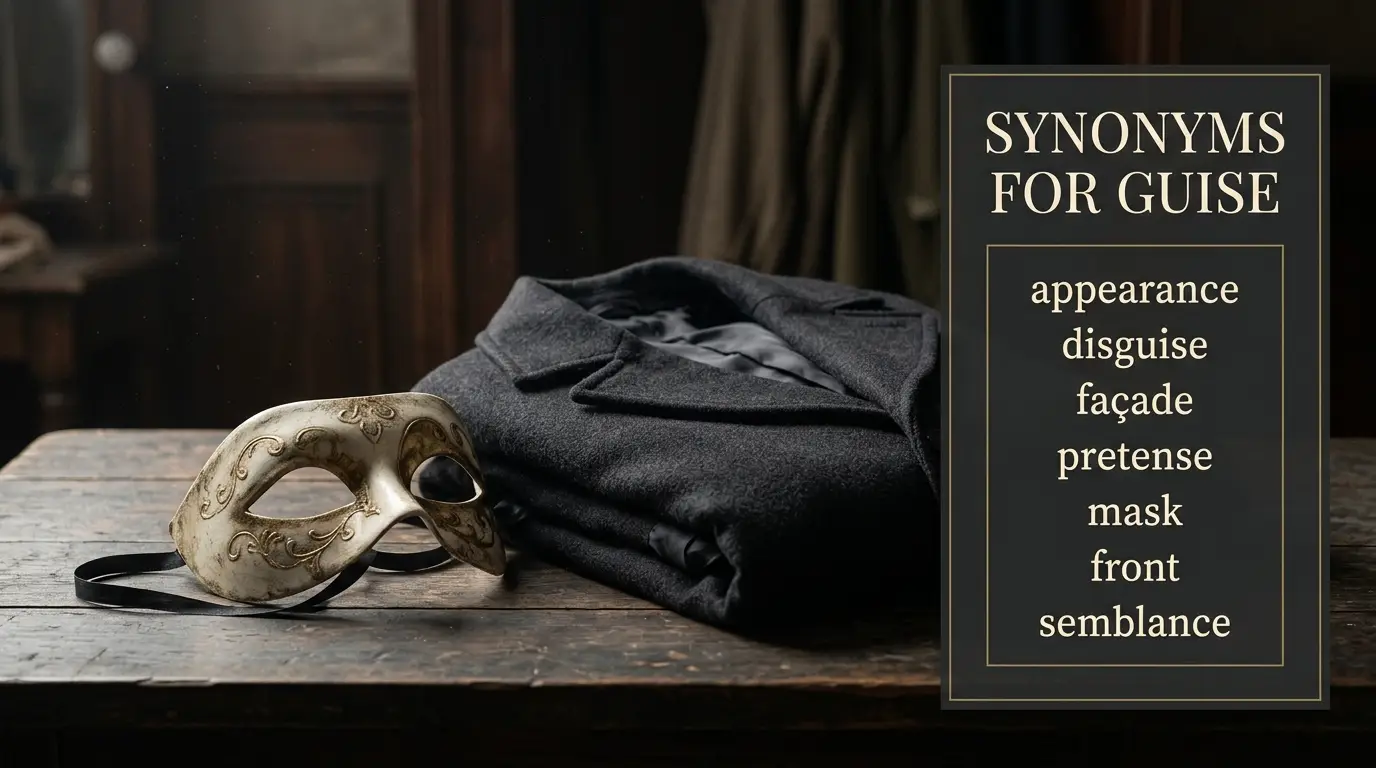
Imagine someone acting friendly while secretly hiding their real intentions. Their behavior may seem genuine, but something about it feels different from who they really are. You might describe this as a false guise.
The word also appears in phrases such as “under the guise of friendship” or “in the guise of a harmless request.” Depending on the sentence, disguise, pretense, façade, or appearance may express the idea more clearly.
This guide explores useful synonyms for guise, explains their differences, and helps students, bloggers, content writers, and everyday English users choose the right alternative.
What Does “Guise” Really Mean?
Guise is a noun that means the outward appearance, form, or way something is presented. It often describes an appearance that hides a person’s real identity, intentions, or nature.
For example, someone might offer help under the guise of friendship while actually hoping to gain something in return. The word is also used more neutrally to describe the form something takes, as in “the story appeared in the guise of a letter.”
Connotative Meaning
(Connotation is the feeling or association a word creates beyond its basic meaning.)
Guise often carries a suggestion that appearances may be misleading.
- Positive: It can describe a harmless change in appearance or presentation.
- Neutral: It can simply mean the form or manner in which something appears.
- Negative: It often suggests deception, hidden motives, or a false appearance.
The phrase “under the guise of” usually has a suspicious or critical tone because it suggests that the stated purpose may not be the real one.
Etymology and Pronunciation
Guise entered English through Old French guise, meaning “manner,” “fashion,” or “way of doing something.” Its older roots are connected to a Germanic word for manner or way.
Pronunciation:
- US IPA: /ɡaɪz/
- UK IPA: /ɡaɪz/
- Syllables: guise (one syllable)
- Part of speech: Noun
Synonyms for Guise — Grouped by Shade of Meaning
The best alternative depends on what you want to describe. A disguise hides someone’s identity, a façade creates a misleading outward impression, and an appearance may simply describe how something looks. These groups explain the main differences.
1. Words That Mean a False Appearance
Use these alternatives when someone or something looks different from its real nature. They often suggest that the outward image is misleading.
- Disguise — an appearance used to hide identity.
- Façade — a false or misleading outward appearance.
- Mask — an appearance hiding true feelings or intentions.
- Front — a false image hiding the truth.
- Veneer — a thin layer hiding reality.
- False front — an outward image designed to deceive.
- Sham — something pretending to be genuine.
- Impersonation — pretending to be another person.
2. Words That Mean Pretense or Deception
These words fit situations where someone presents a false reason, intention, or identity to influence how others see them.
- Pretense — an act of pretending something is true.
- Pretence — the British spelling of pretense.
- Act — behavior performed to create an impression.
- Charade — a deceptive display or performance.
- Ruse — a trick used to deceive someone.
- Deception — the act of making someone believe something false.
- Subterfuge — a dishonest method of hiding intentions.
- Sham — a false display or imitation.
3. Words That Mean Outward Appearance or Image
These alternatives are useful when describing how a person, object, or situation looks or is presented. They do not always suggest dishonesty.
- Appearance — the way someone or something looks.
- Image — the impression presented to others.
- Aspect — a particular way something appears.
- Form — the shape or type something takes.
- Shape — the visible form of something.
- Manner — the way something is done or presented.
- Presentation — the way something is shown.
- Persona — the character or image someone presents.
- Countenance — a person’s facial appearance or expression.
4. Words That Mean a Cover or Hidden Purpose
These alternatives work when something conceals a real intention, action, or purpose. Some are especially natural in phrases about secrecy.
- Cover — something used to hide the truth.
- Cloak — something that conceals an action or intention.
- Pretext — a false reason used to hide the real one.
- Cover story — an invented explanation hiding the truth.
- Screen — something that hides an activity or intention.
- Rationale — a stated explanation or reason.
- Excuse — a reason given to justify an action.
Example Sentences Using Guise Synonyms
These examples show how the alternatives work in everyday situations.
- The thief wore a disguise to avoid being recognized.
- Her confidence was only a façade hiding her nervousness.
- He used kindness as a mask to conceal his selfish intentions.
- The company maintained a professional image despite its internal problems.
- Their friendly invitation turned out to be a pretext for asking for money.
- The entire agreement was a sham designed to mislead investors.
- She adopted a different persona when speaking to clients.
- The official gave a false cover story to explain his absence.
Synonyms by Tone
Tone matters because some alternatives simply describe an outward appearance, while others directly suggest dishonesty or manipulation.
Formal or Professional
These words are suitable for reports, serious discussions, and formal writing:
- Façade
- Pretense
- Pretence
- Subterfuge
- Deception
- Impersonation
- Persona
- Presentation
Neutral and Everyday
These alternatives describe appearance or presentation without necessarily suggesting dishonesty:
- Appearance
- Image
- Aspect
- Form
- Shape
- Manner
- Cover
- Mask
Casual and Conversational
These words are useful in everyday discussions:
- Disguise
- Act
- Front
- Excuse
- Sham
- Cover story
Literary or Descriptive
These words can create a stronger image of concealment or hidden intentions:
- Veneer
- Cloak
- Charade
- Façade
- Mask
- Persona
Guise vs. Close Alternatives
Several words are closely related to guise, but each has a different emphasis. Choosing carefully helps keep your sentence accurate.
Guise vs. Disguise
Guise describes the outward form or appearance something takes. Disguise more specifically suggests an appearance deliberately changed to hide identity or reality.
For example, “He entered the building in the guise of a visitor” describes the appearance he adopted. “He wore a disguise” makes the effort to hide his identity more obvious.
Guise vs. Façade
A façade is an outward appearance that hides an unpleasant or different reality. Guise can describe a broader form or appearance, including situations that are not necessarily deceptive.
For example, “Her cheerful façade hid her disappointment” suggests that her happiness was not genuine. “The proposal came in the guise of a friendly suggestion” suggests that its real purpose may have been different.
Guise vs. Pretense
Pretense refers to pretending something is true or presenting a false reason or impression. Guise describes the form or appearance used to present something.
For example, “He showed concern under the guise of friendship” describes the appearance of his behavior. “His concern was a pretense” directly says that the concern was not genuine.
How “Guise” Changes by Context
The right replacement depends on what you are describing and how clearly you want to suggest hidden intentions.
Daily Conversation
In everyday speech, appearance, disguise, act, and front are often easier to understand than guise.
For example, you might say, “His friendly behavior was just an act,” rather than using a more formal expression.
Writing and Blogging
Writers can use façade, mask, persona, or pretense to describe characters, relationships, and public images.
Choose façade when the outward image hides reality. Use persona when discussing the identity someone presents to other people.
[internal link: synonyms for appearance → synonyms-for-appearance]
Professional or Academic Writing
In formal writing, pretense, deception, subterfuge, and presentation can describe different forms of concealment or outward representation.
For example, “The organization operated under the pretense of providing public assistance” suggests that its stated purpose was not genuine.
[internal link: synonyms for deception → synonyms-for-deception]
Creative or Informal Use
In fiction and storytelling, words such as mask, cloak, charade, and veneer can make descriptions more vivid.
For example, a character might hide their fear behind a mask of confidence. This gives readers a clearer sense of the difference between the character’s feelings and outward behavior.
Common Mistakes Learners Make
Some alternatives have similar meanings but cannot replace guise in every sentence. Keep these differences in mind.
1. Using Disguise for Every Meaning of Guise
Disguise usually suggests an effort to hide identity or appearance. Guise can simply describe the form something takes.
Better choice: Use appearance or form when there is no suggestion of deliberate concealment.
2. Confusing Façade With Appearance
An appearance may be completely genuine. A façade usually suggests that the outward image hides something different.
Better choice: Use appearance for how something looks and façade when the image is misleading.
3. Treating Pretext and Excuse as Exact Matches
A pretext is a reason used to hide the real purpose of an action. An excuse can be a reason offered to explain or justify something, whether truthful or not.
Better choice: Use pretext when the stated reason is deliberately misleading.
4. Using Persona When You Mean Physical Appearance
Persona describes the character or image someone presents, especially in social or professional situations. It does not usually describe someone’s physical appearance.
Better choice: Use appearance for physical looks and persona for a presented identity.
5. Overusing Formal Words in Casual Speech
Words such as subterfuge and impersonation may sound too formal in ordinary conversation.
Better choice: Use trick, act, disguise, or false front when they express your meaning naturally.
Frequently Asked Questions
What Is the Closest Synonym for Guise?
Disguise is one of the closest alternatives when guise describes an appearance that hides someone’s real identity or intentions. Façade and pretense are also useful when the meaning involves a false impression.
What Is a Formal Word for Guise?
Façade, pretense, and subterfuge are formal alternatives in contexts involving misleading appearances or hidden intentions. For a neutral meaning, presentation or appearance may be more suitable.
What Is a Casual Word for Guise?
Act, front, and disguise are common alternatives in casual English. For example, “His friendly attitude was just an act” sounds more conversational than “His friendly attitude was a false guise.”
What Is the Opposite of Guise?
There is no single opposite for every meaning of guise. Depending on the context, words such as reality, truth, genuine identity, and true nature can express the opposite of a misleading outward appearance.
What Does “Under the Guise Of” Mean?
“Under the guise of” means using a particular appearance, reason, or identity to hide the real purpose of something. For example, someone might offer unwanted advice under the guise of helping.
Conclusion
Guise describes the outward form or appearance of someone or something, especially when it hides a different reality. Words such as disguise, façade, mask, and pretense are useful alternatives, but each carries a slightly different meaning.
Learning these differences can make your writing more precise and help you express hidden intentions without repeating the same word. Try using the alternatives in emails, essays, blog posts, and everyday conversations.
The next time you describe a false appearance or hidden purpose, choose the word that best matches your meaning. You can explore synonyms for guise to discover more related words and expand your vocabulary.

Evelyn Hartwell is an English vocabulary writer who focuses on clear, practical language for learners and everyday readers. Her writing explores synonyms, word meanings, pronunciation, tone, and natural usage. She believes that learning vocabulary should be simple, useful, and enjoyable. Her articles are designed to help students, bloggers, and English learners choose the right words with greater confidence.