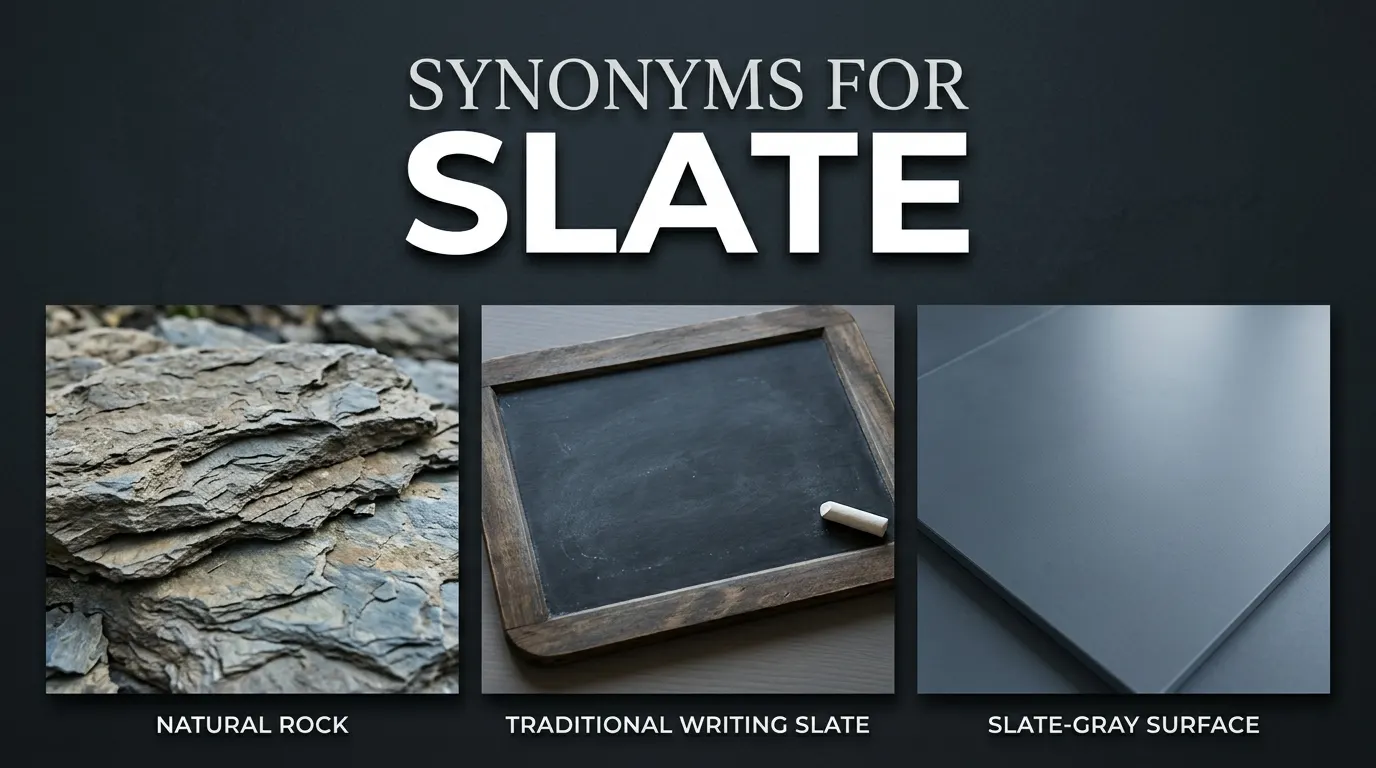
Synonyms for slate depend on how you use the word. You might mean a type of stone, a list of candidates, a schedule, or a smooth dark-gray color.
Imagine hearing that a school has a “clean slate” or reading that a politician is on the election slate. The same word can carry very different meanings.
Learning synonyms for slate helps you choose a clearer word in conversations, essays, and articles. The best alternative depends on whether you mean a material, a list, or a fresh start.
Students, bloggers, content writers, and everyday English users can all benefit from understanding these differences. This guide explains the main meanings and shows how to use suitable alternatives naturally.
What Does “Slate” Really Mean?
Slate is a noun with several meanings. It can refer to a fine-grained rock that splits into thin sheets, a list of candidates or planned activities, or a dark gray-blue color. As a verb, to slate can mean to schedule something, nominate someone, or criticize someone sharply, especially in British English.
The meaning usually becomes clear from the surrounding sentence. For example, “a slate roof” refers to a building material. “The party announced its slate of candidates” refers to a list. “The film was slated for release in June” means it was scheduled for release.
Native English speakers also use slate in familiar expressions. A “clean slate” means a fresh start, while “slate someone” can mean to criticize them harshly in informal British usage.
Connotative Meaning
(Connotation means the feelings or associations a word carries beyond its basic dictionary meaning.)
- Positive tone: “A clean slate” can suggest hope, renewal, and a chance to begin again.
- Negative tone: As a verb, slate can mean to criticize someone severely.
- Neutral tone: In geology, construction, planning, or elections, the word often has a straightforward descriptive meaning.
Etymology of “Slate”
The English word slate came through Old French esclate, associated with a split piece or fragment, and is linked to the idea of a stone that can be split into thin layers. Its history reflects the material’s traditional use for roofing, writing surfaces, and other practical purposes.
Historical Development
- Old English (450–1100): The modern English word slate was not a common established Old English term. Other words described stone, rock, and writing materials.
- Middle English (1100–1500): The word entered English through French forms during the medieval period. It referred to the layered stone used in practical settings.
- Modern English (1500–present): The word expanded beyond the rock itself. It became associated with writing boards, lists of candidates, scheduled events, and expressions such as “clean slate.”
Pronunciation (US and UK – IPA)
- US: /sleɪt/
- UK: /sleɪt/
Syllables
slate — one syllable.
Affixation Pattern
- Root: slate
- Prefix: None in the basic word.
- Suffix: None in the basic word.
Related forms include slated, slating, and slates. Their meanings depend on whether the word refers to scheduling, nomination, or criticism.
40 Synonyms and Alternatives for Slate
The word slate has several distinct meanings, so there is no single synonym that works in every sentence. The following alternatives are grouped by meaning. Some are close synonyms, while others fit only a particular context.
Slate as a Type of Stone or Surface
1. Shale
US: /ʃeɪl/
UK: /ʃeɪl/
Meaning: Shale is a fine-grained sedimentary rock that tends to split into thin layers.
Examples:
- The hillside contained dark shale.
- The geologist explained how shale forms.
2. Stone
US: /stoʊn/
UK: /stəʊn/
Meaning: Stone is a hard natural material used in construction and decoration.
Examples:
- The garden path was made of stone.
- They chose natural stone for the fireplace.
3. Rock
US: /rɑːk/
UK: /rɒk/
Meaning: Rock is a naturally occurring solid material made of minerals.
Examples:
- A large rock blocked the trail.
- The building stands on solid rock.
4. Roofing Tile
US: /ˈruːfɪŋ taɪl/
UK: /ˈruːfɪŋ taɪl/
Meaning: A roofing tile is a piece of material used to cover and protect a roof.
Examples:
- The builder replaced a cracked roofing tile.
- The house has traditional roofing tiles.
5. Flagstone
US: /ˈflæɡstoʊn/
UK: /ˈflæɡstəʊn/
Meaning: Flagstone is a flat stone used for paving paths, patios, and floors.
Examples:
- Flagstone covered the garden patio.
- They laid flagstone around the fountain.
6. Writing Tablet
US: /ˈraɪtɪŋ ˈtæblət/
UK: /ˈraɪtɪŋ ˈtæblət/
Meaning: A writing tablet is a flat surface or device used for writing notes.
Examples:
- The student carried a small writing tablet.
- The teacher wrote the task on the tablet.
7. Blackboard
US: /ˈblækbɔːrd/
UK: /ˈblækbɔːd/
Meaning: A blackboard is a dark writing surface traditionally used with chalk.
Examples:
- The teacher wrote the formula on the blackboard.
- Dust from the chalk covered the blackboard.
8. Chalkboard
US: /ˈtʃɔːkbɔːrd/
UK: /ˈtʃɔːkbɔːd/
Meaning: A chalkboard is a surface designed for writing or drawing with chalk.
Examples:
- The café displayed its menu on a chalkboard.
- She drew a diagram on the chalkboard.
9. Stone Slab
US: /stoʊn slæb/
UK: /stəʊn slæb/
Meaning: A stone slab is a broad, flat piece of natural stone.
Examples:
- A stone slab formed the garden bench.
- The workers lifted the stone slab carefully.
10. Roofing Slate
US: /ˈruːfɪŋ sleɪt/
UK: /ˈruːfɪŋ sleɪt/
Meaning: Roofing slate is a thin piece of slate rock used to cover a roof.
Examples:
- The old cottage had roofing slate.
- The roofer replaced several broken pieces of roofing slate.
Slate as a List of Candidates, Choices, or Events
11. List
US: /lɪst/
UK: /lɪst/
Meaning: A list is a series of names, items, or tasks written or considered together.
Examples:
- The committee published a list of nominees.
- I added the meeting to my list of tasks.
12. Roster
US: /ˈrɑːstər/
UK: /ˈrɒstə/
Meaning: A roster is an organized list of people assigned to a team, role, or duty.
Examples:
- The coach announced the team roster.
- Her name appears on the staff roster.
13. Lineup
US: /ˈlaɪnʌp/
UK: /ˈlaɪnʌp/
Meaning: A lineup is a group of people or things selected for an event or purpose.
Examples:
- The festival revealed its music lineup.
- The team changed its starting lineup.
14. Ticket
US: /ˈtɪkɪt/
UK: /ˈtɪkɪt/
Meaning: In politics, a ticket is a group of candidates running together for elected offices.
Examples:
- The party announced its election ticket.
- Voters discussed the presidential ticket.
15. Nominee List
US: /ˌnɑːməˈniː lɪst/
UK: /ˌnɒmɪˈniː lɪst/
Meaning: A nominee list is a list of people proposed for an award, position, or election.
Examples:
- The award’s nominee list was released today.
- She checked the nominee list before the ceremony.
16. Candidate List
US: /ˈkændɪˌdeɪt lɪst/
UK: /ˈkændɪdət lɪst/
Meaning: A candidate list contains people being considered for a role or election.
Examples:
- The committee reviewed the candidate list.
- Three names remained on the candidate list.
17. Selection
US: /sɪˈlɛkʃən/
UK: /sɪˈlekʃən/
Meaning: A selection is a group of people or things chosen for a particular purpose.
Examples:
- The festival offers a strong selection of films.
- The manager reviewed the final selection.
18. Group
US: /ɡruːp/
UK: /ɡruːp/
Meaning: A group is a number of people or things considered together.
Examples:
- The organizers invited a group of speakers.
- A small group will lead the discussion.
19. Team
US: /tiːm/
UK: /tiːm/
Meaning: A team is a group of people who work together toward a shared goal.
Examples:
- The club announced its new team.
- Our team will present the proposal tomorrow.
20. Cast
US: /kæst/
UK: /kɑːst/
Meaning: A cast is the group of actors who perform in a play, film, or television show.
Examples:
- The film has a talented cast.
- The director introduced the cast at the premiere.
Slate as a Schedule or Planned Arrangement
21. Schedule
US: /ˈskedʒuːl/
UK: /ˈʃedjuːl/
Meaning: A schedule is a plan showing when activities or events will happen.
Examples:
- The meeting is on tomorrow’s schedule.
- We changed the schedule because of the weather.
22. Timetable
US: /ˈtaɪmˌteɪbəl/
UK: /ˈtaɪmˌteɪbəl/
Meaning: A timetable is a plan that lists the times of events or activities.
Examples:
- The school published a new timetable.
- Check the train timetable before leaving.
23. Agenda
US: /əˈdʒendə/
UK: /əˈdʒendə/
Meaning: An agenda is a list of topics or tasks planned for a meeting or event.
Examples:
- The chair shared the meeting agenda.
- Hiring plans are high on the agenda.
24. Program
US: /ˈproʊɡræm/
UK: /ˈprəʊɡræm/
Meaning: A program is a planned series of activities or events.
Examples:
- The conference program includes four talks.
- We received a program at the theater.
25. Calendar
US: /ˈkælənˌdər/
UK: /ˈkæləndə/
Meaning: A calendar is a system or document used to organize dates and planned events.
Examples:
- The event is on my calendar.
- She added the deadline to the shared calendar.
26. Itinerary
US: /aɪˈtɪnəˌreri/
UK: /aɪˈtɪnərəri/
Meaning: An itinerary is a planned route or schedule for a journey or series of activities.
Examples:
- Our travel itinerary includes two museums.
- The guide sent us the updated itinerary.
27. Plan
US: /plæn/
UK: /plæn/
Meaning: A plan is an arrangement for doing something in the future.
Examples:
- The team has a full plan for launch week.
- We changed the plan after the meeting.
28. Program of Events
US: /ˈproʊɡræm əv ɪˈvɛnts/
UK: /ˈprəʊɡræm əv ɪˈvents/
Meaning: A program of events is an organized list of activities planned for a particular occasion.
Examples:
- The school shared its program of events.
- The program of events starts with a welcome speech.
29. Calendar of Events
US: /ˈkælənˌdər əv ɪˈvɛnts/
UK: /ˈkæləndə əv ɪˈvents/
Meaning: A calendar of events lists activities and their dates.
Examples:
- The library posted a calendar of events.
- Check the calendar of events for weekend activities.
30. Run of Show
US: /ˌrʌn əv ˈʃoʊ/
UK: /ˌrʌn əv ˈʃəʊ/
Meaning: A run of show is a detailed sequence and timing plan for a live event or production.
Examples:
- The producer updated the run of show.
- Everyone received the run of show before rehearsal.
Slate as a Color or Visual Description
31. Gray
US: /ɡreɪ/
UK: /ɡreɪ/
Meaning: Gray is a color between black and white.
Examples:
- She wore a gray jacket to work.
- The sky turned gray before the rain.
32. Grey
US: /ɡreɪ/
UK: /ɡreɪ/
Meaning: Grey is the British spelling of the color commonly spelled gray in American English.
Examples:
- The room has grey walls.
- He chose a grey scarf for winter.
33. Charcoal
US: /ˈtʃɑːrˌkoʊl/
UK: /ˈtʃɑːkəʊl/
Meaning: Charcoal is a very dark gray color.
Examples:
- The designer chose charcoal curtains.
- He wore a charcoal suit to the interview.
34. Graphite
US: /ˈɡræfaɪt/
UK: /ˈɡræfaɪt/
Meaning: Graphite can describe a dark gray color inspired by the mineral used in pencil leads.
Examples:
- The phone is available in graphite.
- She picked a graphite-colored laptop.
35. Ash Gray
US: /ˌæʃ ˈɡreɪ/
UK: /ˌæʃ ˈɡreɪ/
Meaning: Ash gray is a muted gray shade similar to the color of cooled ash.
Examples:
- The walls were painted ash gray.
- An ash-gray blanket covered the sofa.
36. Blue-Gray
US: /ˌbluː ˈɡreɪ/
UK: /ˌbluː ˈɡreɪ/
Meaning: Blue-gray is a gray color with a noticeable blue undertone.
Examples:
- The evening clouds looked blue-gray.
- She chose a blue-gray shade for the bedroom.
37. Dark Gray
US: /ˌdɑːrk ˈɡreɪ/
UK: /ˌdɑːk ˈɡreɪ/
Meaning: Dark gray is a deep gray shade close to black.
Examples:
- The artist used dark gray for the outline.
- A dark-gray coat hung by the door.
38. Slate Gray
US: /ˌsleɪt ˈɡreɪ/
UK: /ˌsleɪt ˈɡreɪ/
Meaning: Slate gray is a gray shade often associated with the cool, slightly blue-gray appearance of slate rock.
Examples:
- The website uses slate gray for its headings.
- He painted the cabinet slate gray.
Slate as a Verb: Scheduling, Nomination, or Criticism
39. Schedule
US: /ˈskedʒuːl/
UK: /ˈʃedjuːl/
Meaning: As a verb, schedule means to arrange something for a particular time.
Examples:
- The studio scheduled the film for October.
- We scheduled a follow-up call for Monday.
40. Nominate
US: /ˈnɑːməˌneɪt/
UK: /ˈnɒmɪneɪt/
Meaning: To nominate someone is to formally suggest them for a position, award, or election.
Examples:
- The committee nominated her for chairperson.
- Members can nominate a candidate next week.
Synonyms for Slate by Tone
The tone of slate depends on its meaning. A word that works for a building material may not work for a candidate list or a scheduled event. Choose alternatives that match the context.
Neutral and Descriptive
- Stone: Best for general descriptions of natural building materials.
- List: A simple, neutral alternative when slate means a collection of names or items.
- Schedule: Suitable for planned activities and events.
- Roster: Common when listing team members, employees, or assigned workers.
- Slate gray: Useful for describing a specific color.
Formal and Professional
- Candidate list: Appropriate for recruitment and elections.
- Nominee list: Useful for awards and formal selections.
- Agenda: Best for topics planned for a meeting.
- Itinerary: Suitable for travel and organized activities.
- Run of show: Common in event production and broadcasting.
Positive or Hopeful
These alternatives can suggest opportunity or progress when the context supports that meaning.
- Fresh start: A positive alternative to the expression clean slate.
- New beginning: Useful when someone gets a chance to begin again.
- Opportunity: Focuses on the possibility of future success.
- Renewal: Suggests a process of starting afresh or restoring something.
These are alternatives for the idea behind clean slate, not direct synonyms for the word in every context.
Negative or Critical
- Criticize: A neutral verb for expressing disapproval.
- Condemn: A stronger verb that expresses serious disapproval.
- Pan: An informal verb meaning to criticize something harshly, especially a film or performance.
- Denounce: A formal verb meaning to publicly criticize something strongly.
These words may fit the British English verb slate when it means to criticize. However, each carries a slightly different level of force.
Why Tone Matters
Tone tells readers how a word feels in context. For example, criticize can describe a fair assessment, while condemn suggests stronger disapproval. In professional writing, use the most accurate word rather than the most dramatic one.
“Slate” vs. Close Alternatives
| Word | Meaning difference | Best use |
|---|---|---|
| Slate | A specific type of layered rock, or a list or schedule in certain contexts | Roofing, elections, events, and expressions |
| Shale | A sedimentary rock that splits into thin layers | Geology and rock descriptions |
| List | A collection of names, items, or tasks | Everyday writing and general descriptions |
| Schedule | A plan showing when activities will happen | Meetings, releases, appointments, and events |
| Roster | An organized list of people assigned to a team or duty | Sports, workplaces, and staffing |
Slate vs. Shale
The term Slate is a metamorphic rock often used for roofing and flooring. Shale is a sedimentary rock formed from compacted fine particles. They may look similar, but they are not interchangeable in geology.
Slate vs. List
A list is a broad term for items or names collected together. A slate often refers to a selected group of candidates or a planned lineup. For everyday tasks, list is usually the simpler choice.
Slate vs. Schedule
A schedule shows when something will happen. The verb slate can mean to schedule something, especially in expressions such as “The film is slated for release in December.” In ordinary conversation, “scheduled for release” may be clearer.
How “Slate” Changes by Context
Daily Conversation
In casual speech, the meaning often depends on the words around slate. Someone might say, “Let’s start with a clean slate,” to suggest putting past disagreements aside.
If you mean a group of chores, use list. If you mean plans for the day, schedule or timetable will usually sound more natural.
Writing and Blogging
Writers may use slate when discussing election candidates, entertainment releases, or the color of a design. However, readers should not have to guess which meaning is intended.
For example, “The festival announced its slate of performers” means the festival revealed its selected performers. “The festival announced its schedule” focuses on the timing of the events.
Professional and Academic Writing
In construction and geology, slate can refer to a specific rock. Within politics, it can refer to candidates running together or a selected group of nominees. In event planning, the term may describe a planned series of activities.
Use precise terminology when the distinction matters. A geologist should not replace slate with shale simply to avoid repeating a word.
Creative and Informal Use
Expressions such as clean slate can make writing feel personal and hopeful. In entertainment reviews, British speakers may use slate as a verb to describe harsh criticism.
For example, “Critics slated the film” means critics criticized it strongly. In American English, “Critics panned the film” may sound more familiar in this context.
Common Mistakes and Native Usage
1. Treating Every Alternative as an Exact Synonym
The word slate has several meanings. Stone, schedule, list, and charcoal do not mean the same thing. They work only when the sentence uses the corresponding meaning of slate.
2. Confusing Slate With Shale
Slate and shale are different geological materials. Slate is metamorphic, while shale is sedimentary. This distinction matters in scientific writing and when discussing building materials.
3. Using “Slate” When “List” Is Clearer
A sentence such as “I made a slate of groceries” sounds unusual in everyday English. “I made a grocery list” is the natural choice.
4. Misunderstanding “Clean Slate”
A clean slate is an idiom. It means a fresh start or an opportunity to begin without being held back by past mistakes. It does not literally mean a clean piece of stone in most everyday uses.
5. Confusing Scheduling With Criticism
The verb slate can mean to schedule something or to criticize it harshly. Compare these sentences:
- “The event is slated for Friday.” This means it is planned for Friday.
- “The newspaper slated the performance.” This means the newspaper criticized the performance.
Context helps distinguish the two meanings.
6. Overusing Unusual Alternatives
Writers sometimes replace a repeated word with an alternative that does not quite fit. That can make the sentence less accurate. Repeating slate is better than using a misleading synonym.
Register Notes
- Formal: candidate list, nominee list, schedule, slate roofing, condemn.
- General: list, plan, stone, gray, group.
- Informal: lineup, pan, clean slate.
- Technical: slate, shale, flagstone, metamorphic rock.
If you are writing about a specific meaning, an internal link to a related vocabulary guide can help readers explore other words in the same topic area.
Real-Life Mini Scenarios Using Slate Alternatives
Workplace
A project manager is preparing the week’s activities. The team needs to know when each task will happen. In this case, schedule is clearer than slate for most everyday workplace messages.
Example: “The revised schedule is ready for the team.”
Social Situations
Two friends want to move past an argument. One says, “Let’s start with a clean slate.” The phrase suggests that they want to leave the disagreement behind and begin again.
Media and Pop Culture
A film festival announces the movies that will appear during the event. A writer can call this selection a slate of films or a film lineup.
Example: “The festival’s lineup includes independent films from several countries.”
Writing and Storytelling
A novelist describes a character who has moved to a new city after a difficult period. The character sees the move as a fresh start.
Example: “She viewed the new town as a chance for a clean slate.”
Home Design
A homeowner chooses a dark, cool gray for kitchen cabinets. Slate gray describes the color more accurately than simply saying gray.
Example: “They painted the cabinets slate gray to create a calm, modern look.”
Practice Exercise: Choose the Best Alternative
Choose the most suitable answer for each situation. Think about the meaning and context before checking the answer key.
Part 1: Materials and Colors
1. A builder wants a natural rock material for a traditional roof. Which word is most appropriate?
- A. Agenda
- B. Slate
- C. Roster
- D. Itinerary
2. A geologist is describing a sedimentary rock formed from compacted fine particles. Which term fits?
- A. Flagstone
- B. Slate gray
- C. Shale
- D. Blackboard
3. A designer wants to describe a deep gray color with a cool blue undertone. Which phrase is best?
- A. Blue-gray
- B. Candidate list
- C. Timetable
- D. Stone slab
Part 2: Lists and Selections
4. A sports coach publishes the names of players selected for the season. What is this list commonly called?
- A. Itinerary
- B. Agenda
- C. Roofing tile
- D. Roster
5. A political party announces the group of candidates running together in an election. Which term may fit?
- A. Calendar
- B. Ticket
- C. Blackboard
- D. Shale
6. A theater announces the actors who will perform in its next production. Which word is most appropriate?
- A. Schedule
- B. Nominee list
- C. Cast
- D. Stone
Part 3: Planning and Scheduling
7. Your teacher gives you a document showing the times of your classes. What is it?
- A. Timetable
- B. Candidate list
- C. Social group
- D. Slate gray
8. A conference organizer lists the topics that will be discussed at a meeting. Which word fits?
- A. Flagstone
- B. Roster
- C. Lineup
- D. Agenda
9. A travel guide sends you the planned route and activities for your holiday. What have you received?
- A. Nominee list
- B. Itinerary
- C. Blackboard
- D. Shale
Part 4: Expressions and Word Choice
10. After a disagreement, two friends agree to forget the past and begin again. Which expression fits?
- A. Run of show
- B. Candidate slate
- C. Clean slate
- D. Slate roof
11. A reviewer strongly criticizes a film. Which verb is a natural informal alternative, especially in American English?
- A. Pan
- B. Schedule
- C. Nominate
- D. List
12. A company plans to release a new product in November. Which sentence uses slate correctly?
- A. The company slated the product with gray.
- B. The product was a slate of stone.
- C. The company used a slate to criticize November.
- D. The product is slated for release in November.
Part 5: Apply What You Learned
13. You need to write down groceries you plan to buy. Which word is the most natural?
- A. Slate gray
- B. List
- C. Cast
- D. Shale
14. A live event producer prepares a detailed sequence of stage activities and timings. Which phrase is most suitable?
- A. Stone slab
- B. Customer base
- C. Run of show
- D. Age distribution
15. A committee formally puts someone’s name forward for an award. Which verb should you use?
- A. Nominate
- B. Pan
- C. Pave
- D. Schedule
Answer Key
1-B, 2-C, 3-A, 4-D, 5-B, 6-C, 7-A, 8-D, 9-B, 10-C, 11-A, 12-D, 13-B, 14-C, 15-A
Reflection Task
Write two original sentences using different meanings of slate. For example, use it once to describe a material or color and once in the expression clean slate. Then replace the word with a suitable alternative and check whether the meaning stays the same.
Conclusion
Learning synonyms for slate helps you choose words that match your meaning. The right alternative may describe stone, a list of candidates, a schedule, or a color.
Students can use these words in essays, while bloggers and content writers can make explanations more precise. Everyday speakers can also express ideas more naturally by choosing familiar alternatives.
Practise the words in emails, assignments, reviews, and daily conversations. Pay attention to context because the same word can carry several different meanings.
Keep exploring vocabulary through real examples. Review these synonyms for slate, create your own sentences, and revisit the exercise to build confidence with each meaning.

Evelyn Hartwell is an English vocabulary writer who focuses on clear, practical language for learners and everyday readers. Her writing explores synonyms, word meanings, pronunciation, tone, and natural usage. She believes that learning vocabulary should be simple, useful, and enjoyable. Her articles are designed to help students, bloggers, and English learners choose the right words with greater confidence.