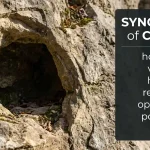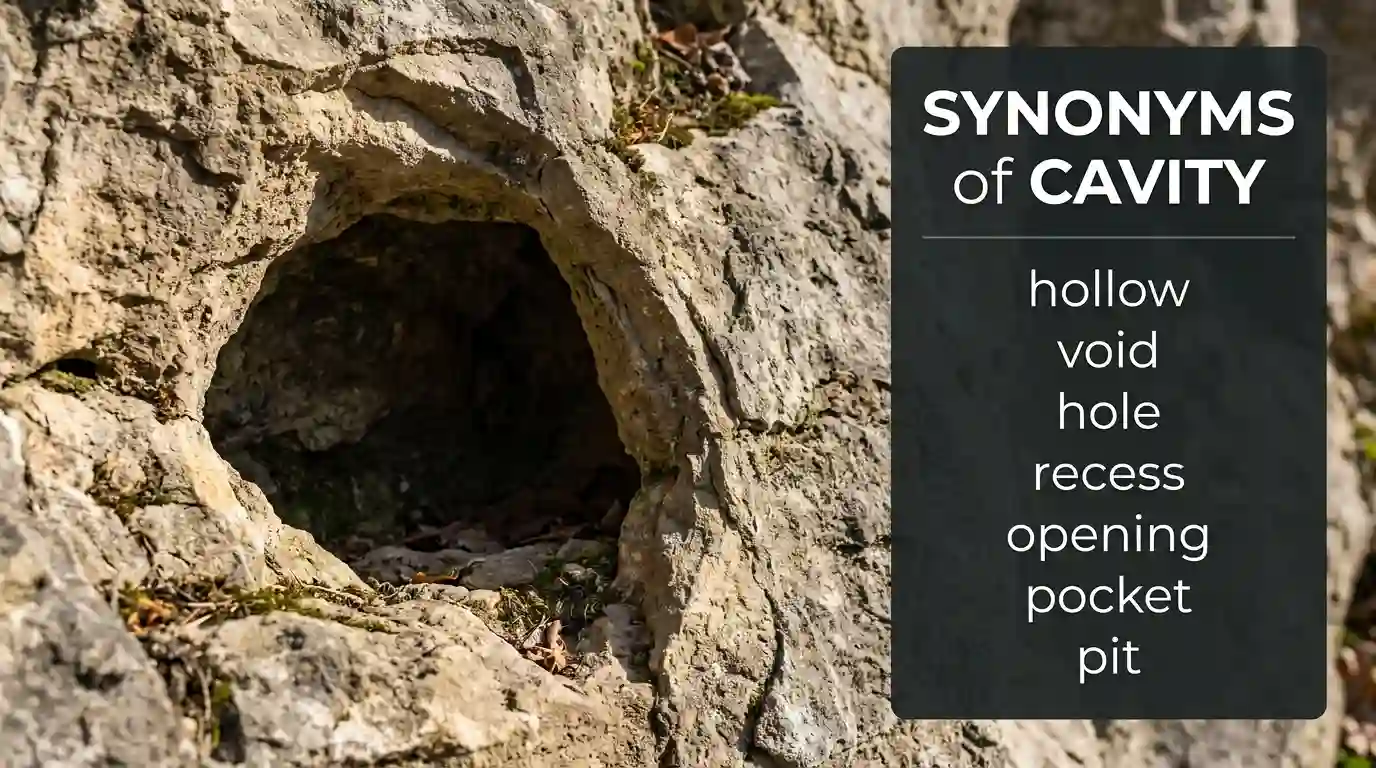
Think about a small hole in a wall, an empty space inside a rock, or a damaged spot in a tooth. English speakers may use the word cavity for all three, but the best replacement changes with the situation.
For example, hollow describes an empty space inside something, while pit suggests a small hole or depression. When talking about dental health, tooth decay or dental caries may be more accurate.
This guide explores useful synonyms of cavity, explains their differences, and helps students, bloggers, content writers, and everyday English users choose the right word.
What Does “Cavity” Really Mean?
Cavity is a noun that means an empty space, hole, or hollow area inside something. It can describe a natural opening in a rock, a space within the body, or a damaged area in a tooth. Native speakers also use it in scientific, medical, and everyday contexts.
The exact meaning depends on what the cavity describes. A cavity in a wall may be a hollow space, while a cavity in a tooth usually refers to an area damaged by tooth decay. These meanings are related, but their synonyms are not always interchangeable.
Connotative Meaning
(Connotation is the feeling or association a word creates beyond its basic meaning.)
Cavity is generally a neutral word. It describes a physical space or damaged area without expressing a strong opinion.
- Neutral: A cavity in a rock or wall is simply an empty or hollow area.
- Scientific: In anatomy, the word describes a space within the body, such as the chest cavity.
- Negative: In dental care, a cavity often suggests tooth damage or decay.
- Descriptive: In creative writing, it can create an image of depth, emptiness, or a hidden space.
The word itself is not usually positive or negative. Its emotional effect comes from the object or situation being described.
Etymology and Pronunciation
The word cavity comes from the Latin cavitas, meaning “hollowness” or “a hollow space.” It is related to cavus, which means “hollow” or “empty.”
Pronunciation:
- US IPA: /ˈkæv.ə.ti/
- UK IPA: /ˈkæv.ɪ.ti/
- Syllables: cav-i-ty
- Part of speech: Noun
Synonyms of Cavity — Grouped by Shade of Meaning
There is no single synonym that works in every situation. Some alternatives describe an empty space, while others refer to a small depression, an enclosed area, or tooth damage. These groups make the differences easier to understand.
1. Words That Mean a Hollow or Empty Space
Use these alternatives when describing an empty area inside an object or structure. They are especially useful for physical descriptions.
- Hollow — an empty space inside something.
- Void — a completely empty space.
- Hole — an opening through or into something.
- Space — an area with nothing inside it.
- Opening — a gap that allows entry or passage.
- Aperture — a small opening or hole.
- Gap — an empty space between two things.
- Bore — a hole made by drilling.
- Perforation — a small hole through material.
2. Words That Mean a Small Pit or Depression
These words describe a lower area, mark, or indentation on a surface. They often work when a cavity is visible from the outside.
- Pit — a small hollow in a surface.
- Depression — an area lower than its surroundings.
- Indentation — a small hollow pressed into something.
- Dent — a shallow mark in a surface.
- Divot — a small piece or hollow in the ground.
- Crater — a large bowl-shaped depression.
- Concavity — a surface that curves inward.
- Puncture — a small hole made by piercing.
- Recess — a hollow area set into a surface.
3. Words That Mean an Enclosed or Sunken Area
These alternatives are useful when the empty space has some depth, structure, or separation from the surrounding area.
- Chamber — an enclosed space inside a structure.
- Compartment — a separate section within something.
- Pocket — a small enclosed or recessed space.
- Socket — a hollow space that holds something.
- Niche — a small recessed space in a wall.
- Alcove — a small recessed area in a room.
- Cell — a small enclosed space or compartment.
- Enclosure — an area surrounded by boundaries.
- Cavern — a large natural underground hollow.
4. Words for Natural Caves and Underground Spaces
When a cavity is naturally formed in rock or underground, words related to caves may provide a clearer description.
- Cave — a natural hollow in the earth or rock.
- Grotto — a small cave, often attractive or scenic.
- Cavern — a large underground chamber.
- Burrow — a hole or tunnel dug by an animal.
- Tunnel — a passage through earth or rock.
- Crevice — a narrow opening or crack.
5. Words Related to Dental Cavities
In dentistry, cavity commonly refers to a hole or damaged area in a tooth caused by decay. These terms are related, but some name the condition rather than the physical hole.
- Tooth decay — damage to a tooth caused by decay.
- Dental caries — the medical term for tooth decay.
- Dental decay — deterioration of tooth structure.
- Caries — decay affecting the hard tissues of teeth.
Example Sentences Using Cavity Synonyms
The following examples show how these alternatives work in everyday writing:
- The old tree had a deep hollow where a small bird had built its nest.
- Rainwater collected in a shallow depression near the garden wall.
- The carpenter used a drill to make a clean bore through the wooden panel.
- A narrow crevice ran along the side of the mountain.
- The stone wall contained a small recess for an old candle holder.
- The explorers entered a dark cavern beneath the hillside.
- The dentist found an early sign of tooth decay during the checkup.
- The metal surface had a noticeable indentation after the impact.
Synonyms by Tone
Tone matters because a word that sounds natural in a casual description may not suit a medical report or technical explanation.
Formal or Technical
These words are useful in scientific, medical, architectural, or professional writing:
- Aperture
- Perforation
- Concavity
- Depression
- Compartment
- Dental caries
- Caries
- Recess
Neutral and Everyday
These are familiar alternatives that work in general descriptions:
- Hollow
- Hole
- Void
- Space
- Opening
- Gap
- Pit
- Dent
- Cave
Descriptive or Literary
These words can help create a stronger visual image in storytelling and creative writing:
- Cavern
- Grotto
- Crevice
- Alcove
- Burrow
- Crater
- Niche
- Hollow
Cavity vs. Close Alternatives
Some words look similar in meaning but describe different shapes or situations. These comparisons help prevent awkward word choices.
Cavity vs. Hollow
A cavity is an empty space or hole, often inside something. A hollow usually emphasizes that something has an empty interior.
For example, a hollow tree has an empty space inside its trunk. A cavity in a rock may be a smaller opening or depression. Use hollow when the empty interior is the main feature.
Cavity vs. Hole
A hole is a general opening through or into something. A cavity often suggests a space with some depth or an enclosed interior.
For example, a hole in a piece of paper may pass completely through it. A cavity inside a rock may form a deeper hollow space.
Cavity vs. Pit
A pit usually describes a depression or hole in a surface. A cavity can refer to a space inside an object or body.
A small pit may appear in the ground, while a cavity may exist inside a bone or tooth. Use pit when the surface depression is the main feature.
Cavity vs. Recess
A recess is a hollow area set back into a surface, such as a wall or ceiling. A cavity is a broader term for an empty or hollow space.
For example, a decorative recess may be built into a wall, while a cavity inside the wall may be hidden from view.
How “Cavity” Changes by Context
The right alternative depends on the subject, the audience, and the kind of writing you are doing.
Daily Conversation
In everyday speech, simple words such as hole, hollow, pit, and dent are usually easier to understand.
If someone points to a small opening in a wooden door, calling it a hole sounds more natural than calling it an aperture.
Writing and Blogging
Writers can choose more descriptive words to help readers picture an object or location. Hollow, crevice, cavern, and recess can add useful detail without making a sentence difficult to read.
For a general audience, choose familiar language unless a more specific term is necessary.
[internal link: synonyms for hollow → synonyms-for-hollow]
Professional or Academic Writing
Technical writing often needs greater precision. In architecture, recess or compartment may describe a particular structural feature. For biology, chamber or cavity may identify an internal space.
In dental writing, use dental caries when discussing the disease process and tooth decay when explaining it to a general audience.
Creative or Informal Use
Creative writers may use cavern, grotto, hollow, or crevice to describe natural spaces and create atmosphere.
For instance, “a dark cavern beneath the hill” gives readers a stronger visual impression than “a large cavity beneath the hill.”
Common Mistakes Learners Make
Even when two words are related, replacing one with the other can change the meaning of a sentence. Watch out for these common mistakes.
1. Using Hole for Every Type of Cavity
Hole is a broad word, but it does not always describe the depth or enclosed nature of a cavity.
Better choice: Use hollow for an empty interior or recess for a space set into a surface.
2. Confusing a Cavity With a Dental Condition
A dental cavity is commonly used to describe a damaged area in a tooth. However, dental caries refers to the decay process or disease.
Better choice: Use tooth decay in everyday explanations and dental caries in technical writing.
3. Using Cavern for a Small Opening
A cavern is a large natural underground space. It is not suitable for a tiny hole in a wall or a small dent in metal.
Better choice: Use hole, pit, or recess when describing a smaller feature.
4. Treating Depression and Indentation as Exact Matches
Both words describe lower areas, but depression can refer to a broader sunken area, while indentation often describes a mark pressed into a surface.
Better choice: Choose indentation for a visible mark and depression for a wider low area.
5. Using Technical Terms in Casual Conversation
Words such as aperture, concavity, and perforation may sound unnecessarily technical in everyday speech.
Better choice: Use simpler alternatives such as opening, hollow, or hole when they express the same idea clearly.
Frequently Asked Questions
What Is the Closest Synonym for Cavity?
Hollow is one of the closest general alternatives because both words can describe an empty space inside something. However, hole, pit, or recess may be more suitable when describing a particular shape or opening.
What Is a Formal Word for Cavity?
Aperture, recess, concavity, and chamber can work in formal or technical writing. The best choice depends on whether you mean an opening, a sunken area, or an enclosed space.
What Is a Common Word for Cavity?
Hole and hollow are common alternatives in everyday English. They are easy to understand and work well in many general descriptions.
What Is Another Word for a Dental Cavity?
Tooth decay is the most familiar alternative in everyday language. Dental caries is the technical term for the decay process that damages the hard tissues of a tooth.
What Is the Opposite of Cavity?
There is no single opposite for every meaning of cavity. Depending on the context, possible contrasts include solid surface, protrusion, projection, or filled space.
Conclusion
Cavity describes an empty or hollow area, but the word you choose can make your meaning more precise. Hollow, hole, and void work for general spaces, while pit, recess, and indentation describe particular shapes. Dental terms such as tooth decay and dental caries belong to a more specific context.
Learning these alternatives can make your writing clearer and help you avoid repeating the same word. Try using them in everyday conversations, emails, descriptions, and essays. Pay attention to the shape or type of space you are describing before choosing a replacement.
For more meanings and related vocabulary, explore synonyms of cavity and compare the alternatives to find the word that best fits your sentence.

Evelyn Hartwell is an English vocabulary writer who focuses on clear, practical language for learners and everyday readers. Her writing explores synonyms, word meanings, pronunciation, tone, and natural usage. She believes that learning vocabulary should be simple, useful, and enjoyable. Her articles are designed to help students, bloggers, and English learners choose the right words with greater confidence.