Have you ever received a message that left you wondering what the sender really meant? Perhaps it contained a strange phrase, an unclear hint, or a few words that seemed to hide a deeper meaning. That is when the word cryptic comes in handy.
However, cryptic is not always the best choice. A message might be vague because it lacks detail, enigmatic because it feels mysterious, or puzzling because it is difficult to understand. Each word gives the reader a slightly different impression.
This guide explores useful synonyms for cryptic, explains their shades of meaning, and helps students, bloggers, content writers, and everyday English users choose words that fit naturally.
What Does “Cryptic” Really Mean?
Cryptic is an adjective that describes something difficult to understand because its meaning is hidden, unclear, or mysterious. It commonly describes messages, remarks, clues, symbols, writing, and behavior that do not reveal their meaning directly.
For example, if someone says, “You’ll understand when the time comes,” without explaining anything further, their response may sound cryptic. Native speakers often use the word when something seems to contain a hidden meaning or requires careful thought to understand.
Connotative Meaning
(Connotation is the feeling or association a word creates beyond its basic meaning.)
Cryptic usually has a mysterious or slightly confusing tone.
- Positive: It can make a clue, story, or message seem intriguing and thought-provoking.
- Neutral: It can simply describe information that is not immediately clear.
- Negative: It may suggest that someone is being unnecessarily unclear or difficult to understand.
In a mystery novel, a cryptic clue can make the story more interesting. In a work email, however, a cryptic instruction may frustrate the reader.
Etymology and Pronunciation
The word cryptic comes from the Greek kryptos, meaning “hidden” or “concealed.” It entered English through Latin and French forms connected with the idea of something hidden from view.
Pronunciation:
- US IPA: /ˈkrɪp.tɪk/
- UK IPA: /ˈkrɪp.tɪk/
- Syllables: cryp-tic
- Part of speech: Adjective
Synonyms for Cryptic — Grouped by Shade of Meaning
The best replacement depends on why something is difficult to understand. A hidden message may be enigmatic, an unclear instruction may be ambiguous, and a difficult passage may be obscure. These groups make it easier to find the right alternative.
1. Words That Mean Mysterious or Enigmatic
Use these words when something seems to hide a meaning, creates curiosity, or leaves people wondering what is really happening.
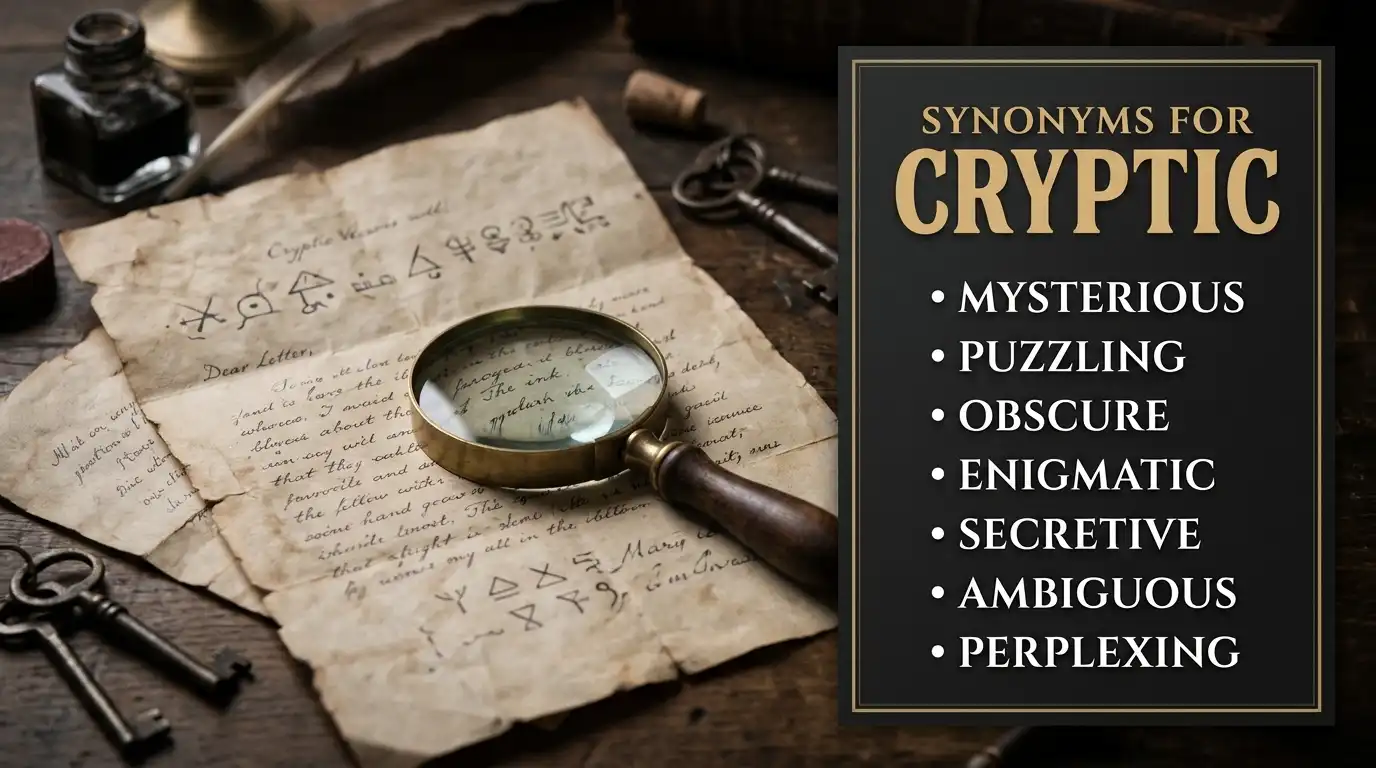
- Mysterious — difficult to explain or understand.
- Enigmatic — mysterious and hard to interpret.
- Inscrutable — impossible or very difficult to understand.
- Unfathomable — too complex to fully understand.
- Arcane — understood by only a few people.
- Esoteric — intended for people with specialized knowledge.
- Uncanny — strangely mysterious or unsettling.
- Puzzling — causing confusion or curiosity.
2. Words That Mean Unclear or Difficult to Understand
These alternatives work when a statement, explanation, or piece of writing does not communicate its meaning clearly.
- Obscure — not clear or easily understood.
- Unclear — lacking a clear meaning.
- Confusing — difficult to follow or understand.
- Perplexing — causing uncertainty or confusion.
- Baffling — extremely difficult to explain.
- Incomprehensible — impossible to understand.
- Unintelligible — impossible to understand or make sense of.
- Unfamiliar — not known or recognized.
3. Words That Mean Vague or Ambiguous
Choose these words when information lacks detail or can be understood in more than one way.
- Vague — not expressed in a clear or exact way.
- Ambiguous — having more than one possible meaning.
- Indistinct — not clearly defined or recognizable.
- Imprecise — lacking exact details.
- Unspecified — not clearly stated or identified.
- Equivocal — open to different interpretations.
- Indirect — expressed without saying something directly.
4. Words That Suggest Hidden or Concealed Meaning
These alternatives fit messages, intentions, clues, or information that do not reveal everything openly.
- Hidden — kept out of sight or knowledge.
- Concealed — deliberately kept from being seen.
- Covert — secret or not openly shown.
- Veiled — expressed in a partly hidden way.
- Oblique — indirect and not straightforward.
- Encoded — changed into a form that hides its meaning.
- Disguised — made to appear different from its real nature.
5. Words That Mean Complicated or Difficult to Interpret
These words are useful when something requires effort, knowledge, or careful thought before its meaning becomes clear.
- Complex — made up of many connected parts.
- Intricate — detailed and difficult to understand.
- Convoluted — unnecessarily complicated or confusing.
- Perplexing — difficult to make sense of.
- Abstruse — hard to understand because it is highly complex.
Example Sentences Using Cryptic Synonyms
Here are a few natural examples showing how these alternatives work in everyday situations.
- The detective received a mysterious note shortly before the investigation began.
- Her enigmatic smile made everyone wonder what she knew.
- The instructions were too vague for the new employees to follow.
- His explanation was so convoluted that nobody understood the main point.
- The old manuscript contained several obscure references to forgotten traditions.
- The message was ambiguous, so we could not tell what the sender intended.
- The professor introduced an esoteric concept that only a few students recognized.
- A veiled warning appeared at the end of the letter.
Synonyms by Tone
A synonym can change the mood of a sentence. Some alternatives sound formal and intellectual, while others feel simple and conversational.
Formal or Academic
These words suit research, literature, professional writing, and detailed explanations:
- Inscrutable
- Unfathomable
- Arcane
- Esoteric
- Abstruse
- Equivocal
- Intricate
- Incomprehensible
Neutral and Everyday
These are familiar alternatives that work in general conversation and writing:
- Mysterious
- Unclear
- Obscure
- Confusing
- Puzzling
- Vague
- Ambiguous
- Hidden
- Indirect
Casual and Conversational
These words are useful in relaxed conversations when something does not make sense:
- Baffling
- Perplexing
- Confusing
- Puzzling
- Unclear
- Complicated
Literary or Descriptive
These words can create suspense, curiosity, or a sense of hidden meaning in creative writing:
- Enigmatic
- Veiled
- Uncanny
- Oblique
- Covert
- Concealed
- Mysterious
Cryptic vs. Close Alternatives
Several words are close in meaning to cryptic, but they are not interchangeable in every sentence. Understanding their differences helps you avoid choosing a word that changes your intended meaning.
Cryptic vs. Mysterious
Cryptic usually describes something whose meaning is difficult to understand. Mysterious describes something that creates curiosity because it is unknown, unusual, or unexplained.
For example, a cryptic message may contain unclear words, while a mysterious visitor may have an unknown identity or background. Use cryptic when the meaning is hidden and mysterious when the situation itself feels unknown.
Cryptic vs. Vague
Vague means that something lacks clear details or precise information. Cryptic suggests that the meaning is hidden or difficult to interpret.
For example, “We will discuss it later” is vague because it gives no specific time. A cryptic statement might say, “The answer is closer than you think,” leaving the listener to work out its meaning.
Cryptic vs. Ambiguous
Ambiguous describes something that has two or more possible meanings. Cryptic describes something that is difficult to understand because its meaning is hidden or unclear.
A sentence can be ambiguous because it allows different interpretations. A cryptic clue may be difficult to solve because it uses indirect language or hidden hints.
Cryptic vs. Obscure
Obscure often describes information that is not widely known, not easily understood, or difficult to find. Cryptic focuses more on a hidden or difficult-to-interpret meaning.
For example, an obscure historical fact may be unfamiliar to most readers. A cryptic note may be familiar in its words but unclear in its message.
How “Cryptic” Changes by Context
The most suitable alternative depends on what you are describing. A word that works in a mystery story may sound strange in a business email.
Daily Conversation
In everyday conversation, confusing, puzzling, unclear, and mysterious are often more natural than formal words such as abstruse or inscrutable.
For example, you might say, “That was a confusing answer,” rather than using a more complicated alternative.
Writing and Blogging
Writers can use enigmatic, obscure, ambiguous, or intriguing when describing a character, statement, story, or idea.
Choose a word that gives readers the right impression. If a passage is difficult because it contains unfamiliar details, obscure may fit better than mysterious.
[internal link: synonyms for mysterious → synonyms-for-mysterious]
Professional or Academic Writing
In professional communication, clarity is usually more important than mystery. Words such as ambiguous, imprecise, and unclear can identify problems in instructions, reports, or research.
For example, “The policy contains ambiguous language” explains the issue more precisely than calling it cryptic.
[internal link: synonyms for ambiguous → synonyms-for-ambiguous]
Creative or Informal Use
In fiction, poetry, and storytelling, enigmatic, veiled, uncanny, and mysterious can help build suspense.
A writer might describe a character as enigmatic to suggest that their thoughts and intentions are difficult to read. In a casual conversation, puzzling or baffling will usually sound more natural.
Common Mistakes Learners Make
Some alternatives look similar but carry different meanings. These are a few mistakes worth avoiding.
1. Using Vague When You Mean Mysterious
A vague statement lacks detail. A mysterious statement creates curiosity or suggests something unknown.
Better choice: Use vague for missing details and mysterious for something that feels unexplained.
2. Confusing Ambiguous With Cryptic
An ambiguous sentence has more than one possible interpretation. A cryptic sentence may hide its meaning or require extra thought.
Better choice: Use ambiguous when multiple meanings are possible and cryptic when the meaning is difficult to uncover.
3. Choosing Overly Formal Words in Casual Speech
Words such as abstruse, inscrutable, and esoteric can sound unnatural in ordinary conversation.
Better choice: Use confusing, unclear, or puzzling when speaking with friends or family.
4. Treating Obscure and Unknown as Exact Matches
Obscure can describe something unfamiliar or difficult to understand, but it does not always mean mysterious.
Better choice: Use unknown when something is not known and cryptic when its meaning is difficult to interpret.
5. Overusing Mysterious in Creative Writing
Using mysterious repeatedly can make descriptions feel predictable.
Better choice: Consider enigmatic, veiled, puzzling, or uncanny when the specific meaning fits.
Frequently Asked Questions
What Is the Closest Synonym for Cryptic?
Enigmatic is one of the closest synonyms because both words describe something mysterious and difficult to understand. Obscure and puzzling are also useful alternatives in the right context.
What Is a Formal Word for Cryptic?
Inscrutable, abstruse, and esoteric are formal alternatives. Use inscrutable when something is extremely difficult to understand and esoteric when it requires specialized knowledge.
What Is a Casual Word for Cryptic?
Confusing, puzzling, and unclear are natural casual alternatives. They work well in everyday conversations without making your sentence sound overly formal.
What Is the Opposite of Cryptic?
Common opposites include clear, explicit, obvious, straightforward, and understandable. These words describe information that communicates its meaning openly.
Is Cryptic Positive or Negative?
It can be either, depending on the situation. A cryptic clue may be interesting and entertaining, while a cryptic instruction may frustrate someone who needs clear information.
Conclusion
Cryptic is a useful word for describing hidden meanings, mysterious messages, and information that takes effort to understand. However, alternatives such as enigmatic, obscure, vague, and ambiguous can express more specific ideas.
Learning these differences gives you more control over your writing. Try using the alternatives in emails, essays, blog posts, and everyday conversations. Notice how each word changes the tone and meaning of your sentence.
The next time you describe something difficult to understand, choose a word that captures exactly what you mean. You can also explore synonyms for cryptic to discover more related vocabulary and expand your English word choices.

Evelyn Hartwell is an English vocabulary writer who focuses on clear, practical language for learners and everyday readers. Her writing explores synonyms, word meanings, pronunciation, tone, and natural usage. She believes that learning vocabulary should be simple, useful, and enjoyable. Her articles are designed to help students, bloggers, and English learners choose the right words with greater confidence.