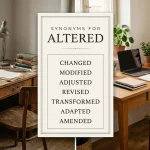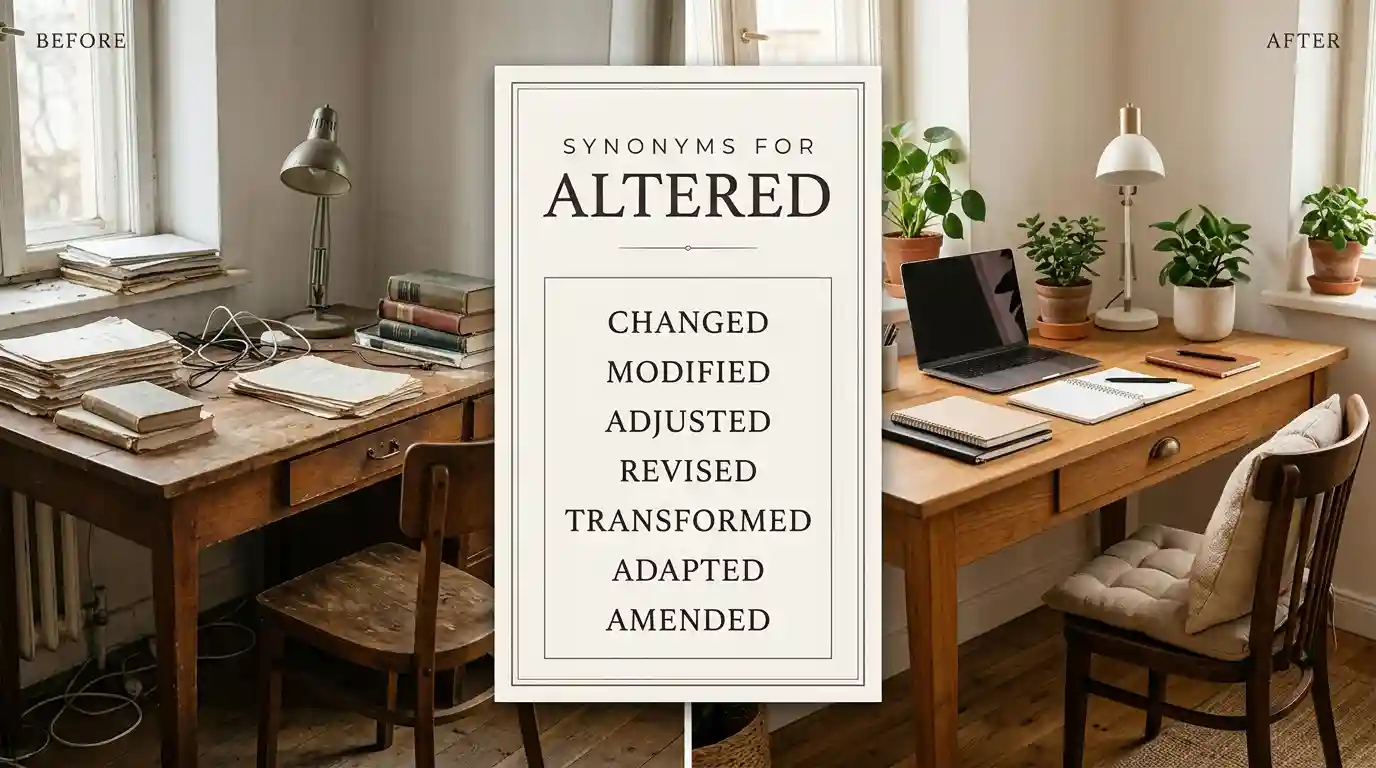
Synonyms for altered can help you explain changes more clearly. Imagine you changed your plans at the last minute. The word adjusted might describe that change better.
The word altered is common in everyday English. We use it when plans, clothes, documents, designs, or even opinions change. However, the best replacement depends on the situation.
Learning synonyms for altered helps you avoid using the same word again and again. For example, revised often suits a written report, while adjusted works well for a small change.
These alternatives are useful for students, bloggers, content writers, and anyone who wants to speak or write in clear English. The right word makes your meaning easier to understand.
What Does “Altered” Really Mean?
Altered means changed from the original form, condition, appearance, or meaning. The change may be small or large. It can affect how something looks, works, or feels.
For example, if you shorten a dress, you have altered it. If you change a sentence in an essay, you have altered the wording. If you change your plans, you have altered your arrangements.
Altered is the past tense and past participle of the verb alter. It can also work as an adjective, as in “an altered document.”
Native English speakers use this word in many situations, including clothing, writing, plans, records, buildings, images, and behavior. It usually describes a change without saying whether that change is good or bad.
Connotative Meaning
Connotation means the feeling or idea a word suggests beyond its basic meaning.
- Positive tone: Improved or refined may suggest that a change made something better.
- Negative tone: Tampered with or distorted may suggest an unwanted or dishonest change.
- Neutral tone: Changed, modified, and adjusted usually describe a change without strong feelings.
The word altered itself is mostly neutral. The surrounding sentence tells readers whether the change is helpful, harmful, or simply different.
Etymology of “Altered”
The word alter comes through Old French and Latin. The Latin word alter means “the other” or “another.” Over time, the word developed the sense of making something different.
Old English (450–1100)
The modern word alter was not a common part of Old English vocabulary. English speakers used other words and phrases to express ideas such as changing, making different, or becoming new.
Middle English (1100–1500)
After the Norman Conquest, English borrowed many words from French and Latin. Alter entered English through this influence and became associated with making a change.
Modern English (1500–Present)
The verb alter became an established part of English. Today, altered appears in everyday speech, formal writing, science, law, fashion, and technology.
Pronunciation, Syllables, and Word Structure
- US pronunciation: /ˈɔːltərd/
- UK pronunciation: /ˈɔːltəd/
- Syllables: al-tered
- Part of speech: Past tense and past participle of a verb; also used as an adjective.
- Root: Alter
- Prefix: None
- Suffix: -ed, which marks the past tense or past participle of the verb.
Synonyms for Altered: 40 Words and Examples
The best synonym for altered depends on what changed. Some words describe a small change, while others suggest a major update or a change made for a special purpose.
Not every word below fits every sentence. Check the meaning and examples before choosing a replacement.
1. Changed
US: /tʃeɪndʒd/ · UK: /tʃeɪndʒd/
Meaning: Changed means made different or became different.
- I changed my plans because it started raining.
- The color of the wall changed in the sunlight.
2. Modified
US: /ˈmɑːdəˌfaɪd/ · UK: /ˈmɒdɪfaɪd/
Meaning: Modified means changed something to make it more suitable or useful.
- We modified the design to make it easier to use.
- The teacher modified the task for younger students.
3. Adjusted
US: /əˈdʒʌstɪd/ · UK: /əˈdʒʌstɪd/
Meaning: Adjusted means changed something slightly to make it fit or work better.
- She adjusted the chair before sitting down.
- We adjusted the schedule to fit everyone’s plans.
4. Revised
US: /rɪˈvaɪzd/ · UK: /rɪˈvaɪzd/
Meaning: Revised means changed something after reviewing it.
- I revised my essay before handing it in.
- The company released a revised version of the report.
5. Amended
US: /əˈmendɪd/ · UK: /əˈmendɪd/
Meaning: Amended means changed a document, rule, or statement, often to correct or improve it.
- The team amended the rules after the meeting.
- She amended the letter to include the correct date.
6. Adapted
US: /əˈdæptɪd/ · UK: /əˈdæptɪd/
Meaning: Adapted means changed something so it works in a new situation.
- We adapted the lesson for online learning.
- The book was adapted for a younger audience.
7. Edited
US: /ˈedɪtɪd/ · UK: /ˈedɪtɪd/
Meaning: Edited means changed written, recorded, or filmed material to improve or prepare it.
- I edited the paragraph to make it clearer.
- She edited the video before sharing it.
8. Updated
US: /ʌpˈdeɪtɪd/ · UK: /ʌpˈdeɪtɪd/
Meaning: Updated means changed something by adding new or more recent information.
- I updated my contact details yesterday.
- The website has an updated list of opening hours.
9. Revised Again
US: /rɪˈvaɪzd əˈɡen/ · UK: /rɪˈvaɪzd əˈɡen/
Meaning: Revised again means reviewed and changed something another time.
- I revised the draft again after reading the feedback.
- The writer revised the ending again before publication.
10. Refined
US: /rɪˈfaɪnd/ · UK: /rɪˈfaɪnd/
Meaning: Refined means improved something by making small, careful changes.
- She refined her speech before the event.
- We refined the design after testing it.
11. Transformed
US: /trænsˈfɔːrmd/ · UK: /trænsˈfɔːmd/
Meaning: Transformed means changed something greatly in appearance, form, or character.
- A fresh coat of paint transformed the room.
- The new coach transformed the team.
12. Altered in Appearance
US: /ˈɔːltərd ɪn əˈpɪrəns/ · UK: /ˈɔːltəd ɪn əˈpɪərəns/
Meaning: Altered in appearance means changed in the way something looks.
- The old photo looked altered in appearance.
- The building was altered in appearance after the renovation.
13. Revised in Form
US: /rɪˈvaɪzd ɪn fɔːrm/ · UK: /rɪˈvaɪzd ɪn fɔːm/
Meaning: Revised in form means changed in structure or arrangement.
- The plan was revised in form before approval.
- The lesson was revised in form to suit the class.
14. Reshaped
US: /ˌriːˈʃeɪpt/ · UK: /ˌriːˈʃeɪpt/
Meaning: Reshaped means changed the shape, structure, or direction of something.
- The artist reshaped the clay into a bowl.
- The new policy reshaped the way the team worked.
15. Reworked
US: /ˌriːˈwɜːrkt/ · UK: /ˌriːˈwɜːkt/
Meaning: Reworked means worked on something again to change or improve it.
- He reworked the introduction to make it clearer.
- The designer reworked the old logo.
16. Remade
US: /ˌriːˈmeɪd/ · UK: /ˌriːˈmeɪd/
Meaning: Remade means made again, often in a different form.
- She remade the dress using softer fabric.
- The film was remade for a new audience.
17. Replaced
US: /rɪˈpleɪst/ · UK: /rɪˈpleɪst/
Meaning: Replaced means took the place of something with another thing.
- I replaced the broken handle.
- The old paragraph was replaced with a shorter one.
Note: Replacing something is a type of change, but it does not always mean the original item itself was altered.
18. Corrected
US: /kəˈrektɪd/ · UK: /kəˈrektɪd/
Meaning: Corrected means changed something to remove a mistake.
- She corrected the spelling in my essay.
- The wrong number was corrected in the report.
19. Amended Slightly
US: /əˈmendɪd ˈslaɪtli/ · UK: /əˈmendɪd ˈslaɪtli/
Meaning: Amended slightly means made a small change to a rule, document, or statement.
- The editor amended the headline slightly.
- We amended the agreement slightly before signing it.
20. Reorganized
US: /riˈɔːrɡənaɪzd/ · UK: /riˈɔːɡənaɪzd/
Meaning: Reorganized means arranged something in a new way.
- I reorganized my notes before the exam.
- The manager reorganized the work schedule.
21. Rearranged
US: /ˌriːəˈreɪndʒd/ · UK: /ˌriːəˈreɪndʒd/
Meaning: Rearranged means changed the order or position of things.
- We rearranged the chairs for the meeting.
- She rearranged the words to make the sentence clearer.
22. Reconfigured
US: /ˌriːkənˈfɪɡjərd/ · UK: /ˌriːkənˈfɪɡəd/
Meaning: Reconfigured means changed the way parts of a system or object are set up.
- The technician reconfigured the computer settings.
- We reconfigured the room for the workshop.
23. Recast
US: /ˌriːˈkæst/ · UK: /ˌriːˈkɑːst/
Meaning: Recast means presented or shaped something in a new way.
- The writer recast the story from a child’s point of view.
- The team recast its message for a wider audience.
24. Rewritten
US: /ˌriːˈrɪtən/ · UK: /ˌriːˈrɪtən/
Meaning: Rewritten means written again with changes to the words or ideas.
- The final paragraph was rewritten for clarity.
- The instructions were rewritten in simple English.
25. Reworded
US: /ˌriːˈwɜːrdɪd/ · UK: /ˌriːˈwɜːdɪd/
Meaning: Reworded means expressed the same idea using different words.
- I reworded the message to sound more polite.
- The question was reworded to make it easier to understand.
26. Repaired
US: /rɪˈperd/ · UK: /rɪˈpeəd/
Meaning: Repaired means fixed something that was damaged or not working properly.
- The mechanic repaired the damaged door.
- They repaired the fence after the storm.
Note: Repairing something changes its condition, but it usually means fixing damage rather than making any kind of change.
27. Improved
US: /ɪmˈpruːvd/ · UK: /ɪmˈpruːvd/
Meaning: Improved means made something better than it was before.
- We improved the layout of the page.
- He improved his answer after checking the facts.
28. Updated and Revised
US: /ʌpˈdeɪtɪd ænd rɪˈvaɪzd/ · UK: /ʌpˈdeɪtɪd ænd rɪˈvaɪzd/
Meaning: Updated and revised means added current information and made other changes.
- The guide was updated and revised this year.
- She updated and revised her notes after class.
29. Customized
US: /ˈkʌstəˌmaɪzd/ · UK: /ˈkʌstəmaɪzd/
Meaning: Customized means changed something to suit a person’s needs or preferences.
- He customized his phone settings.
- We customized the invitation for each guest.
30. Tailored
US: /ˈteɪlərd/ · UK: /ˈteɪləd/
Meaning: Tailored means adjusted or designed to suit a particular person or purpose.
- The course was tailored to new learners.
- She wore a tailored jacket to the interview.
31. Tweaked
US: /twiːkt/ · UK: /twiːkt/
Meaning: Tweaked means made a small change to improve or adjust something.
- I tweaked the wording of the email.
- He tweaked the settings to make the screen brighter.
32. Shifted
US: /ʃɪftɪd/ · UK: /ʃɪftɪd/
Meaning: Shifted means moved or changed position, focus, or direction.
- The meeting shifted to Friday afternoon.
- Her focus shifted to a new project.
33. Replaced with a New Version
US: /rɪˈpleɪst wɪð ə nuː ˈvɜːrʒən/ · UK: /rɪˈpleɪst wɪð ə njuː ˈvɜːʒən/
Meaning: This phrase means an old version was removed and a different version took its place.
- The old map was replaced with a new version.
- The outdated guide was replaced with a new version.
34. Distorted
US: /dɪˈstɔːrtɪd/ · UK: /dɪˈstɔːtɪd/
Meaning: Distorted means changed in a way that makes something look, sound, or seem inaccurate.
- The mirror distorted his reflection.
- The story was distorted as it spread online.
35. Disguised
US: /dɪsˈɡaɪzd/ · UK: /dɪsˈɡaɪzd/
Meaning: Disguised means changed or covered so that someone or something is harder to recognize.
- He disguised his voice during the prank.
- The character disguised herself as a guard.
Note: This word suggests hiding the real identity or appearance, so it is not a general substitute for altered.
36. Tampered With
US: /ˈtæmpərd wɪð/ · UK: /ˈtæmpəd wɪð/
Meaning: Tampered with means changed something without permission, often in a harmful or dishonest way.
- Someone had tampered with the lock.
- The evidence may have been tampered with.
37. Manipulated
US: /məˈnɪpjəˌleɪtɪd/ · UK: /məˈnɪpjʊleɪtɪd/
Meaning: Manipulated means changed or controlled something skillfully, sometimes in a dishonest way.
- The image was manipulated before it was shared.
- He manipulated the figures to make the results look better.
38. Disturbed
US: /dɪˈstɜːrbd/ · UK: /dɪˈstɜːbd/
Meaning: Disturbed means disrupted or changed the normal state or arrangement of something.
- The noise disturbed the quiet atmosphere.
- The soil was disturbed during the building work.
39. Varied
US: /ˈverid/ · UK: /ˈveərid/
Meaning: Varied means changed or differed in type, amount, or form.
- The teacher varied the activities to keep students interested.
- The results varied from one group to another.
40. Converted
US: /kənˈvɜːrtɪd/ · UK: /kənˈvɜːtɪd/
Meaning: Converted means changed something from one form, use, or system to another.
- We converted the document to a PDF.
- The old garage was converted into a small office.
Synonyms for Altered by Tone
The tone of a word can change how readers understand a sentence. Some alternatives suggest helpful changes. Others simply describe a difference or hint that something went wrong.
Positive Synonyms
Use these words when a change makes something better or more suitable.
- Improved: suggests a better result.
- Refined: suggests careful changes that make something better.
- Enhanced: suggests that a quality or feature has been made stronger or better.
- Updated: suggests that something now includes newer information.
- Customized: suggests that something has been changed to suit a particular person.
- Tailored: suggests that something has been made suitable for a specific need.
Example: “We refined the design” sounds more positive than “We altered the design.”
Neutral Synonyms
These words describe changes without clearly saying whether they are good or bad.
- Changed: a general word for becoming different.
- Modified: changed in some way.
- Adjusted: changed to fit or work better.
- Revised: changed after review.
- Amended: changed in a document, rule, or statement.
- Reconfigured: set up in a different way.
- Rearranged: changed the order or position of things.
- Adapted: changed to suit new conditions.
Example: “The schedule was adjusted” simply explains that the schedule changed.
Negative Synonyms
These words may suggest harm, dishonesty, or an unwanted result.
- Distorted: changed in a way that makes something inaccurate or unnatural.
- Tampered with: changed without permission.
- Manipulated: changed or controlled, sometimes dishonestly.
- Disguised: changed to hide the real identity or appearance.
- Damaged: harmed rather than simply changed.
- Corrupted: changed in a way that makes something less reliable or usable.
Example: “The figures were manipulated” suggests that someone may have changed them dishonestly.
Playful and Informal Synonyms
These words work well in relaxed conversations.
- Tweaked: made a small change.
- Fixed up: changed or repaired something to make it better.
- Reworked: worked on something again.
- Switched up: changed something in a noticeable way.
- Mixed up: changed an order or arrangement, sometimes by mistake.
Example: “I tweaked the recipe” sounds casual and natural when talking to a friend.
Choose a word that matches both the size of the change and your attitude toward it. A small edit may be a tweak, while a major change may be a transformation.
“Altered” vs. Close Alternatives
The words changed, modified, adjusted, and revised are close in meaning. However, they are not always interchangeable.
| Word | Main meaning | Best used for |
|---|---|---|
| Altered | Made different from the original | General changes to appearance, form, or condition |
| Changed | Became or made different | Everyday situations |
| Modified | Changed part of something | Designs, systems, rules, and objects |
| Adjusted | Made a change to improve fit or function | Settings, schedules, positions, and plans |
| Revised | Changed after reviewing | Essays, reports, plans, and written work |
Altered vs. Changed
Changed is the simplest and most common alternative. It works in almost any everyday situation.
- Original: “I altered my plans.”
- Simpler: “I changed my plans.”
Both sentences are correct. The second sounds more natural in casual conversation.
Altered vs. Modified
Modified often suggests that someone changed only part of something while keeping its main purpose or structure.
- “The designer modified the chair.”
- “The designer altered the chair.”
Both can work. Modified highlights a deliberate change to part of the chair. Altered is broader.
Altered vs. Adjusted
Adjusted usually means making a small change so something fits, works, or feels right.
- “She adjusted the seat.”
- “She altered the seat.”
The first suggests a practical change, such as changing the seat’s position. The second may suggest a larger change to the seat itself.
Altered vs. Revised
Revised is especially useful for writing, plans, reports, and other work that someone checks before changing.
- “He revised his essay.”
- “He altered his essay.”
Both are possible, but revised more clearly suggests that he reviewed the essay and then made changes.
How “Altered” Changes by Context
The best synonym depends on what has changed and why. Here is how to choose a natural word in different situations.
Daily Conversation
In everyday speech, changed is often the easiest choice. Use adjusted for a small practical change and switched up for a casual change in routine.
- “I changed my plans for tonight.”
- “I adjusted the mirror.”
- “We switched up our usual dinner plans.”
You do not need a formal word when a simple one explains the change clearly.
Writing and Blogging
When writing an article, essay, or blog post, choose a word that explains the type of edit.
Use revised when you review and improve a draft, use edited when you correct or prepare text while use reworded when you express the same idea in different words.
For example, “I revised the article” tells readers that you reviewed and changed it. “I reworded the sentence” focuses on the wording itself.
Professional or Academic English
In workplaces and academic writing, words such as modified, amended, adjusted, and revised can sound more precise than changed.
- A researcher may modify a method.
- A team may revise a proposal.
- A company may amend a policy.
- A manager may adjust a schedule.
Use amended for formal documents or rules, especially when the change is official. Use modified when you change part of a process, design, or system.
Creative or Informal Use
Creative writing often needs words that show the size or effect of a change.
Use transformed when something becomes very different. Make a use of reshaped when its form or direction changes. Use recast when a story, idea, or message takes a new form.
For informal conversations, tweaked is useful for a small change. For a big visual change, transformed may be a better fit.
Common Mistakes Learners Make
Even when two words have similar meanings, they may not fit the same sentence. These common mistakes can help you choose more naturally.
1. Using “Improved” for Every Change
Improved means made better. It does not simply mean made different.
- Less accurate: “I improved my plans because I changed them.”
- Better: “I changed my plans after the meeting.”
Use improved only when the result is better in some way.
2. Confusing “Adjusted” With “Transformed”
Adjusted usually describes a small or practical change. Transformed suggests a much bigger difference.
- “I adjusted the brightness.”
- “The renovation transformed the house.”
The second word would sound too strong if you only moved a chair or changed a setting.
3. Using “Revised” for Physical Objects
Revised is most common with writing, plans, proposals, and ideas. It can sometimes describe other things, but it is not the usual choice for a physical repair.
- Natural: “I revised the report.”
- More natural for a broken table: “I repaired the table.”
4. Treating “Tampered With” as a Neutral Word
Tampered with often suggests that someone changed something without permission or in a dishonest way.
- Neutral: “The settings were modified.”
- Negative: “Someone tampered with the settings.”
Choose it only when the sentence supports that meaning.
5. Using “Replaced” When Something Was Only Changed
Replaced means that one thing took the place of another. It does not always mean the original thing was altered.
- “I changed the wording” means the words were different afterward.
- “I replaced the sentence” means one sentence took the place of another.
Register Notes
- Formal: amended, revised, modified, reconfigured.
- Neutral: changed, adjusted, edited, updated.
- Informal: tweaked, switched up, fixed up.
- Negative or critical: distorted, tampered with, manipulated.
In spoken English, changed and adjusted are often easy choices. In formal writing, a more specific word can make your meaning clearer.
Internal linking suggestion: Link the phrase “words for changed” to a related article about synonyms for changed, if you have one.
Real-Life Examples Using Synonyms for Altered
These short situations show how different alternatives work in real life.
Workplace
A team prepares a report for its manager. After receiving feedback, the writer changes a few sections.
Natural choice: “I revised the report after the meeting.”
If the team changes the project schedule, adjusted may fit better. If it changes the whole plan, reworked may be more suitable.
Social Situations
Your friend plans to meet you outdoors, but the weather changes.
Natural choice: “We changed our plans and met at a café instead.”
If your friend makes a small change to the meeting time, you could say, “We adjusted the time.”
Media and Pop Culture
A filmmaker changes a book into a movie. The story may need new scenes, characters, or a different ending.
Natural choice: “The story was adapted for the screen.”
If the new version looks very different from the original, you might say the filmmaker transformed the story.
Writing and Storytelling
A student writes a first draft but finds that the ending does not work well.
Natural choice: “She rewrote the ending to make it more engaging.”
If she changes only a few words, edited or reworded may be more accurate. If she changes the story’s structure, reworked may fit better.
Practice Exercise: Choose the Best Synonym for Altered
Choose the word that best completes each sentence. Think about the meaning and situation before selecting your answer.
Questions
1. I ______ my essay after finding several spelling mistakes.
A. distorted
B. edited
C. disguised
D. shifted
2. The company ______ its rules to include a new safety measure.
A. amended
B. disguised
C. disturbed
D. varied
3. She ______ the chair so she could sit more comfortably.
A. transformed
B. manipulated
C. adjusted
D. converted
4. The old kitchen looked completely different after the renovation. The work had ______ it.
A. reworded
B. corrected
C. revised
D. transformed
5. I made a small change to the email before sending it. I ______ the wording.
A. tampered with
B. tweaked
C. converted
D. distorted
6. The editor ______ the report after checking the facts.
A. disguised
B. disturbed
C. revised
D. repaired
7. Someone changed the lock without permission. The lock may have been ______.
A. tampered with
B. improved
C. tailored
D. refined
8. We changed the lesson so it would suit younger students. We ______ it.
A. distorted
B. adapted
C. shifted
D. replaced
9. The designer changed the product to meet a customer’s needs. The designer ______ it.
A. disturbed
B. corrected
C. customized
D. converted
10. The photograph was changed in a way that made the person’s face look unnatural. The image was ______.
A. updated
B. adjusted
C. revised
D. distorted
11. The team changed the order of the chairs before the meeting. They ______ them.
A. rearranged
B. improved
C. amended
D. manipulated
12. The writer expressed the same idea using different words. The writer ______ the sentence.
A. repaired
B. reworded
C. disguised
D. converted
Answer Key
1-B, 2-A, 3-C, 4-D, 5-B, 6-C, 7-A, 8-B, 9-C, 10-D, 11-A, 12-B
Reflection Task
Write three sentences about changes you have made recently. Use a different synonym in each sentence.
For example, you could describe a change to your plans, an edit to a piece of writing, or a small change you made at home. Then check whether each word matches the type of change you mean.
Conclusion
Learning synonyms for altered helps you explain changes in a clearer and more natural way. Words such as changed, modified, and adjusted are useful in everyday English.
Other choices have more specific meanings. Revised works well for writing, adapted describes a change for a new purpose, and transformed suggests a major difference.
Students, bloggers, and content writers can use these alternatives to make their work more precise. They can also help you speak with more confidence and avoid repeating the same word.
To build your vocabulary, try using synonyms for altered in your own emails, essays, and daily conversations. Practice choosing the word that best fits each situation.

Evelyn Hartwell is an English vocabulary writer who focuses on clear, practical language for learners and everyday readers. Her writing explores synonyms, word meanings, pronunciation, tone, and natural usage. She believes that learning vocabulary should be simple, useful, and enjoyable. Her articles are designed to help students, bloggers, and English learners choose the right words with greater confidence.