Synonyms for archaeology can help you describe the study of ancient societies in clearer, more varied language. Imagine visiting an ancient city and wondering how researchers uncover its past.
Archaeology is the study of human history through objects, buildings, tools, and other physical remains. You may see related terms such as excavation, antiquarianism, and historical research, but they do not all mean exactly the same thing.
Learning synonyms for archaeology helps students, bloggers, content writers, and everyday English users explain the subject accurately. The right term can make an essay more precise or help a reader understand a museum exhibit.
Although many words relate to archaeology, only a few work as close substitutes. This guide explains the differences so you can choose words that fit your sentence instead of using a misleading alternative.
What Does “Archaeology” Really Mean?
Archaeology is the study of past human life through the physical evidence people left behind. Archaeologists examine objects, structures, landscapes, and other material remains to understand how people lived, worked, traded, and organized their communities.
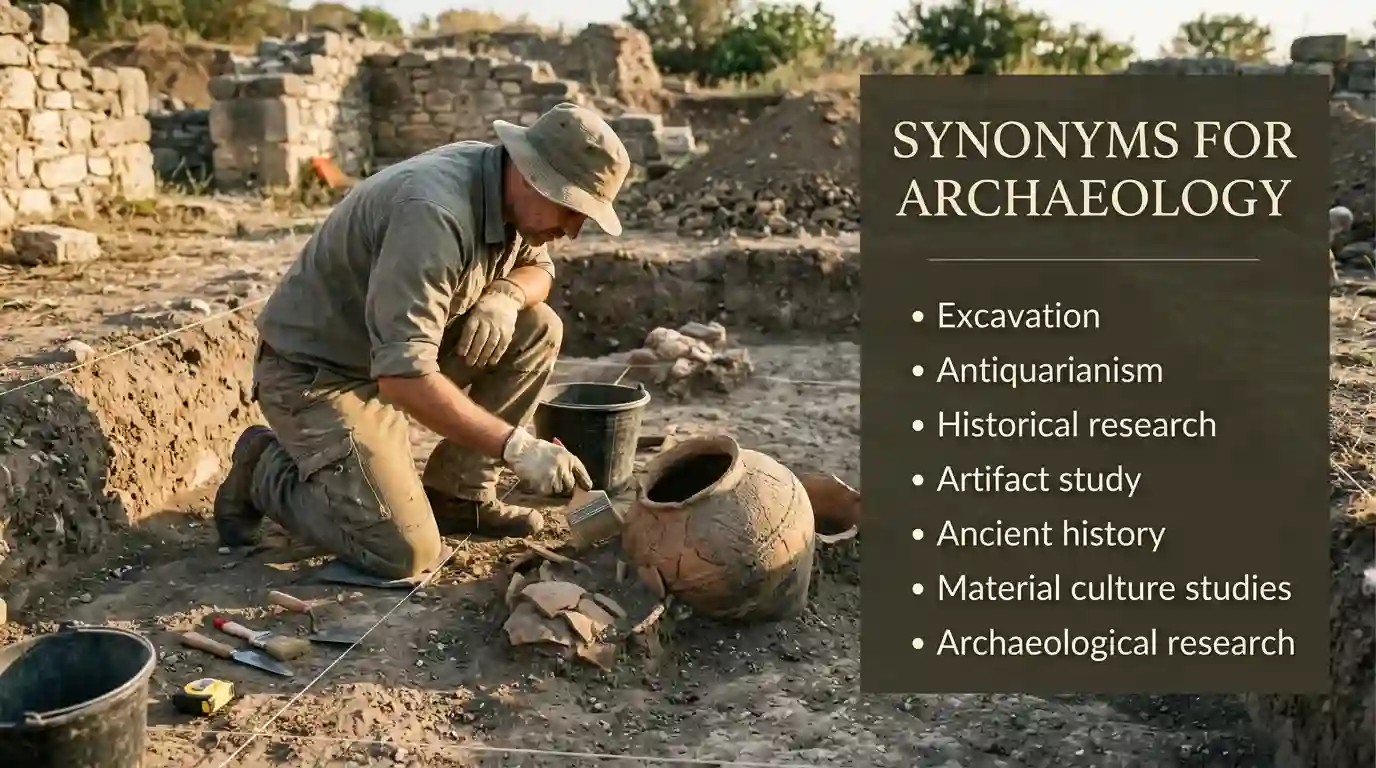
For example, an archaeologist may study pottery fragments from an ancient settlement. Those fragments can reveal what people ate from, how they made goods, and how they traded with neighboring communities.
Archaeology is a noun. It names a field of study rather than one particular activity. Excavation, artifact analysis, and site surveys are methods archaeologists may use within that field.
Native English speakers generally understand archaeology as an academic subject connected with ancient places, historical objects, and past civilizations. The word also appears in museums, documentaries, school lessons, travel writing, and discussions about cultural heritage.
Connotative Meaning
Connotation means the feelings, ideas, or associations a word carries beyond its basic dictionary definition.
- Positive tone: Archaeology may suggest discovery, curiosity, preservation, and a deeper understanding of human history.
- Negative tone: In some contexts, archaeological work may raise concerns about looting, destructive excavation, or the removal of cultural objects.
- Neutral tone: In academic writing, archaeology usually names a field of research without expressing a positive or negative judgment.
The word itself is neutral. Its emotional tone depends on the context and how people discuss archaeological discoveries or practices.
Etymology and Word History
The word archaeology comes from Greek roots. It combines arkhaios, meaning “ancient,” with -logia, meaning “study” or “discourse.” Its basic sense is therefore the study of ancient things.
The word entered English through forms influenced by Latin and French scholarship. Over time, its meaning became more closely connected with the systematic study of past human societies through material evidence.
Old English (450–1100)
The modern word archaeology was not part of everyday Old English vocabulary. People discussed the past using other terms, including words related to history, memory, ancient times, and inherited traditions.
The intellectual activity we now call archaeology existed in some early forms, but it was not yet established as the modern academic discipline.
Middle English (1100–1500)
During the Middle English period, French and Latin strongly influenced English vocabulary. Scholars and chroniclers studied old buildings, written records, religious sites, and historical objects, although their methods differed from those used by modern archaeologists.
The Greek-based term developed within learned European scholarship rather than ordinary conversation.
Modern English (1500–Present)
The word archaeology became established in scholarly English as interest in ancient civilizations, monuments, inscriptions, and artifacts expanded. During the nineteenth and twentieth centuries, archaeology developed into a more systematic discipline.
Today, archaeologists use scientific methods, dating techniques, field surveys, and laboratory analysis to investigate human history. The subject covers periods ranging from early human communities to more recent historical societies.
Pronunciation (US and UK IPA)
- US: /ˌɑːrkiˈɑːlədʒi/
- UK: /ˌɑːkiˈɒlədʒi/
Syllables: ar-chae-ol-o-gy
Affixation pattern:
- Root: archaeo-, from Greek arkhaios, meaning ancient.
- Prefix: No ordinary English prefix is added to the complete word.
- Suffix: -logy, meaning the study of a subject.
The ending -logy also appears in words such as biology, geology, and sociology. Recognizing this pattern can help learners understand other academic terms.
Synonyms for Archaeology: Accurate Alternatives and Related Terms
Archaeology has very few exact synonyms because it names a specific academic discipline. Words such as excavation describe activities within archaeology, while anthropology and history are separate fields that sometimes overlap with it.
The following terms are useful alternatives in particular contexts. Each entry explains whether the term can replace archaeology directly or whether it describes a closely related activity or field.
1. Archaeological Research
US: /ˌɑːrkiəˈlɑːdʒɪkəl rɪˈsɝːtʃ/ | UK: /ˌɑːkiəˈlɒdʒɪkəl rɪˈsɜːtʃ/
Meaning: Archaeological research is the investigation of past human societies through material evidence.
Examples:
- Archaeological research revealed new details about the settlement.
- The team published its archaeological research last spring.
2. Archaeological Study
US: /ˌɑːrkiəˈlɑːdʒɪkəl ˈstʌdi/ | UK: /ˌɑːkiəˈlɒdʒɪkəl ˈstʌdi/
Meaning: An archaeological study examines artifacts, sites, or other evidence to understand the human past.
Examples:
- The archaeological study focused on ancient farming.
- Her archaeological study examined tools from the Bronze Age.
3. Antiquarianism
US: /ˌæntɪˈkwɛriəˌnɪzəm/ | UK: /ˌæntɪˈkweəriəˌnɪzəm/
Meaning: Antiquarianism is the study or collection of old objects, monuments, and historical records, often with an emphasis on their age and preservation.
Examples:
- Antiquarianism encouraged interest in ancient monuments.
- The lecture explored the history of antiquarianism in Britain.
Usage note: Antiquarianism overlaps with archaeology historically, but modern archaeology usually uses more systematic methods to interpret evidence.
4. The Study of Antiquity
US: /ðə ˈstʌdi əv ænˈtɪkwəti/ | UK: /ðə ˈstʌdi əv ænˈtɪkwəti/
Meaning: The study of antiquity examines ancient societies, cultures, and historical periods.
Examples:
- The study of antiquity includes art, architecture, and material culture.
- She chose the study of antiquity as her university focus.
Usage note: This phrase is broader than archaeology. It can also include ancient literature, philosophy, and written history.
5. Material Culture Studies
US: /məˈtɪriəl ˈkʌltʃər ˈstʌdiz/ | UK: /məˈtɪəriəl ˈkʌltʃə ˈstʌdiz/
Meaning: Material culture studies examine the objects people make, use, and value to understand their societies.
Examples:
- Material culture studies helped explain how the community traded goods.
- The course connects material culture studies with archaeology.
6. Historical Archaeology
US: /hɪˈstɔːrɪkəl ˌɑːrkiˈɑːlədʒi/ | UK: /hɪˈstɒrɪkəl ˌɑːkiˈɒlədʒi/
Meaning: Historical archaeology uses physical evidence alongside written records to study past societies.
Examples:
- Historical archaeology revealed how people lived near the old port.
- The project combines historical archaeology with archival research.
Usage note: This is a branch of archaeology, not a full synonym for the entire discipline.
7. Prehistoric Archaeology
US: /ˌpriːhɪˈstɔːrɪkəl ˌɑːrkiˈɑːlədʒi/ | UK: /ˌpriːhɪˈstɒrɪkəl ˌɑːkiˈɒlədʒi/
Meaning: Prehistoric archaeology investigates human communities from periods before written records were available.
Examples:
- Prehistoric archaeology helps researchers study early farming.
- He specializes in prehistoric archaeology.
8. Classical Archaeology
US: /ˈklæsɪkəl ˌɑːrkiˈɑːlədʒi/ | UK: /ˈklæsɪkəl ˌɑːkiˈɒlədʒi/
Meaning: Classical archaeology studies the material remains of ancient Greek and Roman societies and related cultures.
Examples:
- Classical archaeology explores ancient temples and public buildings.
- Her classical archaeology course examined Roman sculpture.
9. Industrial Archaeology
US: /ɪnˈdʌstriəl ˌɑːrkiˈɑːlədʒi/ | UK: /ɪnˈdʌstriəl ˌɑːkiˈɒlədʒi/
Meaning: Industrial archaeology studies the physical remains of industry, technology, manufacturing, and related work.
Examples:
- Industrial archaeology documented the abandoned textile mill.
- The museum features research from industrial archaeology.
10. Underwater Archaeology
US: /ˌʌndərˈwɔːtər ˌɑːrkiˈɑːlədʒi/ | UK: /ˌʌndəˈwɔːtə ˌɑːkiˈɒlədʒi/
Meaning: Underwater archaeology investigates human remains, objects, and structures submerged in seas, lakes, rivers, or other bodies of water.
Examples:
- Underwater archaeology uncovered parts of an ancient ship.
- She hopes to study underwater archaeology.
11. Archaeological Excavation
US: /ˌɑːrkiəˈlɑːdʒɪkəl ˌɛkskəˈveɪʃən/ | UK: /ˌɑːkiəˈlɒdʒɪkəl ˌekskəˈveɪʃən/
Meaning: An archaeological excavation carefully removes soil or other material to investigate buried evidence.
Examples:
- The archaeological excavation uncovered pottery fragments.
- Archaeological excavation began after researchers surveyed the site.
Usage note: Excavation is a method used in archaeology, not a synonym for the whole discipline.
12. Excavation
US: /ˌɛkskəˈveɪʃən/ | UK: /ˌekskəˈveɪʃən/
Meaning: Excavation is the process of digging or removing material to uncover something buried.
Examples:
- The excavation revealed an old stone wall.
- Workers paused the excavation to document the findings.
Usage note: In archaeological contexts, this word refers to fieldwork. In other contexts, it may simply mean digging for construction or engineering.
13. Archaeological Fieldwork
US: /ˌɑːrkiəˈlɑːdʒɪkəl ˈfiːldwɝːk/ | UK: /ˌɑːkiəˈlɒdʒɪkəl ˈfiːldwɜːk/
Meaning: Archaeological fieldwork is research carried out at sites or landscapes to locate, record, and investigate evidence of past human activity.
Examples:
- Archaeological fieldwork continued throughout the summer.
- The students gained experience in archaeological fieldwork.
14. Artifact Analysis
US: /ˈɑːrtɪˌfækt əˈnæləsɪs/ | UK: /ˈɑːtɪfækt əˈnæləsɪs/
Meaning: Artifact analysis examines human-made objects to understand their age, use, manufacture, and cultural significance.
Examples:
- Artifact analysis revealed how the tools were made.
- The team used artifact analysis to compare pottery styles.
15. Archaeological Survey
US: /ˌɑːrkiəˈlɑːdʒɪkəl ˈsɝːveɪ/ | UK: /ˌɑːkiəˈlɒdʒɪkəl ˈsɜːveɪ/
Meaning: An archaeological survey examines an area to identify and record sites or evidence of past human activity.
Examples:
- The archaeological survey identified several ancient foundations.
- Researchers completed an archaeological survey before construction began.
16. Heritage Research
US: /ˈherɪtɪdʒ rɪˈsɝːtʃ/ | UK: /ˈherɪtɪdʒ rɪˈsɜːtʃ/
Meaning: Heritage research investigates places, objects, traditions, and other features valued for their cultural or historical importance.
Examples:
- Heritage research helped document the old settlement.
- The project combines heritage research with archaeological evidence.
Usage note: Heritage research is broader than archaeology and may include buildings, traditions, archives, and community history.
17. Historical Research
US: /hɪˈstɔːrɪkəl rɪˈsɝːtʃ/ | UK: /hɪˈstɒrɪkəl rɪˈsɜːtʃ/
Meaning: Historical research investigates past events and societies using evidence such as documents, objects, photographs, and records.
Examples:
- Historical research helped establish when the building was constructed.
- She combined historical research with an examination of old maps.
Usage note: Historical research can use archaeological evidence, but it often relies heavily on written sources.
18. Ancient History
US: /ˈeɪnʃənt ˈhɪstəri/ | UK: /ˈeɪnʃənt ˈhɪstəri/
Meaning: Ancient history studies past civilizations and events from early historical periods.
Examples:
- Ancient history explores the rise of early empires.
- He studies ancient history and Roman political life.
Usage note: Ancient history is a related field. Archaeology focuses on material evidence, while ancient history often examines written records as well.
19. Anthropology
US: /ˌænθrəˈpɑːlədʒi/ | UK: /ˌænθrəˈpɒlədʒi/
Meaning: Anthropology studies humans, their societies, cultures, and development.
Examples:
- Anthropology helped the researchers understand local burial customs.
- She studies anthropology with a focus on ancient communities.
Usage note: Archaeology is considered a subfield of anthropology in some academic traditions, especially in the United States. The two terms are not interchangeable in every context.
20. Cultural Anthropology
US: /ˈkʌltʃərəl ˌænθrəˈpɑːlədʒi/ | UK: /ˈkʌltʃərəl ˌænθrəˈpɒlədʒi/
Meaning: Cultural anthropology studies people’s beliefs, customs, social practices, and ways of life.
Examples:
- Cultural anthropology examined how the community marked important life events.
- Her research connects cultural anthropology with heritage studies.
21. Paleoanthropology
US: /ˌpeɪlioʊˌænθrəˈpɑːlədʒi/ | UK: /ˌpæliəʊˌænθrəˈpɒlədʒi/
Meaning: Paleoanthropology studies human evolution through fossil evidence and related scientific findings.
Examples:
- Paleoanthropology investigates the origins of early humans.
- The documentary introduced viewers to paleoanthropology.
Usage note: This field overlaps with archaeology but focuses particularly on human evolution and fossil evidence.
22. Epigraphy
US: /ɪˈpɪɡrəfi/ | UK: /ɪˈpɪɡrəfi/
Meaning: Epigraphy is the study and interpretation of inscriptions carved, engraved, or written on durable materials.
Examples:
- Epigraphy helped researchers interpret the inscription on the stone.
- The team used epigraphy to study an ancient dedication.
23. Numismatics
US: /ˌnuːmɪzˈmætɪks/ | UK: /ˌnjuːmɪzˈmætɪks/
Meaning: Numismatics is the study or collection of coins, currency, and related objects.
Examples:
- Numismatics revealed how trade changed across the region.
- Her numismatics research focused on ancient coins.
24. Geoarchaeology
US: /ˌdʒiːoʊˌɑːrkiˈɑːlədʒi/ | UK: /ˌdʒiːəʊˌɑːkiˈɒlədʒi/
Meaning: Geoarchaeology applies earth science methods to archaeological questions about landscapes, soils, and site formation.
Examples:
- Geoarchaeology helped explain why the settlement was buried.
- The team used geoarchaeology to study ancient river deposits.
25. Bioarchaeology
US: /ˌbaɪoʊˌɑːrkiˈɑːlədʒi/ | UK: /ˌbaɪəʊˌɑːkiˈɒlədʒi/
Meaning: Bioarchaeology studies biological remains from archaeological contexts to understand past human lives and populations.
Examples:
- Bioarchaeology offered clues about ancient diets.
- She used bioarchaeology to investigate health in an early settlement.
26. Archaeometry
US: /ˌɑːrkiˈɑːmətri/ | UK: /ˌɑːkiˈɒmətri/
Meaning: Archaeometry applies scientific and quantitative methods to archaeological materials and questions.
Examples:
- Archaeometry helped determine the composition of the pottery.
- The research team used archaeometry to study ancient metal objects.
27. Paleography
US: /ˌpeɪliˈɑːɡrəfi/ | UK: /ˌpæliˈɒɡrəfi/
Meaning: Paleography is the study of ancient or historical handwriting and writing systems.
Examples:
- Paleography helped scholars read the old manuscript.
- The researcher used paleography to date the handwritten record.
28. Historical Preservation
US: /hɪˈstɔːrɪkəl ˌprezərˈveɪʃən/ | UK: /hɪˈstɒrɪkəl ˌprezəˈveɪʃən/
Meaning: Historical preservation protects buildings, sites, objects, and other resources valued for their historical significance.
Examples:
- Historical preservation helped protect the old fort.
- The town invested in historical preservation after the survey.
Usage note: Preservation is a goal or practice that can involve archaeology, but it is not another name for the discipline.
29. Cultural Resource Management
US: /ˈkʌltʃərəl ˈriːsɔːrs ˈmænɪdʒmənt/ | UK: /ˈkʌltʃərəl ˈriːsɔːs ˈmænɪdʒmənt/
Meaning: Cultural resource management identifies and protects archaeological sites and other resources with cultural or historical value.
Examples:
- Cultural resource management guided the survey before construction.
- She works in cultural resource management.
30. Archaeological Investigation
US: /ˌɑːrkiəˈlɑːdʒɪkəl ɪnˌvɛstəˈɡeɪʃən/ | UK: /ˌɑːkiəˈlɒdʒɪkəl ɪnˌvestɪˈɡeɪʃən/
Meaning: An archaeological investigation examines a site or evidence to answer questions about past human activity.
Examples:
- The archaeological investigation uncovered traces of an early settlement.
- Officials approved an archaeological investigation before redevelopment.
31. Archaeological Interpretation
US: /ˌɑːrkiəˈlɑːdʒɪkəl ɪnˌtɝːprəˈteɪʃən/ | UK: /ˌɑːkiəˈlɒdʒɪkəl ɪnˌtɜːprɪˈteɪʃən/
Meaning: Archaeological interpretation explains what material evidence may reveal about past human behavior.
Examples:
- Archaeological interpretation connected the pottery with local trade.
- The report offered a new archaeological interpretation of the burial site.
32. Archaeological Documentation
US: /ˌɑːrkiəˈlɑːdʒɪkəl ˌdɑːkjəmenˈteɪʃən/ | UK: /ˌɑːkiəˈlɒdʒɪkəl ˌdɒkjumenˈteɪʃən/
Meaning: Archaeological documentation records site conditions, discoveries, measurements, and research findings.
Examples:
- Archaeological documentation preserved details of the excavation.
- The team completed archaeological documentation before removing the artifacts.
33. Archaeological Science
US: /ˌɑːrkiəˈlɑːdʒɪkəl ˈsaɪəns/ | UK: /ˌɑːkiəˈlɒdʒɪkəl ˈsaɪəns/
Meaning: Archaeological science uses scientific techniques to investigate archaeological materials and questions.
Examples:
- Archaeological science helped researchers date the remains.
- The laboratory specializes in archaeological science.
34. Environmental Archaeology
US: /ɪnˌvaɪrənˈmentəl ˌɑːrkiˈɑːlədʒi/ | UK: /ɪnˌvaɪərənˈmentəl ˌɑːkiˈɒlədʒi/
Meaning: Environmental archaeology studies how past people interacted with their environments through evidence such as seeds, animal bones, soils, and landscapes.
Examples:
- Environmental archaeology revealed changes in ancient farming.
- The project uses environmental archaeology to study settlement patterns.
35. Landscape Archaeology
US: /ˈlændskeɪp ˌɑːrkiˈɑːlədʒi/ | UK: /ˈlændskeɪp ˌɑːkiˈɒlədʒi/
Meaning: Landscape archaeology examines how people used, changed, and understood landscapes in the past.
Examples:
- Landscape archaeology identified routes between ancient settlements.
- The course introduced students to landscape archaeology.
36. Maritime Archaeology
US: /ˈmærɪˌtaɪm ˌɑːrkiˈɑːlədʒi/ | UK: /ˈmærɪtaɪm ˌɑːkiˈɒlədʒi/
Meaning: Maritime archaeology studies human relationships with seas and waterways through ships, ports, harbors, and other related remains.
Examples:
- Maritime archaeology examined the remains of an old harbor.
- The team specializes in maritime archaeology.
37. Archaeological Prospection
US: /ˌɑːrkiəˈlɑːdʒɪkəl prəˈspekʃən/ | UK: /ˌɑːkiəˈlɒdʒɪkəl prəˈspekʃən/
Meaning: Archaeological prospection uses surveys and other methods to locate possible archaeological remains before excavation.
Examples:
- Archaeological prospection revealed buried structures.
- The researchers used archaeological prospection to select a study area.
38. Archaeological Heritage Studies
US: /ˌɑːrkiəˈlɑːdʒɪkəl ˈherɪtɪdʒ ˈstʌdiz/ | UK: /ˌɑːkiəˈlɒdʒɪkəl ˈherɪtɪdʒ ˈstʌdiz/
Meaning: Archaeological heritage studies examine archaeological places and objects as parts of cultural heritage.
Examples:
- Archaeological heritage studies informed the site’s conservation plan.
- Her degree combines archaeological heritage studies with museum work.
39. The Study of Material Remains
US: /ðə ˈstʌdi əv məˈtɪriəl rɪˈmeɪnz/ | UK: /ðə ˈstʌdi əv məˈtɪəriəl rɪˈmeɪnz/
Meaning: The study of material remains examines physical evidence left by people in the past.
Examples:
- The study of material remains revealed how the settlement developed.
- Archaeology involves the study of material remains from human communities.
Usage note: This is a descriptive phrase that explains archaeology’s central focus. It is not a fixed technical synonym in every context.
40. The Study of Ancient Civilizations
US: /ðə ˈstʌdi əv ˈeɪnʃənt ˌsɪvələˈzeɪʃənz/ | UK: /ðə ˈstʌdi əv ˈeɪnʃənt ˌsɪvəlaɪˈzeɪʃənz/
Meaning: The study of ancient civilizations examines early societies, including their cultures, institutions, technology, and ways of life.
Examples:
- The study of ancient civilizations explores how early cities developed.
- Her course covers the study of ancient civilizations across several regions.
Usage note: This phrase is broader than archaeology because it can include written history, literature, religion, and political systems.
How to Choose the Right Alternative
Since most of these terms describe a branch, method, or related field, they cannot all replace archaeology in the same sentence. Use the term that matches the activity you want to describe.
- For the academic subject: Use archaeology or archaeological research.
- For digging at a site: Use excavation or archaeological excavation.
- For examining objects: Use artifact analysis or material culture studies.
- For studying ancient inscriptions: Use epigraphy.
- For studying coins: Use numismatics.
- For investigating human evolution: Use paleoanthropology.
- For protecting historic sites: Use historical preservation or cultural resource management.
- For studying written accounts of the past: Use historical research or ancient history.
This approach helps you expand your vocabulary without changing the meaning of your writing.
Synonyms for Archaeology by Tone and Context
Because archaeology names a field of study, it does not have ordinary positive, negative, or playful synonyms in the way an adjective might. However, related terms can create different impressions.
Neutral and Academic Terms
These expressions work well in essays, research papers, educational content, and museum descriptions.
- Archaeological research: Emphasizes investigation and the production of knowledge.
- Archaeological study: Refers to a focused examination of a site, object, or question.
- Historical archaeology: Highlights the use of physical evidence alongside historical records.
- Material culture studies: Focuses on what objects reveal about society.
- Archaeological investigation: Emphasizes the process of examining evidence.
Example: “The researchers conducted an archaeological investigation of the settlement.”
Technical and Specialized Terms
These terms are best when you know which specific method or research area you mean.
- Excavation: Removing soil or other material to uncover evidence.
- Epigraphy: Studying inscriptions.
- Numismatics: Studying coins and currency.
- Geoarchaeology: Applying earth science to archaeological questions.
- Bioarchaeology: Studying biological remains from archaeological contexts.
- Archaeometry: Applying scientific methods to archaeological materials.
- Paleography: Studying historical handwriting and scripts.
Example: “Epigraphy helped researchers interpret the inscription on the ancient monument.”
Historical and Cultural Terms
These phrases emphasize broader connections with human history and cultural heritage.
- Antiquarianism: Interest in old objects, monuments, and historical records.
- Ancient history: Study of ancient societies and events.
- Heritage research: Investigation of culturally significant places, objects, and traditions.
- Historical preservation: Protecting historic resources.
- Cultural resource management: Identifying and managing resources with cultural significance.
Example: “Heritage research helped the community understand the significance of the ancient site.”
Positive, Negative, and Informal Language
Archaeology itself is generally neutral. The surrounding words create the tone.
Positive: Discovery, preservation, cultural heritage, and historical insight can emphasize the value of archaeological work.
Negative: Looting, destruction, and unauthorized excavation describe harmful activities connected with archaeological sites. They are not synonyms for archaeology.
Playful or informal: Phrases such as digging up the past can make the subject more approachable in casual writing. However, they are descriptive expressions rather than exact technical alternatives.
Tone matters because the same field can be discussed as a scientific discipline, an exciting discovery process, or a cultural preservation responsibility.
Archaeology vs. Close Alternatives
| Term | Meaning difference | When to use it |
|---|---|---|
| Archaeology | Studies past human societies through material evidence | When referring to the discipline as a whole |
| Excavation | Removes soil or material to uncover buried evidence | When describing digging at a site |
| Antiquarianism | Focuses on studying or collecting old objects and records | When discussing historical interest in antiquities |
| Historical research | Investigates the past using documents and other evidence | When discussing written records or broader historical questions |
| Anthropology | Studies humans, societies, and cultures broadly | When the subject includes human behavior beyond archaeological evidence |
Consider this example: “Archaeology examines the settlement, excavation uncovers its buried remains, and historical research compares the findings with written records.”
Each term contributes a different meaning. Replacing all three with archaeology would make the sentence less precise.
How to Use Archaeology-Related Terms in Different Contexts
Daily Conversation
In casual conversation, people often use simple descriptions rather than technical vocabulary.
- “I’m interested in the study of ancient civilizations.”
- “The team is digging up an old settlement.”
- “Researchers found ancient tools during an excavation.”
The phrase digging up the past can work in an informal discussion, but archaeological excavation is more precise in an academic setting.
Writing and Blogging
Bloggers should choose terms that help readers understand the topic without making the writing unnecessarily technical.
For example, an article about an ancient city might introduce archaeology as the main subject. It could then explain how excavation uncovered buildings and how artifact analysis helped researchers interpret the objects.
Use archaeology when discussing the broad field. Introduce specialist terms only when they add useful information.
Professional and Academic Writing
Academic writing benefits from specific terminology. A research paper might discuss archaeological surveys, excavation methods, material analysis, and interpretations of evidence.
For example:
“The research combined archaeological survey methods with geoarchaeology to investigate the development of the settlement.”
This sentence identifies the methods rather than using archaeology as a vague replacement for every research activity.
Creative and Informal Writing
Creative writers can use vivid expressions such as uncovering the past, tracing ancient footsteps, or discovering buried history.
These phrases make the subject more engaging, especially in introductions, travel writing, and historical storytelling. However, they describe the experience or purpose of archaeology rather than serving as direct synonyms.
Common Mistakes and Native Usage
Mistake 1: Treating Every Related Term as a Synonym
Excavation, anthropology, and ancient history are related to archaeology, but each has a different meaning.
Incorrect: “Archaeology and excavation mean exactly the same thing.”
Better: “Excavation is one method archaeologists use to investigate the past.”
Mistake 2: Using “Antiquarianism” for All Modern Archaeology
Antiquarianism has historical connections with the study of old objects and monuments. However, modern archaeology generally follows systematic methods to document, analyze, and interpret evidence.
Use antiquarianism when discussing the history or practice of studying antiquities, not as a universal replacement for archaeology.
Mistake 3: Confusing Archaeology With History
History often relies on written documents, records, and accounts of past events. Archaeology focuses on material evidence, although it can also use written sources.
A study of an ancient letter may be historical research. An investigation of the building where someone wrote that letter may involve archaeology.
Mistake 4: Using Technical Terms Without Understanding Them
Words such as epigraphy, numismatics, and paleography have specific meanings. Using one simply to avoid repeating archaeology can make a sentence inaccurate.
Choose a specialized term only when the research actually involves that subject.
Mistake 5: Overusing “Ancient” as a Replacement
Archaeology does not only examine ancient civilizations. Archaeologists can also study more recent periods, including industrial sites and modern historical communities.
Use ancient when the period genuinely concerns antiquity. Otherwise, past societies or historical communities may be more accurate.
Register Notes
- Formal: Archaeological research, material culture studies, archaeological investigation.
- Technical: Geoarchaeology, epigraphy, numismatics, archaeometry.
- General: Archaeology, the study of the past, the study of ancient civilizations.
- Informal: Digging up the past, uncovering buried history.
For related vocabulary, you can also explore your site’s articles on historical terms and specialized academic vocabulary.
Real-Life Mini Scenarios
Workplace Scenario
A construction company plans to develop land near a historic settlement. Before work begins, researchers survey the area for archaeological evidence.
Best term: Archaeological survey.
It identifies the activity more precisely than simply saying the company arranged for archaeology.
Social Scenario
A friend visits a museum and asks how researchers learned about the people who once lived in an ancient town.
Natural explanation: “Archaeologists studied pottery, tools, and building remains to understand how people lived.”
Here, archaeology is the best broad term because the conversation concerns the discipline as a whole.
Media and Pop Culture Scenario
A documentary follows a team as it searches for an ancient shipwreck beneath the sea.
Best term: Maritime archaeology or underwater archaeology.
These expressions tell viewers which kind of archaeological research the team performs.
Writing and Storytelling Scenario
A writer describes a researcher who examines an old stone inscription to learn more about a forgotten ruler.
Best term: Epigraphy when focusing on the inscription itself.
The writer can still use archaeology to describe the broader investigation.
Practice Exercise: Choose the Best Term
Choose the term that best fits each situation. Focus on the specific activity rather than selecting a word simply because it relates to archaeology.
Question 1
Researchers carefully remove layers of soil to uncover a buried building. What are they doing?
A. Numismatics B. Excavation C. Paleography D. Historical preservation
Question 2
A specialist studies ancient inscriptions carved into stone. Which field is most relevant?
A. Epigraphy B. Geoarchaeology C. Cultural anthropology D. Numismatics
Question 3
A researcher examines old coins to learn about trade and political authority. Which subject fits best?
A. Paleography B. Excavation C. Numismatics D. Landscape archaeology
Question 4
A team investigates how soil and river deposits affected an ancient settlement. Which field is most suitable?
A. Antiquarianism B. Geoarchaeology C. Ancient history D. Epigraphy
Question 5
A student wants to study the material remains of past human societies as a broad academic subject. What should the student study?
A. Archaeology B. Excavation C. Historical preservation D. Paleography
Question 6
A researcher uses written records alongside physical remains to understand a past community. Which field may fit the work?
A. Numismatics only B. Historical archaeology C. Industrial archaeology only D. Paleography only
Question 7
A scientist studies human evolution through fossils and related evidence. Which field is most relevant?
A. Heritage research B. Antiquarianism C. Paleoanthropology D. Historical preservation
Question 8
A scholar investigates old handwriting to understand a historical manuscript. Which field should the scholar use?
A. Bioarchaeology B. Paleography C. Maritime archaeology D. Excavation
Question 9
A team surveys land to locate possible archaeological sites before digging. What is this activity called?
A. Archaeological prospection B. Numismatics C. Historical preservation D. Antiquarianism
Question 10
A town protects a historic fort from damage and plans its long-term care. Which term best describes this goal?
A. Artifact analysis B. Excavation C. Historical preservation D. Epigraphy
Question 11
A researcher studies pottery, household objects, and tools to understand everyday life in an ancient community. Which phrase is particularly relevant?
A. Material culture studies B. Paleography C. Numismatics D. Historical preservation
Question 12
A student researches ancient empires using written records, political accounts, and historical documents. Which broad field is most appropriate?
A. Geoarchaeology B. Ancient history C. Excavation D. Archaeological prospection
Reflection Task
Write two sentences about an archaeological discovery. In one sentence, use archaeology as the broad field of study. In the other, use a more specific term such as excavation, epigraphy, or artifact analysis.
Answer key: 1-B, 2-A, 3-C, 4-B, 5-A, 6-B, 7-C, 8-B, 9-A, 10-C, 11-A, 12-B.
Conclusion
Learning synonyms for archaeology helps you describe the study of the past more accurately. Related terms can explain particular methods, specialist fields, and the cultural importance of discoveries.
The best word depends on what you want to say. Excavation describes digging, epigraphy focuses on inscriptions, and historical research often examines written records.
A broader vocabulary can improve essays, blog posts, academic writing, and everyday communication. It also helps readers understand complex ideas without losing the meaning behind them.
Practice using these terms in your own sentences and explanations. As you learn more about synonyms for archaeology, choose precision over repetition and let each word clarify a different part of the past.

Evelyn Hartwell is an English vocabulary writer who focuses on clear, practical language for learners and everyday readers. Her writing explores synonyms, word meanings, pronunciation, tone, and natural usage. She believes that learning vocabulary should be simple, useful, and enjoyable. Her articles are designed to help students, bloggers, and English learners choose the right words with greater confidence.