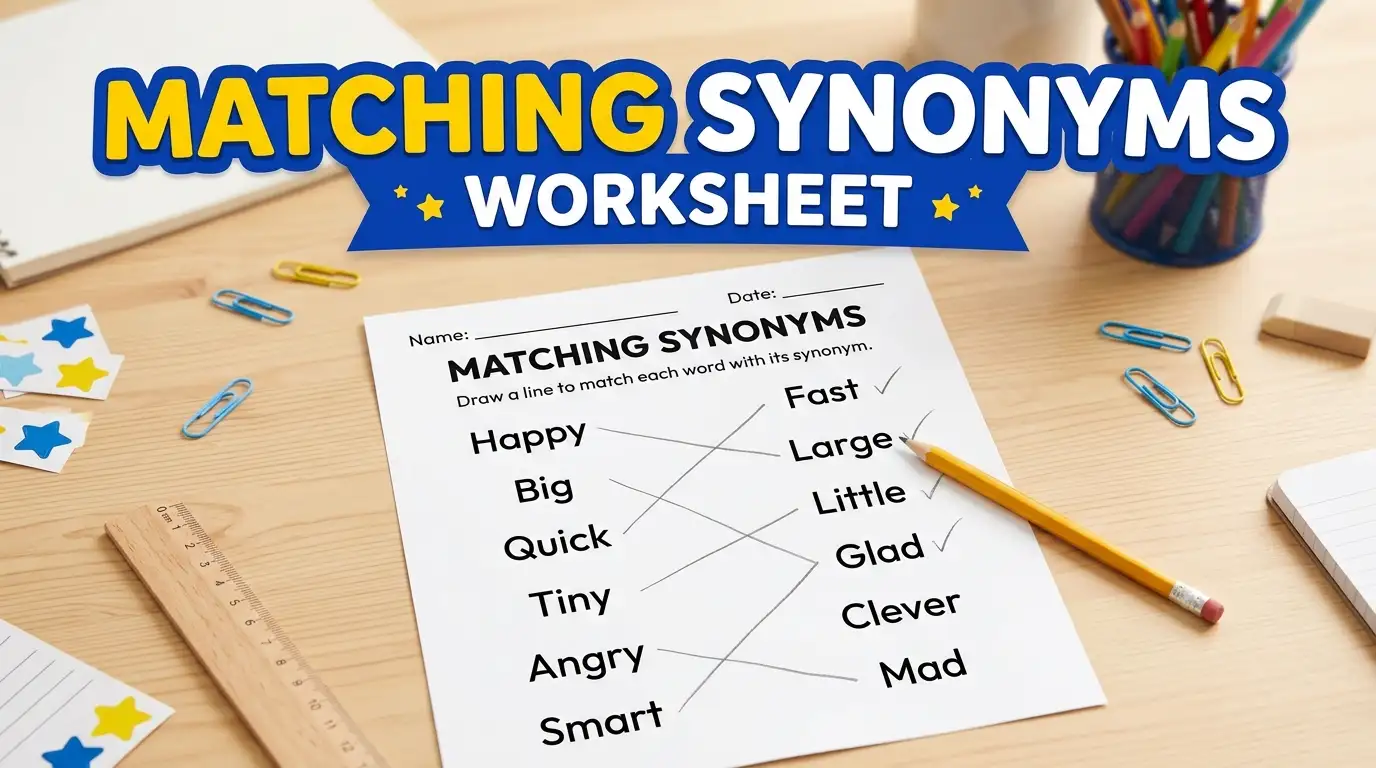
Matching synonyms worksheet activities can turn vocabulary practice into a simple challenge. Imagine seeing the word happy on one side and joyful on the other. Your task is to connect the words with similar meanings.
A matching synonyms worksheet helps learners recognize words that mean the same or nearly the same thing. It makes vocabulary practice more active than simply memorizing definitions or copying word lists.
These exercises are useful for students, teachers, bloggers, and anyone learning English. Matching words such as begin and start helps learners understand alternatives and use them naturally in speaking and writing.
Whether you are preparing a classroom activity or studying independently, a matching synonyms worksheet gives you a practical way to build vocabulary. You can work through the exercises, check your answers, and learn from each mistake.
What Does “Matching Synonyms Worksheet” Mean?
A matching synonyms worksheet is a vocabulary activity in which learners connect words with their synonyms. Synonyms are words that share the same or a similar meaning.
For example, a worksheet may place quick in one column and rapid in another. The learner matches the two words because both describe something that happens or moves fast.
These worksheets commonly appear in elementary classrooms, English lessons, ESL programs, spelling activities, and vocabulary assessments. They can include simple words, advanced vocabulary, descriptive adjectives, verbs, nouns, and phrases.
Part of Speech and Meaning
The phrase matching synonyms worksheet is a noun phrase.
- Matching: Connecting items that belong together.
- Synonyms: Words with the same or similar meanings.
- Worksheet: A page or document containing exercises or tasks.
Simple definition: A matching synonyms worksheet is a learning activity that asks you to pair words with other words that have similar meanings.
How Native English Speakers Understand the Phrase
English speakers generally understand this phrase as an educational resource for vocabulary practice. Teachers may use it during lessons, while parents may use it for homework or revision.
The phrase can refer to a printed page, a digital classroom activity, or a set of questions displayed on a screen. The main purpose remains the same: identify relationships between words.
Connotative Meaning of Matching Synonyms Worksheet
Connotation means the feelings or associations a word or phrase suggests beyond its basic definition.
- Positive tone: The phrase may suggest learning, progress, confidence, and educational achievement.
- Negative tone: It can feel repetitive or boring if learners complete too many similar exercises without variety.
- Neutral tone: In most educational contexts, it simply describes a vocabulary activity.
The phrase itself has no strong emotional meaning. Its tone depends on how the activity is presented and whether the learner finds it helpful.
Etymology and Word Origins
The phrase matching synonyms worksheet is made from three English words with different histories. It is a modern educational expression rather than a word inherited as one unit from Old English.
Matching
Matching comes from the verb match, which developed in English through Middle English and has connections to earlier European vocabulary. Today, it often means finding two items that correspond or belong together.
Synonyms
Synonym comes from Greek synōnymon, meaning a word having the same name or meaning. It entered English through Latin and French scholarly traditions.
Worksheet
Worksheet combines work and sheet. The term became widely associated with educational and practical activity sheets, especially as classroom teaching developed more structured written exercises.
Historical Development
Old English (450–1100): The modern phrase did not exist. English speakers used different words for work, written sheets, and the act of identifying similarities.
Middle English (1100–1500): English vocabulary expanded through contact with French and Latin. Words related to matching and synonymy developed through different linguistic pathways.
Modern English (1500–present): The words became established in their current forms. The phrase matching synonyms worksheet reflects modern classroom practices and the widespread use of structured vocabulary exercises.
Pronunciation
The full phrase does not have one universally fixed pronunciation pattern, but the individual words are commonly pronounced as follows:
- Matching — US: /ˈmætʃɪŋ/ | UK: /ˈmætʃɪŋ/
- Synonyms — US: /ˈsɪnənɪmz/ | UK: /ˈsɪnənɪmz/
- Worksheet — US: /ˈwɜːrkʃiːt/ | UK: /ˈwɜːkʃiːt/
Syllables
- Matching: match-ing
- Synonyms: syn-o-nyms
- Worksheet: work-sheet
Affixation Pattern
- Matching: match + -ing
- Synonyms: syn- (together or same) + -onym (name or word) + plural -s
- Worksheet: work + sheet
40 Useful Synonyms for Common Worksheet Vocabulary
The following words are useful for matching exercises because they have clear, commonly understood relationships. Some are close synonyms, while others overlap only in specific contexts.
Use the examples to understand how each word works in a sentence. Remember that synonyms are not always interchangeable in every situation.
1. Happy
US: /ˈhæpi/ | UK: /ˈhæpi/
Meaning: Feeling pleased, cheerful, or satisfied.
Examples:
- I am happy with my test results.
- She felt happy when her friend arrived.
2. Joyful
US: /ˈdʒɔɪfəl/ | UK: /ˈdʒɔɪfəl/
Meaning: Feeling or showing great happiness.
Examples:
- The children had a joyful afternoon.
- Her joyful smile brightened the room.
3. Sad
US: /sæd/ | UK: /sæd/
Meaning: Feeling unhappy or disappointed.
Examples:
- He felt sad about leaving his school.
- The ending of the story was sad.
4. Unhappy
US: /ʌnˈhæpi/ | UK: /ʌnˈhæpi/
Meaning: Not feeling happy or satisfied.
Examples:
- She was unhappy with the result.
- The customer seemed unhappy with the service.
5. Big
US: /bɪɡ/ | UK: /bɪɡ/
Meaning: Large in size, amount, or importance.
Examples:
- They live in a big house.
- We have a big decision to make.
6. Large
US: /lɑːrdʒ/ | UK: /lɑːdʒ/
Meaning: Greater than average in size or amount.
Examples:
- A large dog stood by the gate.
- The shop has a large collection of books.
7. Small
US: /smɔːl/ | UK: /smɔːl/
Meaning: Limited in size, amount, or extent.
Examples:
- She carried a small bag.
- We made a small change to the plan.
8. Tiny
US: /ˈtaɪni/ | UK: /ˈtaɪni/
Meaning: Extremely small.
Examples:
- A tiny bird sat on the branch.
- He found a tiny mark on the page.
9. Fast
US: /fæst/ | UK: /fɑːst/
Meaning: Moving or happening quickly.
Examples:
- That car is very fast.
- We need a fast solution.
10. Quick
US: /kwɪk/ | UK: /kwɪk/
Meaning: Happening or done in a short time.
Examples:
- Let’s take a quick break.
- She gave a quick answer.
11. Smart
US: /smɑːrt/ | UK: /smɑːt/
Meaning: Intelligent or able to make good decisions.
Examples:
- He is a smart student.
- That was a smart choice.
12. Clever
US: /ˈklevər/ | UK: /ˈklevə/
Meaning: Good at thinking, learning, or solving problems.
Examples:
- She found a clever way to save time.
- The clever child solved the puzzle.
13. Begin
US: /bɪˈɡɪn/ | UK: /bɪˈɡɪn/
Meaning: To start doing something.
Examples:
- We begin class at nine.
- The show will begin soon.
14. Start
US: /stɑːrt/ | UK: /stɑːt/
Meaning: To begin an activity or process.
Examples:
- Let’s start the lesson.
- He will start his new job tomorrow.
15. End
US: /end/ | UK: /end/
Meaning: To finish or bring something to a close.
Examples:
- The meeting will end at noon.
- Please end your answer with a full stop.
16. Finish
US: /ˈfɪnɪʃ/ | UK: /ˈfɪnɪʃ/
Meaning: To complete an activity or task.
Examples:
- I need to finish my homework.
- She finished reading the book.
17. Easy
US: /ˈiːzi/ | UK: /ˈiːzi/
Meaning: Not difficult to do or understand.
Examples:
- The first question was easy.
- This recipe is easy to follow.
18. Simple
US: /ˈsɪmpəl/ | UK: /ˈsɪmpəl/
Meaning: Not complicated or difficult.
Examples:
- The teacher gave a simple explanation.
- We need a simple plan.
19. Difficult
US: /ˈdɪfɪkəlt/ | UK: /ˈdɪfɪkəlt/
Meaning: Not easy to do, understand, or solve.
Examples:
- The final question was difficult.
- It is difficult to learn a language overnight.
20. Hard
US: /hɑːrd/ | UK: /hɑːd/
Meaning: Requiring effort or skill.
Examples:
- The puzzle was hard to solve.
- She worked hard for the exam.
21. Beautiful
US: /ˈbjuːtɪfəl/ | UK: /ˈbjuːtɪfəl/
Meaning: Pleasing to look at or experience.
Examples:
- We watched a beautiful sunset.
- She wore a beautiful dress.
22. Pretty
US: /ˈprɪti/ | UK: /ˈprɪti/
Meaning: Attractive or pleasing in appearance.
Examples:
- The garden looks pretty in spring.
- That is a pretty picture.
23. Angry
US: /ˈæŋɡri/ | UK: /ˈæŋɡri/
Meaning: Feeling strong displeasure or annoyance.
Examples:
- He was angry about the delay.
- She sounded angry during the call.
24. Mad
US: /mæd/ | UK: /mæd/
Meaning: Angry or annoyed, especially in informal American English.
Examples:
- I was mad when my bus left early.
- He gets mad when people interrupt him.
25. Quiet
US: /ˈkwaɪət/ | UK: /ˈkwaɪət/
Meaning: Making little or no noise.
Examples:
- The library is quiet in the morning.
- Please stay quiet during the test.
26. Silent
US: /ˈsaɪlənt/ | UK: /ˈsaɪlənt/
Meaning: Making no sound or not speaking.
Examples:
- The room fell silent.
- He remained silent during the discussion.
27. Rich
US: /rɪtʃ/ | UK: /rɪtʃ/
Meaning: Having a great deal of money or valuable resources.
Examples:
- The story describes a rich merchant.
- The region has rich natural resources.
28. Wealthy
US: /ˈwelθi/ | UK: /ˈwelθi/
Meaning: Having a large amount of money or assets.
Examples:
- The wealthy family donated to the school.
- She interviewed a wealthy business owner.
29. Friendly
US: /ˈfrendli/ | UK: /ˈfrendli/
Meaning: Kind, pleasant, and welcoming toward others.
Examples:
- Our new neighbor is friendly.
- The staff gave us a friendly welcome.
30. Kind
US: /kaɪnd/ | UK: /kaɪnd/
Meaning: Caring about other people and treating them well.
Examples:
- It was kind of you to help.
- She is kind to younger children.
31. Brave
US: /breɪv/ | UK: /breɪv/
Meaning: Willing to face danger or difficulty.
Examples:
- The brave firefighter rescued the family.
- It was brave of him to speak up.
32. Courageous
US: /kəˈreɪdʒəs/ | UK: /kəˈreɪdʒəs/
Meaning: Showing courage when facing fear or danger.
Examples:
- She made a courageous decision.
- The courageous student reported the problem.
33. Tired
US: /ˈtaɪərd/ | UK: /ˈtaɪəd/
Meaning: Needing rest or sleep.
Examples:
- I feel tired after work.
- The tired child fell asleep quickly.
34. Exhausted
US: /ɪɡˈzɔːstɪd/ | UK: /ɪɡˈzɔːstɪd/
Meaning: Extremely tired and lacking energy.
Examples:
- She was exhausted after the long trip.
- I felt exhausted after moving the furniture.
35. Cold
US: /koʊld/ | UK: /kəʊld/
Meaning: Having a low temperature.
Examples:
- The water is cold.
- We stayed inside on the cold morning.
36. Chilly
US: /ˈtʃɪli/ | UK: /ˈtʃɪli/
Meaning: Slightly cold in an uncomfortable way.
Examples:
- It feels chilly outside.
- She wore a jacket on the chilly evening.
37. Funny
US: /ˈfʌni/ | UK: /ˈfʌni/
Meaning: Causing laughter or amusement.
Examples:
- He told a funny story.
- That video is really funny.
38. Humorous
US: /ˈhjuːmərəs/ | UK: /ˈhjuːmərəs/
Meaning: Entertaining or amusing because it shows humor.
Examples:
- The writer added a humorous scene.
- Her humorous speech made everyone laugh.
39. Important
US: /ɪmˈpɔːrtənt/ | UK: /ɪmˈpɔːtənt/
Meaning: Having great value, influence, or significance.
Examples:
- Sleep is important for good health.
- We discussed an important issue.
40. Significant
US: /sɪɡˈnɪfɪkənt/ | UK: /sɪɡˈnɪfɪkənt/
Meaning: Important enough to deserve attention or consideration.
Examples:
- The study found a significant difference.
- This was a significant moment in her career.
Synonyms by Tone and Meaning
Not all synonym pairs express exactly the same idea. Some are interchangeable in many sentences, while others differ in intensity, formality, or context.
Positive Synonym Pairs
These pairs can describe desirable qualities or pleasant experiences.
- Happy — joyful
- Beautiful — pretty
- Friendly — kind
- Brave — courageous
- Funny — humorous
Why tone matters: Joyful often suggests stronger happiness than happy. Courageous can sound more formal than brave. Choosing the right word makes your writing more precise.
Neutral Synonym Pairs
These pairs are common in daily communication.
- Begin — start
- End — finish
- Big — large
- Small — tiny
- Fast — quick
Some pairs are close but not identical. Tiny usually suggests a smaller size than small, while finish often emphasizes completing a task.
Negative Synonym Pairs
These words describe unpleasant feelings or demanding situations.
- Sad — unhappy
- Difficult — hard
- Angry — mad
- Tired — exhausted
- Cold — chilly
Intensity matters here. Exhausted means much more than simply tired. Chilly usually means slightly cold, rather than extremely cold.
Formal and Informal Alternatives
Some words sound more formal than others.
- Informal: mad, big, funny, start
- More formal in many contexts: angry, large, humorous, begin
The formal alternative is not always better. Natural writing depends on the audience, purpose, and sentence.
Matching Synonyms Worksheet: Printable-Style Activities
The following activities are designed for classroom use, independent learning, or vocabulary revision. Each exercise uses a different matching method so learners can practice meaning rather than memorizing pairs.
Worksheet 1: Match the Words
Match each word in Column A with its closest synonym in Column B. Write the correct letter next to each number.
| Column A | Column B |
|---|---|
| 1. Happy | A. Quick |
| 2. Fast | B. Kind |
| 3. Begin | C. Joyful |
| 4. Friendly | D. Start |
| 5. Difficult | E. Hard |
| 6. Small | F. Tiny |
| 7. Angry | G. Mad |
| 8. Finish | H. End |
| 9. Beautiful | I. Pretty |
| 10. Smart | J. Clever |
Worksheet 2: Match the Words to Their Meanings
Choose the correct definition for each word.
| Word | Meaning options |
|---|---|
| 1. Exhausted | A. Having great value |
| 2. Courageous | B. Extremely tired |
| 3. Significant | C. Showing courage |
| 4. Silent | D. Making no sound |
| 5. Wealthy | E. Having a lot of money |
Worksheet 3: Match the Synonyms in Sentences
Read each sentence and choose the closest synonym for the bold word.
- The quick learner finished the task early.
A. Rapid B. Weak C. Late - The kind neighbor helped us carry the bags.
A. Caring B. Angry C. Silent - We need to begin the meeting now.
A. Finish B. Start C. Leave - The children were joyful after the celebration.
A. Happy B. Tired C. Afraid - The instructions were simple to follow.
A. Complicated B. Easy C. Unclear
Worksheet 4: Match the Opposites Carefully
This activity checks whether learners can distinguish synonyms from antonyms. Match each word with its opposite, not its synonym.
| Word | Opposite |
|---|---|
| 1. Happy | A. Difficult |
| 2. Big | B. Quiet |
| 3. Easy | C. Small |
| 4. Loud | D. Sad |
| 5. Begin | E. Finish |
Worksheet 5: Complete the Synonym Pairs
Write a suitable synonym for each word. More than one answer may be acceptable when the meaning fits.
- Happy — __________
- Fast — __________
- Difficult — __________
- Beautiful — __________
- Angry — __________
- Begin — __________
- Friendly — __________
- Important — __________
- Tired — __________
- Funny — __________
Matching Synonyms Worksheet vs. Other Vocabulary Activities
A matching worksheet is one way to learn synonyms, but it is not the only method.
| Activity | Main purpose | Best use |
|---|---|---|
| Matching synonyms | Connect words with similar meanings | Beginner and intermediate practice |
| Fill-in-the-blank | Select a word that fits a sentence | Understanding context |
| Multiple-choice quiz | Identify the best answer | Quick review and assessment |
| Sentence writing | Use new vocabulary independently | Developing writing skills |
| Word sorting | Group words by meaning or tone | Understanding word relationships |
Matching exercises are especially useful for introducing new vocabulary. However, learners should also use the words in sentences. This helps them remember meaning, grammar, and context.
How to Use a Matching Synonyms Worksheet in Different Settings
In the Classroom
Teachers can use matching activities as warm-up exercises, revision tasks, or short assessments. Begin with familiar words, then introduce more challenging vocabulary as students gain confidence.
For younger learners, use short words and simple instructions. For advanced students, include close alternatives that differ in tone or formality.
English Language Learners
ESL learners can use a worksheet to build vocabulary and recognize common alternatives. Reading the words aloud and creating example sentences can reinforce understanding.
Learners should also check whether two words fit the same grammatical role. For instance, begin and start are verbs, while beginning and start can function as nouns in certain contexts.
For Parents and Independent Learners
Parents can turn matching exercises into a short daily game. Learners can cover the answer column, match the words, and then explain why each pair belongs together.
Independent learners can keep a vocabulary notebook. Record the word, its synonym, a short definition, and one original sentence.
For Bloggers and Content Writers
Writers can use synonym exercises to reduce repetitive wording. However, synonyms should never be inserted merely to avoid repeating a word.
Choose an alternative that preserves the intended meaning. Large may replace big when describing a building, but big decision is often more natural than large decision.
Common Mistakes When Matching Synonyms
Assuming All Similar Words Are Interchangeable
Synonyms share meanings, but they may differ in intensity or usage. Tired and exhausted both describe a lack of energy, yet exhausted is much stronger.
Ignoring Context
The word hard can describe a difficult task or a solid surface. The word difficult usually describes something that requires effort or skill, not a physically solid object.
Matching Only by Appearance
Two words may look or sound similar without having the same meaning. Learners should compare definitions and example sentences rather than relying on spelling.
Choosing an Unnatural Alternative
A synonym can be technically related but still sound awkward in a sentence. For example, rapid meal is not a natural replacement for quick meal in most everyday contexts.
Confusing Synonyms and Antonyms
Synonyms have similar meanings. Antonyms have opposite meanings. A matching activity should make the task clear so learners know whether they are finding similar or contrasting words.
Overusing Advanced Vocabulary
Longer or more formal words are not always better. Clear, familiar vocabulary often communicates an idea more effectively than an uncommon alternative.
Real-Life Examples of Synonym Matching
At School
A student matches clever with smart during a vocabulary lesson. Later, the student writes, “She is a clever problem-solver.” The activity supports both recognition and practical use.
At Home
A parent asks a child to match tiny with very small. The child then describes a tiny insect in the garden. Connecting a definition with a real object makes the word easier to remember.
In the Workplace
An employee learns that begin and start often have similar meanings. The employee can write, “The presentation will begin at ten” or “The presentation will start at ten.”
In Blogging
A blogger notices that important appears repeatedly in an article. The writer considers significant where it fits the context, then checks that the sentence still sounds natural.
These situations show why matching activities are most effective when learners move beyond connecting words and start using them in meaningful sentences.
Practice Exercise: Test Your Synonym Knowledge
Choose the best answer for each situation. Think about meaning and context before selecting an option.
Part 1: Match Common Synonyms
1. Which word is closest in meaning to happy?
- A. Joyful
- B. Angry
- C. Tired
- D. Silent
2. Which word is closest in meaning to begin?
- A. Finish
- B. Start
- C. Stop
- D. Leave
3. Which word is closest in meaning to clever?
- A. Smart
- B. Sleepy
- C. Weak
- D. Cold
Part 2: Choose the Best Word for the Context
4. A student feels extremely tired after a long journey. Which word fits best?
- A. Exhausted
- B. Cheerful
- C. Tiny
- D. Friendly
5. A task is not difficult to understand. Which word best describes it?
- A. Simple
- B. Severe
- C. Angry
- D. Huge
6. A person treats others with care and warmth. Which word is most appropriate?
- A. Kind
- B. Hostile
- C. Unhappy
- D. Silent
Part 3: Understand Word Intensity
7. Which word usually describes something smaller than small?
- A. Tiny
- B. Large
- C. Huge
- D. Wide
8. Which word describes being more tired than simply tired?
- A. Exhausted
- B. Relaxed
- C. Curious
- D. Cheerful
9. Which word is often more formal than funny?
- A. Humorous
- B. Mad
- C. Tiny
- D. Quick
Part 4: Avoid Common Matching Mistakes
10. Which word is a synonym of angry in informal American English?
- A. Mad
- B. Happy
- C. Gentle
- D. Quiet
11. Which word is closest in meaning to wealthy?
- A. Rich
- B. Poor
- C. Tired
- D. Shy
12. Which word is closest in meaning to silent?
- A. Noisy
- B. Quiet
- C. Fast
- D. Brave
Part 5: Apply Your Vocabulary
13. Which word best replaces important in the sentence, “The research found an important difference”?
- A. Significant
- B. Tiny
- C. Funny
- D. Chilly
14. Which word is closest in meaning to courageous?
- A. Brave
- B. Afraid
- C. Unkind
- D. Uncertain
15. Which word is closest in meaning to beautiful in the sentence, “They saw a beautiful garden”?
- A. Pretty
- B. Difficult
- C. Silent
- D. Angry
Reflection Task
Choose five word pairs from this article. Write one original sentence for each pair, using a different synonym each time. Check that both words make sense in their sentence.
Answer Key
1-A, 2-B, 3-A, 4-A, 5-A, 6-A, 7-A, 8-A, 9-A, 10-A, 11-A, 12-B, 13-A, 14-A, 15-A.
Conclusion
A matching synonyms worksheet helps learners recognize words with similar meanings and build a stronger vocabulary. It offers a straightforward way to practice reading, word recognition, and language skills.
For students, these activities support classroom learning and revision. For bloggers and content writers, they encourage more varied language. Everyday English users make communication clearer and more natural.
Remember that synonyms can differ in tone, intensity, and context. Matching words is a useful first step, but using them in original sentences helps you understand their differences.
Choose a few word pairs, complete the exercises, and write your own examples. With regular practice, a matching synonyms worksheet can help you develop vocabulary you can confidently use in conversation, essays, and daily writing.

Evelyn Hartwell is an English vocabulary writer who focuses on clear, practical language for learners and everyday readers. Her writing explores synonyms, word meanings, pronunciation, tone, and natural usage. She believes that learning vocabulary should be simple, useful, and enjoyable. Her articles are designed to help students, bloggers, and English learners choose the right words with greater confidence.