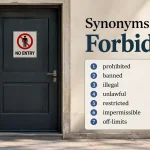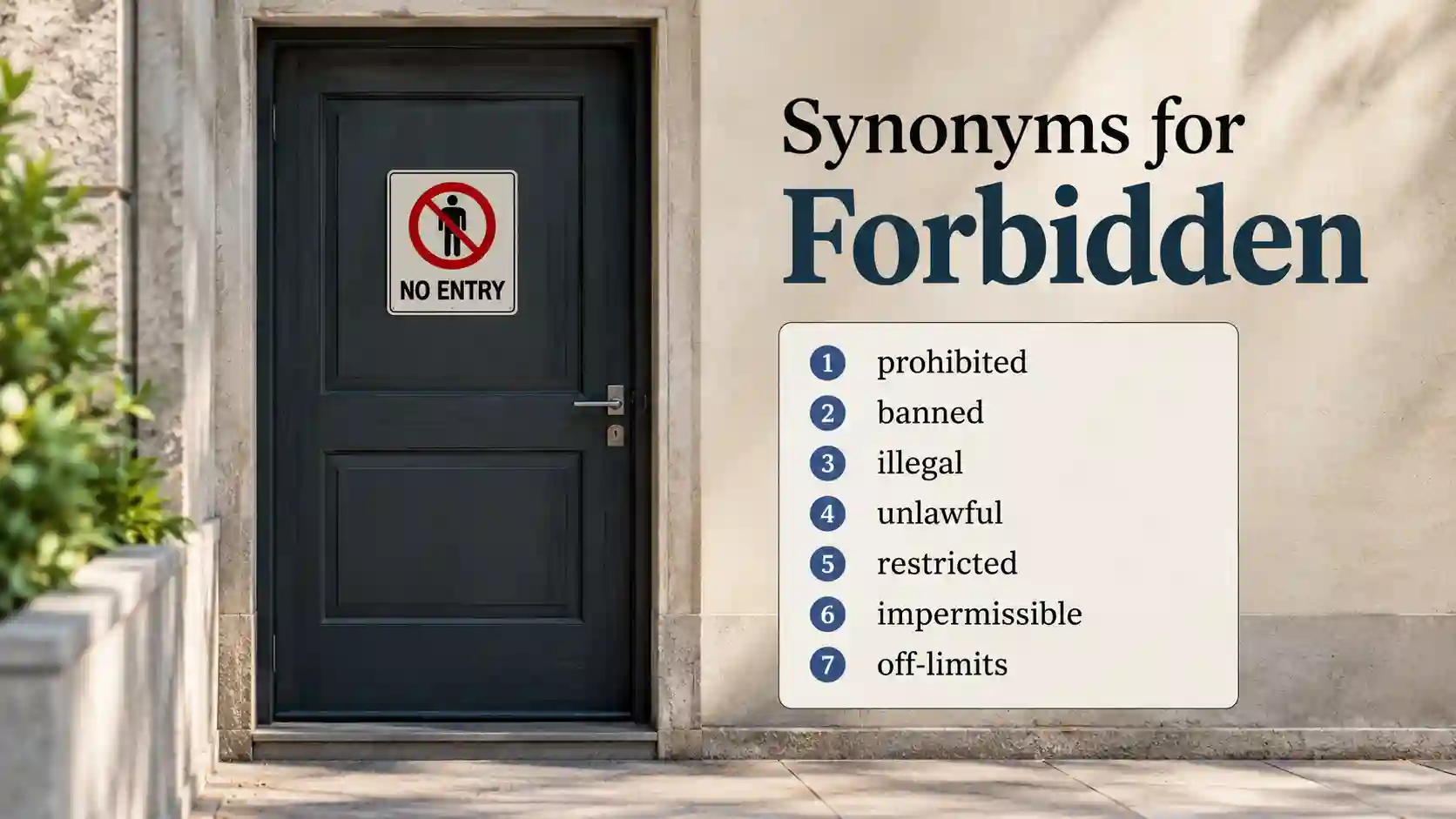
Synonyms for forbidden help you explain rules, restrictions, and things people cannot do or access. Imagine a sign on a locked door that says, “Entry Forbidden.” Would “Entry Prohibited” or “No Entry Allowed” mean the same thing?
The word forbidden appears in school rules, workplace policies, laws, social expectations, and everyday conversations. Learning its alternatives helps you express restrictions with greater accuracy and choose words that fit each situation.
For example, a school might ban mobile phones during an exam, while a government might prohibit certain activities by law. Both situations involve something forbidden, but the best word depends on the context.
Whether you are a student, blogger, content writer, or everyday English user, learning synonyms for forbidden can improve your vocabulary. You can make your writing clearer, avoid repetition, and communicate rules without changing their meaning.
What Does “Forbidden” Really Mean?
Forbidden means not allowed, not permitted, or officially or socially prohibited. It describes an action, object, place, or activity that someone must not do, use, enter, or access.
For example, if a sign says that swimming is forbidden, people must not swim in that area. A parent might also forbid a child from watching a particular film.
Forbidden is commonly used in legal documents, school policies, religious rules, safety notices, relationships, and stories. The exact meaning depends on who sets the restriction and why it exists.
Part of Speech
Forbidden usually functions as an adjective. It describes something that rules, laws, authorities, or social expectations do not allow.
It is also the past participle of the verb forbid.
- Adjective: “The students entered a forbidden area.”
- Verb form: “The school has forbidden students from using phones during the test.”
Connotative Meaning
Connotation (the emotional feeling or association a word carries beyond its basic dictionary meaning) helps explain how forbidden sounds to readers.
- Positive tone: In stories, forbidden things can seem exciting, mysterious, or tempting.
- Negative tone: The word can suggest strict control, danger, punishment, or unfair restrictions.
- Neutral tone: In rules and notices, it can simply communicate that something is not allowed.
Native English speakers understand forbidden as a strong word for something that people must not do or access. It can sound formal, serious, dramatic, or mysterious depending on the sentence.
Etymology of “Forbidden”
The word forbidden comes from the verb forbid, which has Germanic roots. It developed from Old English forbeodan, meaning to prohibit, command against, or warn against something.
The word combines an older form related to for- with beodan, meaning to command or announce. Over time, forbid came to mean officially or firmly preventing an action.
Old English (450–1100)
In Old English, forbeodan expressed the idea of commanding someone not to do something. It was used for restrictions, warnings, and commands against particular actions.
Middle English (1100–1500)
During Middle English, forms of forbid continued to develop as English spelling and pronunciation changed. The word remained associated with prohibitions and rules.
Modern English (1500–Present)
In Modern English, forbid means to prohibit or refuse permission. Forbidden is its past participle and adjective form, used in phrases such as forbidden area, forbidden fruit, and forbidden knowledge.
Pronunciation (US and UK – IPA)
- US: /fərˈbɪdən/
- UK: /fəˈbɪdən/
Syllables
for-bid-den — 3 syllables
Affixation Pattern of “Forbidden”
- Root: bid is part of the historical word forbid, but forbid is best treated as the modern base verb.
- Prefix: for- appears in the historical formation of forbid.
- Suffix: -en forms the past participle forbidden from forbid.
Note that forbidden is an irregular form. The standard past tense is forbade or, in some varieties and contexts, forbad. The standard past participle is forbidden.
Synonyms for Forbidden: 40 Accurate Alternatives
Not every alternative to forbidden works in every sentence. Some words describe legal bans, while others refer to limited access, strict rules, or social disapproval. Choose the word that matches the situation.
1. Prohibited
US: /proʊˈhɪbɪtɪd/ · UK: /prəˈhɪbɪtɪd/
Meaning: Prohibited means officially or legally not allowed.
Examples:
- Parking is prohibited outside the emergency entrance.
- The policy prohibits employees from sharing private records.
2. Banned
US: /bænd/ · UK: /bænd/
Meaning: Banned means officially stopped or not allowed, often by an authority.
Examples:
- The school banned energy drinks from its campus.
- The platform banned the account for repeated violations.
3. Impermissible
US: /ˌɪmpərˈmɪsəbəl/ · UK: /ˌɪmpəˈmɪsəbəl/
Meaning: Impermissible describes an action that rules or standards do not permit.
Examples:
- Sharing the exam answers was impermissible.
- The judge ruled that the evidence was impermissible.
4. Unlawful
US: /ʌnˈlɔːfəl/ · UK: /ʌnˈlɔːfəl/
Meaning: Unlawful means not permitted by law.
Examples:
- The court found the search unlawful.
- It is unlawful to falsify official documents.
5. Illegal
US: /ɪˈliːɡəl/ · UK: /ɪˈliːɡəl/
Meaning: Illegal describes something that breaks the law.
Examples:
- The company refused to take part in illegal activity.
- Selling counterfeit passports is illegal.
6. Disallowed
US: /ˌdɪsəˈlaʊd/ · UK: /ˌdɪsəˈlaʊd/
Meaning: Disallowed means that a rule or authority does not allow something.
Examples:
- The referee disallowed the goal.
- The website disallows usernames that contain offensive language.
7. Not Permitted
US: /nɑːt pərˈmɪtɪd/ · UK: /nɒt pəˈmɪtɪd/
Meaning: Not permitted means that someone does not have permission to do something.
Examples:
- Visitors are not permitted beyond this point.
- You are not permitted to record the meeting.
8. Unauthorized
US: /ʌnˈɔːθəraɪzd/ · UK: /ʌnˈɔːθəraɪzd/
Meaning: Unauthorized describes an action or access that lacks official approval.
Examples:
- The system detected an unauthorized login.
- Staff removed the unauthorized vehicle from the property.
9. Restricted
US: /rɪˈstrɪktɪd/ · UK: /rɪˈstrɪktɪd/
Meaning: Restricted means limited by rules, conditions, or permission requirements.
Examples:
- Only trained staff can enter the restricted area.
- The archive keeps restricted documents in a secure room.
Usage note: Restricted does not always mean completely forbidden. Some people may still have permission.
10. Proscribed
US: /proʊˈskraɪbd/ · UK: /prəʊˈskraɪbd/
Meaning: Proscribed means formally forbidden by a law, rule, or authority.
Examples:
- The organization listed the proscribed activities in its code.
- The government declared the group proscribed under national law.
11. Vetoed
US: /ˈviːtoʊd/ · UK: /ˈviːtəʊd/
Meaning: Vetoed means officially rejected or blocked by someone with the power to do so.
Examples:
- The committee vetoed the proposed change.
- The president vetoed the bill.
Usage note: Vetoed describes an act of rejection, not usually a permanent state of being forbidden.
12. Outlawed
US: /ˈaʊtˌlɔːd/ · UK: /ˈaʊtlɔːd/
Meaning: Outlawed means made illegal by law.
Examples:
- The country outlawed the sale of the dangerous substance.
- The new law outlawed the practice.
13. Barred
US: /bɑːrd/ · UK: /bɑːd/
Meaning: Barred means prevented from entering, joining, or doing something.
Examples:
- He was barred from entering the stadium.
- The rules barred applicants who missed the deadline.
14. Banned by Law
US: /bænd baɪ lɔː/ · UK: /bænd baɪ lɔː/
Meaning: Banned by law describes something that legislation does not allow.
Examples:
- The sale of that product is banned by law.
- The activity is banned by law in several countries.
15. Forbidden by Rules
US: /fərˈbɪdən baɪ ruːlz/ · UK: /fəˈbɪdən baɪ ruːlz/
Meaning: Forbidden by rules means that a set of established rules does not allow an action.
Examples:
- Bringing pets inside is forbidden by the building rules.
- The game forbids moves that violate its rules.
16. Impermissible Under the Rules
US: /ˌɪmpərˈmɪsəbəl ˈʌndər ðə ruːlz/ · UK: /ˌɪmpəˈmɪsəbəl ˈʌndə ðə ruːlz/
Meaning: Impermissible under the rules means that an action does not meet the requirements of a particular rule system.
Examples:
- Using outside notes was impermissible under the exam rules.
- The referee said the move was impermissible under the competition rules.
17. Unacceptable
US: /ˌʌnəkˈseptəbəl/ · UK: /ˌʌnəkˈseptəbəl/
Meaning: Unacceptable means not considered suitable or allowed under a standard.
Examples:
- Bullying is unacceptable in our classroom.
- The manager said the repeated delays were unacceptable.
Usage note: Unacceptable often expresses judgment or disapproval. It does not always mean a law or rule explicitly forbids something.
18. Inadmissible
US: /ˌɪnədˈmɪsəbəl/ · UK: /ˌɪnədˈmɪsəbəl/
Meaning: Inadmissible means not allowed to be accepted or considered, especially in legal or formal settings.
Examples:
- The court ruled the statement inadmissible.
- The application was inadmissible because it lacked required documents.
19. Illicit
US: /ɪˈlɪsɪt/ · UK: /ɪˈlɪsɪt/
Meaning: Illicit describes an activity that is illegal or forbidden by accepted rules.
Examples:
- Police investigated an illicit trade in stolen goods.
- The report exposed an illicit arrangement between the companies.
20. Contraband
US: /ˈkɑːntrəˌbænd/ · UK: /ˈkɒntrəbænd/
Meaning: Contraband refers to goods that people are not legally allowed to possess, import, or trade.
Examples:
- Officers found contraband inside the vehicle.
- The prison checks packages for contraband.
Usage note: Contraband is usually a noun, not a direct adjective synonym for forbidden. You can say “forbidden goods” or “contraband goods.”
21. Restricted by Law
US: /rɪˈstrɪktɪd baɪ lɔː/ · UK: /rɪˈstrɪktɪd baɪ lɔː/
Meaning: Restricted by law means that legislation limits how something can be used or accessed.
Examples:
- Access to the protected site is restricted by law.
- The law restricts the use of certain chemicals.
22. Prohibited by Policy
US: /proʊˈhɪbɪtɪd baɪ ˈpɑːləsi/ · UK: /prəˈhɪbɪtɪd baɪ ˈpɒləsi/
Meaning: Prohibited by policy means that an organization’s official policy does not allow something.
Examples:
- Sharing customer passwords is prohibited by company policy.
- Personal calls are prohibited by the policy during examinations.
23. Off-Limits
US: /ˌɔːf ˈlɪmɪts/ · UK: /ˌɒf ˈlɪmɪts/
Meaning: Off-limits means that a place, subject, or activity is not open for use or discussion.
Examples:
- The construction site is off-limits to visitors.
- For now, the topic of her resignation is off-limits.
24. Taboo
US: /təˈbuː/ · UK: /təˈbuː/
Meaning: Taboo describes something that a society or group strongly discourages or forbids.
Examples:
- In some communities, discussing money remains taboo.
- The novel explores a taboo relationship.
Usage note: A taboo may be socially or culturally forbidden without being illegal.
25. Proscribed by Tradition
US: /proʊˈskraɪbd baɪ trəˈdɪʃən/ · UK: /prəʊˈskraɪbd baɪ trəˈdɪʃən/
Meaning: Proscribed by tradition describes something that a traditional custom does not permit.
Examples:
- The ceremony excludes practices proscribed by tradition.
- The community avoids actions proscribed by its customs.
26. Impermissible by Custom
US: /ˌɪmpərˈmɪsəbəl baɪ ˈkʌstəm/ · UK: /ˌɪmpəˈmɪsəbəl baɪ ˈkʌstəm/
Meaning: Impermissible by custom means that established social practices do not accept an action.
Examples:
- The behavior was considered impermissible by local custom.
- Certain gestures are impermissible by custom during the ceremony.
27. Unapproved
US: /ˌʌnəˈpruːvd/ · UK: /ˌʌnəˈpruːvd/
Meaning: Unapproved means that an authorized person or body has not accepted or endorsed something.
Examples:
- The employee installed unapproved software.
- The school rejected the unapproved field trip plan.
Usage note: Something unapproved may not have received permission yet; it is not necessarily forbidden forever.
28. Unauthorized by Law
US: /ʌnˈɔːθəraɪzd baɪ lɔː/ · UK: /ʌnˈɔːθəraɪzd baɪ lɔː/
Meaning: Unauthorized by law describes an action that lacks the legal authority or permission it requires.
Examples:
- The company carried out an unauthorized transfer.
- The officer investigated the unauthorized use of public funds.
29. Impermissible in Court
US: /ˌɪmpərˈmɪsəbəl ɪn kɔːrt/ · UK: /ˌɪmpəˈmɪsəbəl ɪn kɔːt/
Meaning: Impermissible in court describes evidence or conduct that a court does not allow.
Examples:
- The lawyer argued that the evidence was impermissible in court.
- The judge explained why the testimony was impermissible.
30. Noncompliant
US: /ˌnɑːnkəmˈplaɪənt/ · UK: /ˌnɒnkəmˈplaɪənt/
Meaning: Noncompliant means failing to follow a required rule, standard, or instruction.
Examples:
- The inspector flagged the noncompliant equipment.
- The company replaced its noncompliant safety signs.
Usage note: Noncompliant describes failure to follow rules, rather than simply being forbidden.
31. Restricted-Access
US: /rɪˈstrɪktɪd ˈækses/ · UK: /rɪˈstrɪktɪd ˈækses/
Meaning: Restricted-access describes a place or resource that only approved people can use.
Examples:
- The files are stored in a restricted-access folder.
- Employees need special credentials to enter the restricted-access laboratory.
32. Prohibited from
US: /proʊˈhɪbɪtɪd frəm/ · UK: /prəˈhɪbɪtɪd frəm/
Meaning: Prohibited from means officially prevented from doing something.
Examples:
- Visitors are prohibited from feeding the animals.
- The player was prohibited from competing during the suspension.
33. Barred from
US: /bɑːrd frəm/ · UK: /bɑːd frəm/
Meaning: Barred from means prevented from taking part in an activity or entering a place.
Examples:
- She was barred from the competition after breaking the rules.
- Former members were barred from accessing the private forum.
34. Not Allowed
US: /nɑːt əˈlaʊd/ · UK: /nɒt əˈlaʊd/
Meaning: Not allowed means that a person does not have permission to do something.
Examples:
- You are not allowed to bring food into the laboratory.
- Children are not allowed to play near the road.
35. Unpermitted
US: /ˌʌnpərˈmɪtɪd/ · UK: /ˌʌnpəˈmɪtɪd/
Meaning: Unpermitted means not granted permission or authorization.
Examples:
- The workers removed an unpermitted structure.
- The inspector stopped the unpermitted activity.
Usage note: Unpermitted is less common than unauthorized, not permitted, or prohibited. Choose the more natural alternative in everyday writing.
36. Inadvisable
US: /ˌɪnədˈvaɪzəbəl/ · UK: /ˌɪnədˈvaɪzəbəl/
Meaning: Inadvisable means unwise or not recommended.
Examples:
- Hiking alone during the storm would be inadvisable.
- The doctor said that skipping rest was inadvisable.
Usage note: Inadvisable does not mean forbidden. It suggests that an action is a poor choice rather than prohibited.
37. Disapproved
US: /ˌdɪsəˈpruːvd/ · UK: /ˌdɪsəˈpruːvd/
Meaning: Disapproved means judged negatively or not accepted by someone.
Examples:
- Her parents disapproved of the decision.
- The board disapproved of the proposed changes.
Usage note: Disapproval expresses a negative opinion. It does not automatically prevent an action.
38. Condemned
US: /kənˈdemd/ · UK: /kənˈdemd/
Meaning: Condemned means strongly criticized or declared wrong.
Examples:
- Community leaders condemned the violent behavior.
- The editorial condemned the misuse of public money.
Usage note: Condemned is stronger than disapproved, but it does not always mean officially forbidden.
39. Restricted by Regulation
US: /rɪˈstrɪktɪd baɪ ˌreɡjəˈleɪʃən/ · UK: /rɪˈstrɪktɪd baɪ ˌreɡjʊˈleɪʃən/
Meaning: Restricted by regulation means that an official rule limits an action, activity, or resource.
Examples:
- The chemical’s use is restricted by regulation.
- The industry follows rules that restrict waste disposal.
40. Forbidden by Decree
US: /fərˈbɪdən baɪ dɪˈkriː/ · UK: /fəˈbɪdən baɪ dɪˈkriː/
Meaning: Forbidden by decree means officially prohibited through an order issued by an authority.
Examples:
- The ruler declared the practice forbidden by decree.
- Public gatherings were forbidden by decree during the emergency.
Usage note: This phrase is most suitable for historical, political, or formal contexts.
Synonyms for Forbidden by Tone
The best alternative depends on what you want to communicate. A legal restriction requires different wording from a social taboo or a personal warning.
Positive or Protective Tone
These words can communicate boundaries that protect people, property, or safety.
- Restricted: Useful when access is limited to authorized people.
- Off-limits: Works for places or topics that people should avoid.
- Not permitted: Communicates a clear boundary without sounding dramatic.
Example: “The laboratory is restricted to trained staff.”
Neutral or Official Tone
These alternatives work well in policies, notices, instructions, and formal writing.
- Prohibited: Suitable for official rules and regulations.
- Disallowed: Useful for rules in games, schools, and organizations.
- Not permitted: Clear and easy for most readers to understand.
- Unauthorized: Best when someone acts without required approval.
- Impermissible: Appropriate for formal, legal, or academic contexts.
Example: “Unauthorized access to the records is prohibited.”
Negative or Strong Tone
These words may suggest illegality, wrongdoing, or serious disapproval.
- Illegal: Clearly indicates a violation of law.
- Unlawful: Often appears in legal and formal writing.
- Illicit: Suggests prohibited or improper activity.
- Outlawed: Means the law has made something illegal.
- Condemned: Expresses strong criticism rather than a formal ban.
Example: “The investigation uncovered an illicit trade in stolen goods.”
Cultural or Social Tone
Use these words when a community, tradition, or social expectation discourages something.
- Taboo: Something strongly discouraged or prohibited by social or cultural norms.
- Disapproved: Something someone views negatively.
- Unacceptable: Behavior that fails to meet a social or professional standard.
Example: “In that community, discussing family disputes in public is considered taboo.”
Playful, Dramatic, or Informal Tone
Some phrases make a restriction sound mysterious, dramatic, or conversational.
- Off-limits: “My brother’s room is off-limits when he is away.”
- Forbidden: “She was fascinated by the forbidden room.”
- Not allowed: “Sorry, we’re not allowed to bring pets inside.”
Why tone matters: The word you choose shapes how readers understand a restriction. Prohibited sounds official, taboo suggests a social boundary, and off-limits often sounds conversational.
“Forbidden” vs. Close Alternatives
These words overlap in meaning, but they are not always interchangeable.
| Word | Main meaning | Tone | Best use |
|---|---|---|---|
| Forbidden | Not allowed or permitted | Strong, formal, or dramatic | General restrictions, stories, rules |
| Prohibited | Officially not allowed | Formal and authoritative | Policies, laws, signs |
| Banned | Officially stopped or excluded | Direct and firm | Products, activities, people, accounts |
| Restricted | Limited by conditions or permissions | Neutral and administrative | Access, information, areas |
| Taboo | Socially or culturally forbidden | Cultural or emotional | Customs, sensitive topics, social norms |
Forbidden vs. Prohibited
Forbidden is a broad word for something people must not do. It can describe legal rules, personal boundaries, and even fictional situations.
Prohibited usually sounds more formal. It is especially useful in official notices and policies.
- “The use of phones is forbidden during the exam.”
- “The use of phones is prohibited during the exam.”
Both sentences work. The second sounds more like a formal rule.
Forbidden vs. Banned
Forbidden describes something that is not allowed. Banned often suggests that an authority has actively stopped or excluded it.
- “The school forbids eating in the computer room.”
- “The school banned a student from the competition.”
The first describes a rule. The second describes an action taken against someone.
Forbidden vs. Restricted
Forbidden usually means that an action is not allowed. Restricted means that access or use is limited, often to certain people or situations.
- “Entry is forbidden to all visitors.”
- “Entry is restricted to authorized visitors.”
The first excludes everyone in the specified group. The second allows people who meet the conditions.
How “Forbidden” Changes by Context
Daily Conversation
In everyday speech, people often prefer simple expressions such as not allowed, banned, and off-limits. These phrases are easy to understand and sound natural.
For example, a parent might say, “You’re not allowed to use your phone during dinner.” Friends might say, “That subject is off-limits today.”
Choose a phrase that matches how serious the restriction is. You do not need a formal word when a simple explanation works.
Writing and Blogging
Writers use forbidden, prohibited, and banned to explain rules, restricted activities, and social boundaries. The choice depends on the topic and intended audience.
A blog about school policies might use prohibited. A lifestyle article about sensitive cultural topics might use taboo. A mystery story might use forbidden to create suspense.
Use alternatives naturally. Replacing every instance of forbidden with a different word can make an article confusing if the alternatives have different meanings.
Professional or Academic Writing
Formal writing often benefits from precise terms such as prohibited, impermissible, unauthorized, and unlawful.
For example, a workplace policy might state, “Unauthorized disclosure of confidential information is prohibited.” A legal analysis might use unlawful when discussing conduct that violates the law.
Do not use illegal unless the situation actually concerns a law. A company policy may forbid an action even when the action is not illegal.
Creative or Informal Writing
Stories often use forbidden to build mystery, conflict, or emotional tension. The phrase forbidden love, for instance, suggests a relationship that social rules, family expectations, or other obstacles prevent.
Off-limits is more conversational, while taboo can emphasize cultural expectations. Banned is direct and works well when a character faces an official restriction.
Pick words that match the atmosphere you want to create.
Common Mistakes Learners Make
1. Treating Every Restriction as Illegal
Not everything forbidden breaks the law. A school can forbid phone use in class, and a parent can forbid a child from staying out late. These restrictions do not automatically make the actions illegal.
Use illegal or unlawful only when a law is involved.
2. Using “Restricted” When Something Is Completely Banned
Restricted usually suggests limits or conditions. Forbidden suggests that the specified action is not allowed.
If nobody may enter a dangerous room, say “Entry is forbidden.” If only trained workers may enter, say “Access is restricted to trained workers.”
3. Confusing “Taboo” With “Prohibited”
Taboo usually refers to social or cultural expectations. Prohibited usually points to a rule or authority that explicitly disallows something.
A subject can be taboo in a community without being against the law.
4. Using “Unacceptable” as a Perfect Synonym
Unacceptable means unsuitable or not approved according to a standard. It does not always mean that an action is formally forbidden.
For example, a manager may find a suggestion unacceptable without having a rule against employees making it.
5. Overusing Formal Words in Conversation
Words such as impermissible and proscribed may sound stiff in everyday speech. Most people would naturally say “not allowed” or “against the rules.”
Save formal vocabulary for situations where it improves precision or suits the tone.
Register Notes: Formal vs. Informal
- Formal: prohibited, impermissible, proscribed, unlawful
- Neutral: forbidden, banned, restricted, unauthorized
- Informal: not allowed, off-limits
- Cultural or social: taboo, disapproved, unacceptable
In spoken English, simple phrases often sound more natural. In policies, academic writing, and legal discussions, more precise terms can be helpful.
Real-Life Examples Using “Forbidden”
Workplace
A company prohibits employees from sharing confidential files with unauthorized people. In casual conversation, a colleague might simply say, “We’re not allowed to share those files.”
Social Situations
A family may consider discussing a private dispute in public taboo. Another family might have a clear rule that forbids such conversations at gatherings.
Media and Pop Culture
A film may feature a forbidden relationship between two people whose families oppose their romance. The word adds tension because the characters face limits on their choices.
Writing and Storytelling
A fantasy writer might describe a forbidden library that no student may enter. If only senior scholars can access it, however, restricted library may be more accurate.
These examples show why context matters. The right alternative communicates not only that something is limited, but also why and how the restriction applies.
Practice Exercise: Synonyms for Forbidden
1. Choose the Best Synonym for Forbidden
Select the word that best replaces forbidden in each sentence.
1. Visitors are not allowed to enter the restricted area.
- A. Permitted
- B. Prohibited
- C. Welcome
- D. Encouraged
2. The school has banned mobile phones during examinations.
- A. Allowed
- B. Accepted
- C. Prohibited
- D. Recommended
3. Smoking is not permitted inside the hospital.
- A. Forbidden
- B. Optional
- C. Suitable
- D. Necessary
4. The law makes it illegal to sell these products to minors.
- A. Ordinary
- B. Acceptable
- C. Legal
- D. Unlawful
5. Employees cannot access confidential files without authorization.
- A. Available
- B. Restricted
- C. Public
- D. Recommended
2. Fill in the Blanks With Suitable Synonyms
Choose the most appropriate word from the following list: banned, prohibited, restricted, impermissible, off-limits.
- Parking is __________ in front of the emergency exit.
- The government __________ the sale of the dangerous product.
- Access to the laboratory is __________ to authorized staff.
- Sharing private customer information without consent is __________.
- The construction area is __________ to visitors.
3. Identify the Correct Word for Each Situation
Match each situation with the most suitable synonym for forbidden.
| Situation | Best synonym |
|---|---|
| A law does not allow an action | Illegal |
| A school officially disallows an activity | Prohibited |
| Only selected people may enter an area | Restricted |
| A place cannot be entered | Off-limits |
| An action is not acceptable under a rule | Impermissible |
4. Rewrite the Sentences Using Synonyms for Forbidden
Rewrite each sentence by replacing forbidden with a suitable synonym without changing its meaning.
- Photography is forbidden inside the museum.
- Visitors are forbidden from entering the private garden.
- The company forbids employees from sharing confidential information.
- Parking is forbidden in this area.
- The rules forbid students from using phones during the test.
5. Answer Key
Exercise 1: 1-B, 2-C, 3-A, 4-D, 5-B
The Exercise 2:
- prohibited
- banned
- restricted
- impermissible
- off-limits
Exercise 3: The matches are shown in the table.
Exercise 4 — Sample answers:
- Photography is prohibited inside the museum.
- Visitors are not permitted to enter the private garden.
- The company bans employees from sharing confidential information.
- Parking is prohibited in this area.
- The rules prohibit students from using phones during the test.
6. Apply What You Have Learned
Write three original sentences using different synonyms for forbidden. Use one in a school setting, one in a public place, and one in a workplace. This will help you understand how each word fits different situations.
Conclusion
Learning synonyms for forbidden helps you describe rules, boundaries, and restrictions with greater accuracy. Each alternative adds a slightly different meaning or tone.
Words such as prohibited, banned, restricted, and taboo help you distinguish legal rules from limited access and social expectations. Choosing carefully makes your message clearer.
A stronger vocabulary also improves essays, blogs, emails, and everyday conversations. You can avoid repetition while expressing your ideas in a way that suits your audience.
Keep practicing by using these words in your own sentences, writing exercises, and daily conversations. Explore the meaning of forbidden, then try using synonyms for forbidden in a few new examples of your own.

Evelyn Hartwell is an English vocabulary writer who focuses on clear, practical language for learners and everyday readers. Her writing explores synonyms, word meanings, pronunciation, tone, and natural usage. She believes that learning vocabulary should be simple, useful, and enjoyable. Her articles are designed to help students, bloggers, and English learners choose the right words with greater confidence.