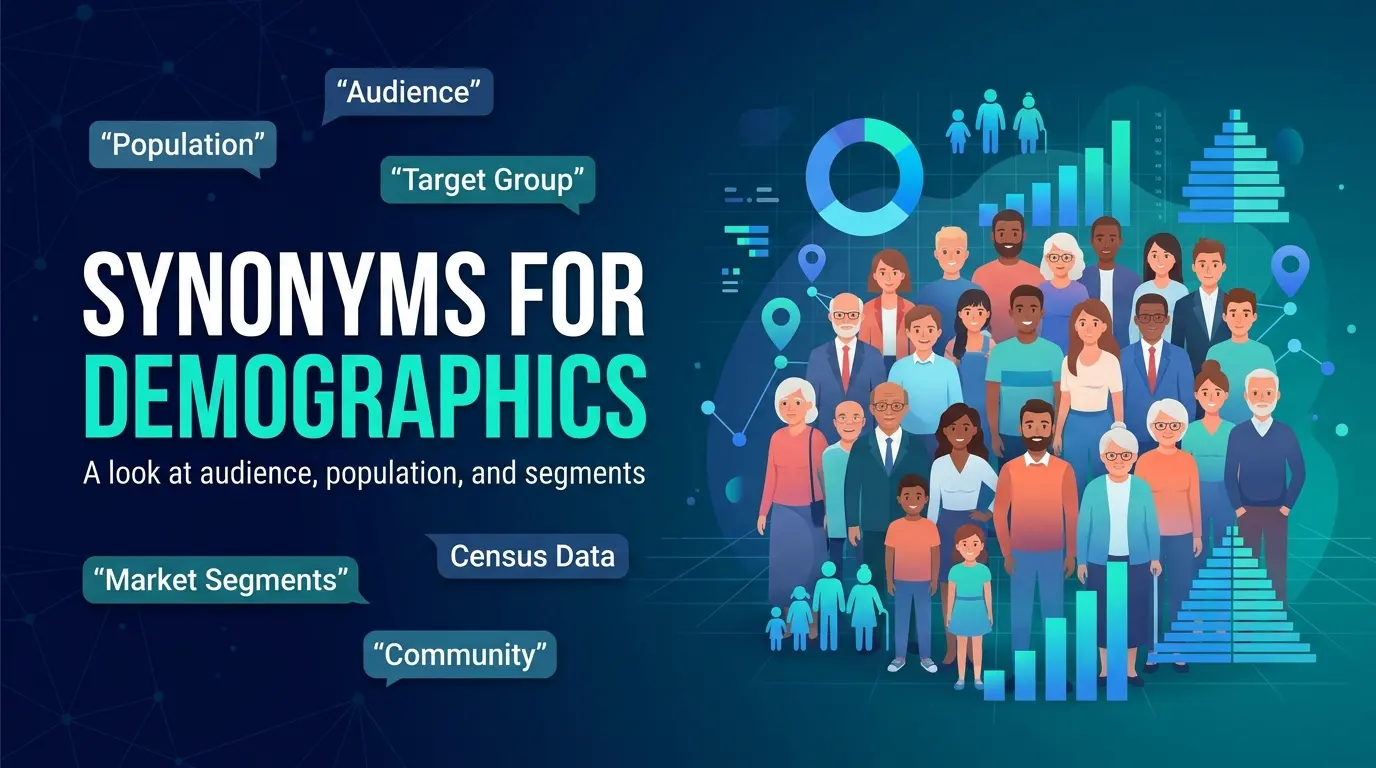
Synonyms for demographics become useful when you describe the people in a community, audience, or study. Imagine writing a report and using the same word in every sentence.
Learning alternatives helps you explain who people are more clearly. You might describe a population, a group, an audience, or a community, depending on your meaning.
The phrase synonyms for demographics is common in research, marketing, education, and blogging. The right alternative makes your writing easier to understand and more precise.
Students, bloggers, content writers, and everyday English users can all benefit. These words help you discuss age groups, household types, locations, and other population characteristics naturally.
What Does “Demographics” Really Mean?
Demographics refers to measurable characteristics of a population or group of people. These characteristics may include age, income, education, occupation, location, household size, and other relevant details.
For example, a school might study the demographics of its students to understand their ages, home languages, and communities. A business might examine customer demographics to learn who buys its products.
The word is usually a noun. It often refers to the characteristics of a group, but it can also refer informally to the group itself. In research, the exact meaning depends on the data being discussed.
Native English speakers commonly use demographics in surveys, news reports, academic studies, business discussions, public planning, and audience analysis. The word is generally neutral. It does not automatically express praise or criticism.
Connotative Meaning
(Connotation means the feelings or associations a word carries beyond its basic dictionary meaning.)
- Positive tone: The word may sound useful and constructive when discussing inclusion, community needs, or better public services.
- Negative tone: It can sound impersonal when people are reduced to statistics or treated only as marketing targets.
- Neutral tone: In research, census reports, and data analysis, it usually describes population characteristics without expressing an opinion.
Etymology of “Demographics”
The word demographics comes from demography, which combines Greek elements: dēmos, meaning “people” or “population,” and -graphy, meaning “writing,” “description,” or “recording.”
The term demography developed as a name for the systematic study of human populations. The plural noun demographics later became widely used for the characteristics and statistical profiles of those populations.
Historical Development
- Old English (450–1100): The modern word demographics was not part of Old English. People used other words and expressions to discuss people, communities, families, and populations.
- Middle English (1100–1500): English vocabulary continued to develop around people, settlements, and social groups. The modern technical term had not yet entered ordinary English.
- Modern English (1500–present): Demography emerged much later as a formal term for population study. Demographics became especially familiar through statistics, government planning, market research, and social science.
Pronunciation (US and UK – IPA)
- US: /ˌdɛməˈɡræfɪks/
- UK: /ˌdɛməˈɡræfɪks/
Pronunciation can vary slightly by speaker and accent.
Syllables
dem-o-graph-ics — four syllables.
Affixation Pattern
- Root element: demo- relates to people or a population.
- Prefix: No separate modern English prefix is normally added to demographics.
- Suffix: -graphy appears in the related noun demography. The ending -ics forms part of demographics and is associated with a field, system, or body of information.
40 Synonyms and Alternatives for Demographics
Not every alternative is interchangeable with demographics. Some refer to the people being studied, while others refer to their characteristics, statistical information, or a specific part of a population. Choose the word that matches your intended meaning.
Population Characteristics and Statistical Profiles
1. Population Characteristics
US: /ˌpɑːpjəˈleɪʃən ˌkærəktəˈrɪstɪks/
UK: /ˌpɒpjʊˈleɪʃən ˌkærəktəˈrɪstɪks/
Meaning: Population characteristics are the features used to describe a population, such as age, education, location, and income.
Examples:
- The report examines the population characteristics of the region.
- Researchers compared population characteristics across several towns.
2. Population Profile
US: /ˌpɑːpjəˈleɪʃən ˈproʊfaɪl/
UK: /ˌpɒpjʊˈleɪʃən ˈprəʊfaɪl/
Meaning: A population profile is a summary of the main characteristics of a group of people.
Examples:
- The council published a population profile for the city.
- Our project begins with a population profile of the area.
3. Population Data
US: /ˌpɑːpjəˈleɪʃən ˈdeɪtə/
UK: /ˌpɒpjʊˈleɪʃən ˈdeɪtə/
Meaning: Population data is information collected about the people living in a particular place or belonging to a group.
Examples:
- The team used population data to plan new clinics.
- Population data can reveal changes in a community.
4. Demographic Profile
US: /ˌdɛməˈɡræfɪk ˈproʊfaɪl/
UK: /ˌdɛməˈɡræfɪk ˈprəʊfaɪl/
Meaning: A demographic profile summarizes the key demographic features of a group or audience.
Examples:
- The survey created a demographic profile of local residents.
- The nonprofit updated its demographic profile last year.
5. Demographic Characteristics
US: /ˌdɛməˈɡræfɪk ˌkærəktəˈrɪstɪks/
UK: /ˌdɛməˈɡræfɪk ˌkærəktəˈrɪstɪks/
Meaning: Demographic characteristics are measurable details that help describe a population.
Examples:
- Age and household size are demographic characteristics.
- The study compared several demographic characteristics.
6. Population Statistics
US: /ˌpɑːpjəˈleɪʃən stəˈtɪstɪks/
UK: /ˌpɒpjʊˈleɪʃən stəˈtɪstɪks/
Meaning: Population statistics are numerical facts about a population and its characteristics.
Examples:
- Population statistics help officials plan transport.
- The article includes recent population statistics.
7. Demographic Data
US: /ˌdɛməˈɡræfɪk ˈdeɪtə/
UK: /ˌdɛməˈɡræfɪk ˈdeɪtə/
Meaning: Demographic data is information about characteristics such as age, income, education, and location.
Examples:
- The researchers collected demographic data from volunteers.
- Please protect the demographic data in this survey.
8. Demographic Information
US: /ˌdɛməˈɡræfɪk ˌɪnfərˈmeɪʃən/
UK: /ˌdɛməˈɡræfɪk ˌɪnfəˈmeɪʃən/
Meaning: Demographic information is descriptive information about the makeup of a population or group.
Examples:
- The form asks for basic demographic information.
- Demographic information helped explain the survey results.
9. Population Composition
US: /ˌpɑːpjəˈleɪʃən ˌkɑːmpəˈzɪʃən/
UK: /ˌpɒpjʊˈleɪʃən ˌkɒmpəˈzɪʃən/
Meaning: Population composition describes how a population is made up of different groups.
Examples:
- Migration changed the population composition of the town.
- The report discusses the population composition by age.
10. Population Structure
US: /ˌpɑːpjəˈleɪʃən ˈstrʌktʃər/
UK: /ˌpɒpjʊˈleɪʃən ˈstrʌktʃə/
Meaning: Population structure describes how people in a population are distributed across categories such as age and sex.
Examples:
- The country’s population structure is changing.
- The chart shows the population structure by age.
Groups of People and Audiences
11. Population
US: /ˌpɑːpjəˈleɪʃən/
UK: /ˌpɒpjʊˈleɪʃən/
Meaning: A population is the people who live in a place or belong to a defined group.
Examples:
- The population of the island is growing.
- The study focused on a rural population.
12. People
US: /ˈpiːpəl/
UK: /ˈpiːpəl/
Meaning: People are human beings considered individually or as a group.
Examples:
- The survey asked people about their daily habits.
- People in the area need better public transport.
13. Population Group
US: /ˌpɑːpjəˈleɪʃən ɡruːp/
UK: /ˌpɒpjʊˈleɪʃən ɡruːp/
Meaning: A population group is a set of people who share a relevant feature or characteristic.
Examples:
- The program supports a population group with limited access to care.
- The study compared two population groups.
14. Social Group
US: /ˈsoʊʃəl ɡruːp/
UK: /ˈsəʊʃəl ɡruːp/
Meaning: A social group consists of people connected by shared interests, identities, relationships, or circumstances.
Examples:
- The research explored how the social group used public spaces.
- Different social groups may have different needs.
15. Community
US: /kəˈmjuːnəti/
UK: /kəˈmjuːnəti/
Meaning: A community is a group of people connected by place, interests, identity, or shared experiences.
Examples:
- The community includes families from many backgrounds.
- Local leaders surveyed the community before planning the project.
16. Audience
US: /ˈɔːdiəns/
UK: /ˈɔːdiəns/
Meaning: An audience is the group of people a message, performance, product, or service is intended for.
Examples:
- The writer studied the audience before choosing a tone.
- Our audience includes new learners and experienced readers.
17. Target Audience
US: /ˈtɑːrɡɪt ˈɔːdiəns/
UK: /ˈtɑːɡɪt ˈɔːdiəns/
Meaning: A target audience is the particular group a message or product is designed to reach.
Examples:
- Parents are the target audience for this guide.
- The campaign was adjusted for its target audience.
18. Customer Base
US: /ˈkʌstəmər beɪs/
UK: /ˈkʌstəmə beɪs/
Meaning: A customer base is the group of people who buy from or use a business.
Examples:
- The shop has a loyal customer base.
- The company studied its customer base before expanding.
19. Consumer Group
US: /kənˈsuːmər ɡruːp/
UK: /kənˈsjuːmə ɡruːp/
Meaning: A consumer group is a category of people who share relevant purchasing habits or needs.
Examples:
- The survey compared two consumer groups.
- This consumer group prefers simple product information.
20. User Base
US: /ˈjuːzər beɪs/
UK: /ˈjuːzə beɪs/
Meaning: A user base is the group of people who use a service, platform, or product.
Examples:
- The app has a growing user base.
- The team studied its user base by age group.
Research, Census, and Survey Terms
21. Census Data
US: /ˈsɛnsəs ˈdeɪtə/
UK: /ˈsɛnsəs ˈdeɪtə/
Meaning: Census data is information collected through an official count or survey of a population.
Examples:
- The planner used census data to estimate housing needs.
- Census data showed that the town had grown.
22. Survey Data
US: /ˈsɜːrveɪ ˈdeɪtə/
UK: /ˈsɜːveɪ ˈdeɪtə/
Meaning: Survey data is information gathered by asking people questions.
Examples:
- The survey data included age and education levels.
- We checked the survey data before writing the report.
23. Statistical Profile
US: /stəˈtɪstɪkəl ˈproʊfaɪl/
UK: /stəˈtɪstɪkəl ˈprəʊfaɪl/
Meaning: A statistical profile is a summary of numerical information about a person, group, or population.
Examples:
- The report provides a statistical profile of the district.
- Researchers built a statistical profile from several surveys.
24. Population Breakdown
US: /ˌpɑːpjəˈleɪʃən ˈbreɪkdaʊn/
UK: /ˌpɒpjʊˈleɪʃən ˈbreɪkdaʊn/
Meaning: A population breakdown shows how a population is divided into categories.
Examples:
- The table gives a population breakdown by age.
- We need a population breakdown for each region.
25. Group Composition
US: /ɡruːp ˌkɑːmpəˈzɪʃən/
UK: /ɡruːp ˌkɒmpəˈzɪʃən/
Meaning: Group composition describes the characteristics and proportions of the people in a group.
Examples:
- The teacher reviewed the group composition before the activity.
- Group composition influenced the study’s results.
26. Sample Characteristics
US: /ˈsæmpəl ˌkærəktəˈrɪstɪks/
UK: /ˈsɑːmpəl ˌkærəktəˈrɪstɪks/
Meaning: Sample characteristics are the features of the people selected for a research study.
Examples:
- The paper explains the sample characteristics clearly.
- Age was one of the sample characteristics recorded.
27. Respondent Profile
US: /rɪˈspɑːndənt ˈproʊfaɪl/
UK: /rɪˈspɒndənt ˈprəʊfaɪl/
Meaning: A respondent profile summarizes details about the people who answered a survey.
Examples:
- The report includes a respondent profile.
- The respondent profile shows a broad range of ages.
28. Population Trends
US: /ˌpɑːpjəˈleɪʃən trɛndz/
UK: /ˌpɒpjʊˈleɪʃən trendz/
Meaning: Population trends are patterns of change in a population over time.
Examples:
- Population trends can affect school planning.
- The report tracks population trends over ten years.
29. Social Statistics
US: /ˈsoʊʃəl stəˈtɪstɪks/
UK: /ˈsəʊʃəl stəˈtɪstɪks/
Meaning: Social statistics are numerical facts about social conditions and groups of people.
Examples:
- The researcher used social statistics to study inequality.
- Social statistics can guide public policy.
30. Population Metrics
US: /ˌpɑːpjəˈleɪʃən ˈmɛtrɪks/
UK: /ˌpɒpjʊˈleɪʃən ˈmetrɪks/
Meaning: Population metrics are measurable indicators used to describe or compare populations.
Examples:
- The agency tracks population metrics each year.
- Age distribution is one of the population metrics in the report.
Specific Characteristics and Related Concepts
31. Age Distribution
US: /eɪdʒ ˌdɪstrɪˈbjuːʃən/
UK: /eɪdʒ ˌdɪstrɪˈbjuːʃən/
Meaning: Age distribution shows how people in a group are spread across age ranges.
Examples:
- The town’s age distribution has changed.
- The chart compares age distribution across regions.
32. Income Distribution
US: /ˈɪnkʌm ˌdɪstrɪˈbjuːʃən/
UK: /ˈɪnkʌm ˌdɪstrɪˈbjuːʃən/
Meaning: Income distribution describes how income is spread among people or households.
Examples:
- The report examines income distribution in the city.
- Income distribution can reveal economic differences.
33. Household Composition
US: /ˈhaʊsˌhoʊld ˌkɑːmpəˈzɪʃən/
UK: /ˈhaʊsˌhəʊld ˌkɒmpəˈzɪʃən/
Meaning: Household composition describes who lives together in a home and how the household is arranged.
Examples:
- Household composition affects housing demand.
- The survey recorded household composition and size.
34. Educational Attainment
US: /ˌɛdʒəˈkeɪʃənəl əˈteɪnmənt/
UK: /ˌedʒʊˈkeɪʃənəl əˈteɪnmənt/
Meaning: Educational attainment is the highest level of education a person or group has completed.
Examples:
- The study compared educational attainment by region.
- Educational attainment was included in the report.
35. Employment Profile
US: /ɪmˈplɔɪmənt ˈproʊfaɪl/
UK: /ɪmˈplɔɪmənt ˈprəʊfaɪl/
Meaning: An employment profile summarizes the work status, occupations, or employment patterns of a group.
Examples:
- The city published an employment profile of local residents.
- The employment profile helped explain changes in commuting.
36. Geographic Distribution
US: /ˌdʒiːəˈɡræfɪk ˌdɪstrɪˈbjuːʃən/
UK: /ˌdʒiːəˈɡræfɪk ˌdɪstrɪˈbjuːʃən/
Meaning: Geographic distribution describes where people or groups are located across an area.
Examples:
- The map shows the geographic distribution of residents.
- Geographic distribution can affect access to healthcare.
37. Socioeconomic Profile
US: /ˌsoʊsioʊˌɛkəˈnɑːmɪk ˈproʊfaɪl/
UK: /ˌsəʊsiəʊˌiːkəˈnɒmɪk ˈprəʊfaɪl/
Meaning: A socioeconomic profile describes social and economic features such as income, education, and occupation.
Examples:
- The study compared the socioeconomic profiles of two districts.
- The socioeconomic profile helped explain differences in access.
38. Social Makeup
US: /ˈsoʊʃəl ˈmeɪkʌp/
UK: /ˈsəʊʃəl ˈmeɪkʌp/
Meaning: Social makeup is the combination of social groups and characteristics within a community.
Examples:
- Migration has changed the social makeup of the neighborhood.
- The article describes the social makeup of the city.
39. Demographic Mix
US: /ˌdɛməˈɡræfɪk mɪks/
UK: /ˌdɛməˈɡræfɪk mɪks/
Meaning: Demographic mix refers to the range and proportions of demographic groups within a population or audience.
Examples:
- The school has a diverse demographic mix.
- The event attracted a different demographic mix this year.
40. Population Makeup
US: /ˌpɑːpjəˈleɪʃən ˈmeɪkʌp/
UK: /ˌpɒpjʊˈleɪʃən ˈmeɪkʌp/
Meaning: Population makeup describes the different types of people who form a population.
Examples:
- The census helped explain the population makeup of the region.
- The population makeup varies between urban and rural areas.
Synonyms for Demographics by Tone
The best alternative depends on your audience and purpose. Some terms sound technical, while others are more conversational. Also, many options below are related expressions rather than exact synonyms.
Neutral
- Population characteristics: Clear and broadly useful for describing a group.
- Demographic data: Suitable for reports and research.
- Population profile: Useful when summarizing a group.
- Population composition: Appropriate for explaining how a population is made up.
- Demographic information: General and easy to understand.
Professional or Academic
- Population statistics: Emphasizes numerical information.
- Sample characteristics: Best for describing study participants.
- Respondent profile: Useful for survey reports.
- Socioeconomic profile: Highlights social and economic factors.
- Population metrics: Focuses on measurable indicators.
Positive or Community-Focused
These expressions are not inherently positive, but they can support constructive discussions about people’s needs and experiences.
- Community profile: Useful for planning local services.
- Audience profile: Helps writers understand readers.
- Population needs: Appropriate when discussing services and support.
- Community composition: Useful in inclusive community planning.
Informal or Conversational
- Group makeup: An accessible way to describe who is in a group.
- Social makeup: Useful in everyday discussions about communities.
- Audience mix: Suitable for events, media, and content.
- Customer base: Natural in business conversations, when referring to customers.
Why Tone Matters
Use technical terms when precision matters. Choose simpler phrases when writing for a general audience. Avoid language that makes people sound like numbers alone, especially in sensitive social topics.
“Demographics” vs. Close Alternatives
| Term | Main meaning | Best use |
|---|---|---|
| Demographics | Characteristics of a population or group | General discussion, research, audience analysis |
| Population | The people in a defined place or group | Describing who is included |
| Demographic data | Recorded information about population characteristics | Surveys, reports, data analysis |
| Audience profile | Summary of the people a message is meant to reach | Blogging, publishing, media planning |
| Population characteristics | Specific features of a population | Academic and public reports |
Example: “The demographics of the town are changing” refers broadly to the town’s population characteristics. “The population is growing” focuses on the number of people. “The demographic data shows an increase in older residents” refers to collected information.
How “Demographics” Changes by Context
Daily Conversation
In everyday speech, people may say “the age groups in the area,” “the people who live here,” or “the makeup of the community.” These expressions often sound more natural than technical language.
For example, instead of saying, “We need to understand the demographics of the club,” you could say, “We need to know who joins the club.”
Writing and Blogging
Bloggers often use audience profile, reader demographics, or audience characteristics. These phrases help explain who the content serves without repeating the same word.
For example, a blogger might write, “Our reader profile includes students, parents, and professionals.” This is clearer when the article is about readers rather than an entire population.
Professional and Academic Writing
Research reports often need precise terms. Use demographic data, sample characteristics, or population composition when those expressions accurately describe the information.
Do not replace a specific research term with a broad synonym just to avoid repetition. Precision is more important than variety.
Creative and Informal Use
In a story or casual article, phrases such as the town’s social makeup or the mix of people at the event can feel more vivid and approachable.
These expressions work best when the context is clear. They are not always suitable substitutes in formal statistical writing.
Common Mistakes Learners Make
1. Treating Every Alternative as an Exact Synonym
Population refers to the people in a group. Demographics usually refers to their characteristics or, informally, the group described by those characteristics. They overlap, but they are not identical.
2. Confusing Demographics With Psychographics
Demographics often includes age, location, education, income, and household details. Psychographics focuses more on interests, values, attitudes, lifestyle, and motivations.
For example, a person’s age is a demographic characteristic. A preference for minimalist design is more likely a psychographic detail.
3. Using “Audience” for Every Population
An audience is a group being reached by a message, performance, or product. It is not a suitable replacement when discussing every resident of a country or town.
4. Using “Statistics” When You Mean People
Statistics are numerical facts or methods. They are not the people themselves. Write “the population statistics show…” rather than “the statistics attended the meeting.”
5. Repeating Technical Terms Too Often
Repeated use of demographics can make a paragraph sound stiff. However, replacing it with a different term in every sentence can create confusion. Repeat the main term when needed, and use alternatives only when they preserve the meaning.
Register Notes
- Formal: demographic characteristics, population composition, demographic data.
- General: population profile, population makeup, group characteristics.
- Informal: group makeup, audience mix, the kinds of people involved.
- Research-focused: sample characteristics, respondent profile, census data.
For related vocabulary, you can also link this article internally to a relevant guide about synonyms and alternatives for common academic terms.
Real-Life Mini Scenarios Using Demographic Alternatives
Workplace
A human resources team wants to understand its workforce. It reviews employee age ranges, roles, and locations. In this context, workforce profile or employee demographics may be appropriate, depending on the details collected.
Social Situations
A community group is planning a free workshop. It asks who lives nearby and what services residents need. Community profile is more welcoming than a highly technical phrase in a public announcement.
Media and Pop Culture
A podcast host wants to understand who listens to each episode. Audience profile and listener demographics are useful because they focus on people who consume the content.
Writing and Storytelling
A writer creates a believable fictional town. The writer describes its age groups, occupations, and household types. The phrase social makeup can make this description feel natural in a narrative.
Research and Education
A researcher explains who participated in a study. Sample characteristics is usually more precise than demographics alone when describing the selected participants.
Practice Exercise: Choose the Best Alternative
Select the word or phrase that fits each situation best. The answers are listed after all questions.
Part 1: Everyday Meaning
1. A report describes the ages, education levels, and locations of people in a town. Which term fits best?
- A. Population characteristics
- B. Performance review
- C. Product description
- D. Personal opinion
2. A writer wants to describe the people a blog is designed to reach. Which term is most suitable?
- A. Census data
- B. Target audience
- C. Population trend
- D. Household composition
3. A city planner needs information collected through an official population count. What should the planner consult?
- A. Audience mix
- B. Social makeup
- C. Census data
- D. User base
4. A researcher is describing the people who answered a questionnaire. Which phrase is most precise?
- A. Customer base
- B. Geographic distribution
- C. Population growth
- D. Respondent profile
Part 2: Research and Professional Writing
5. A study compares how many people fall into each age range. Which term fits the chart?
- A. Age distribution
- B. Employment profile
- C. Target audience
- D. Social group
6. A report focuses on income, education, and occupation together. Which phrase is most appropriate?
- A. Audience mix
- B. Socioeconomic profile
- C. Population count
- D. User base
7. A team is describing the features of people selected for an experiment. Which term should it use?
- A. Community
- B. Consumer group
- C. Sample characteristics
- D. Population trend
8. A map shows where residents live across a large region. Which phrase best describes the map’s subject?
- A. Educational attainment
- B. Customer base
- C. Respondent profile
- D. Geographic distribution
Part 3: Context and Word Choice
9. A business wants to describe the people who regularly buy its products. Which term is most suitable?
- A. Customer base
- B. Census data
- C. Population composition
- D. Sample characteristics
10. A researcher wants to discuss people’s values, interests, and lifestyles rather than their age or income. Which concept is more relevant?
- A. Age distribution
- B. Psychographics
- C. Census data
- D. Population metrics
11. A community newsletter needs a friendly phrase for describing the kinds of people who live locally. Which option sounds most accessible?
- A. Statistical profile
- B. Population metrics
- C. Community profile
- D. Respondent profile
12. A report explains how many people belong to different groups within a population. Which phrase fits best?
- A. User base
- B. Employment profile
- C. Audience profile
- D. Population breakdown
Part 4: Apply What You Learned
13. A digital service wants to understand the people who use its platform. Which term is most natural?
- A. User base
- B. Income distribution
- C. Census data
- D. Household composition
14. A local government wants to understand changes in the number and characteristics of residents over time. Which term is most relevant to patterns of change?
- A. Sample characteristics
- B. Population trends
- C. Target audience
- D. Customer base
15. A writer wants a less technical phrase to describe the mix of social groups in a neighborhood. Which option works well?
- A. Demographic data
- B. Population metrics
- C. Social makeup
- D. Census statistics
Answer Key
1-A, 2-B, 3-C, 4-D, 5-A, 6-B, 7-C, 8-D, 9-A, 10-B, 11-C, 12-D, 13-A, 14-B, 15-C
Reflection Task
Choose one alternative from this article and write a sentence about your school, workplace, neighborhood, website, or a group you know. Then check whether the phrase describes people, their characteristics, or numerical information.
Conclusion
Learning synonyms for demographics helps you describe people and populations with greater accuracy. The best choice depends on whether you mean a group, its characteristics, or collected data.
Students can use these alternatives in essays and reports. Bloggers and content writers can make explanations clearer, while everyday English users can communicate ideas more naturally.
Practice these terms in emails, academic writing, blog posts, and conversations. Focus on meaning first, then choose the phrase that sounds most natural for your audience.
Keep building your vocabulary one useful phrase at a time. Review the synonyms for demographics in context, write your own examples, and revisit the exercise to strengthen your understanding.

Evelyn Hartwell is an English vocabulary writer who focuses on clear, practical language for learners and everyday readers. Her writing explores synonyms, word meanings, pronunciation, tone, and natural usage. She believes that learning vocabulary should be simple, useful, and enjoyable. Her articles are designed to help students, bloggers, and English learners choose the right words with greater confidence.