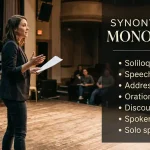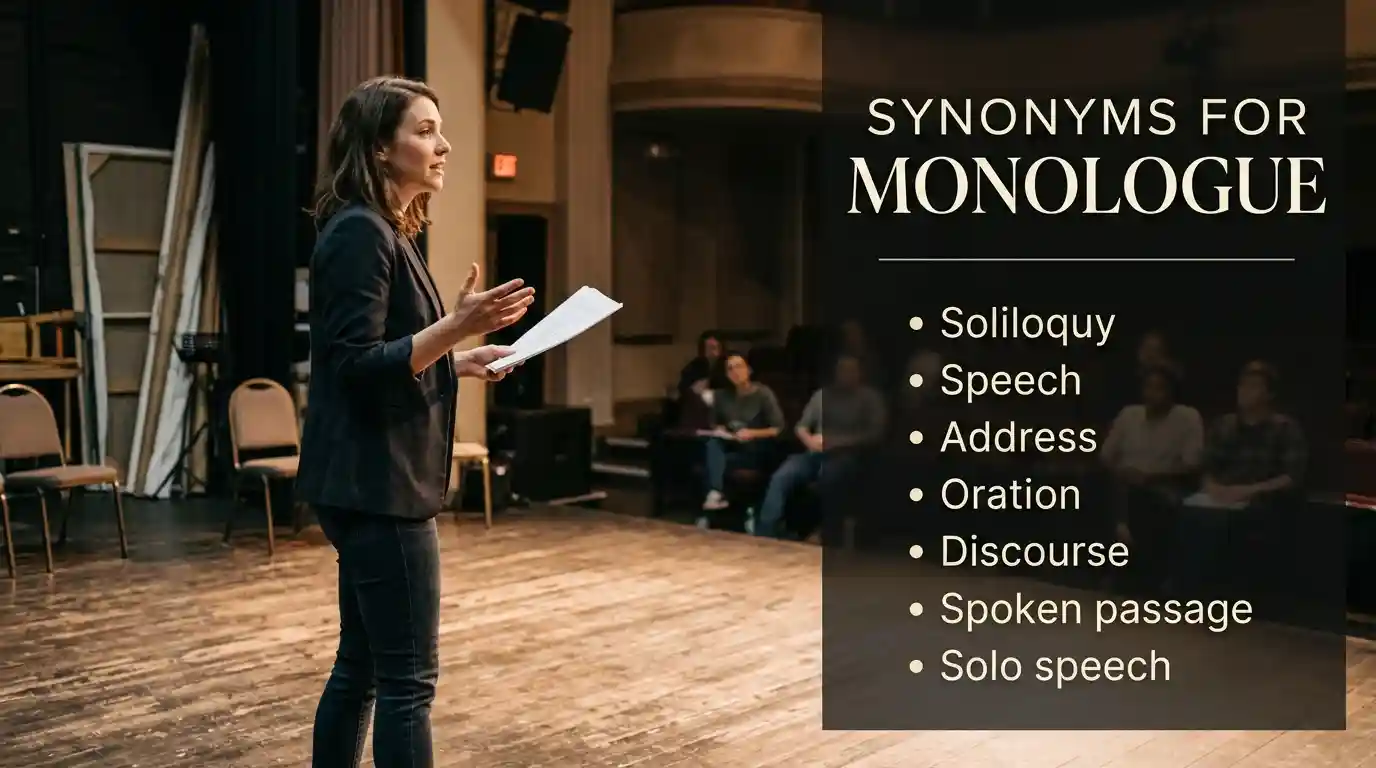
Synonyms for monologue include speech, soliloquy, address, oration, and spoken narrative. The best alternative depends on the setting. A soliloquy often reveals a character’s private thoughts, while an address is a formal speech to an audience. A speech is broader and can involve different purposes and audiences.
Imagine watching a play where one character stands alone and reveals their deepest thoughts. Later, a speaker delivers a long statement at a public event. Both involve extended speaking, but the words used to describe them may differ.
Choosing the right alternative helps readers understand whether someone is speaking to an audience, thinking aloud, telling a story, or delivering a formal message. These distinctions make descriptions more accurate and engaging.
This guide to synonyms for monologue helps students, bloggers, content writers, drama enthusiasts, and everyday English users find suitable words for different speaking situations.
What Does “Monologue” Really Mean?
A monologue is a long speech delivered by one person without another person taking part in the speaking. It can be spoken to an audience, directed at another character, or presented as a character’s private thoughts in a play, film, or story.
The word is a noun. In everyday English, it can also describe someone who talks for a long time without giving others a chance to respond. Depending on the situation, a monologue may be thoughtful, entertaining, dramatic, informative, or frustrating.
Monologues commonly appear in theater, films, novels, comedy performances, public speaking, interviews, and everyday conversations. The best alternative depends on the speaker’s purpose and whether the speech is formal, dramatic, personal, or one-sided.
Connotative Meaning of Monologue
(Connotation is the feeling or association a word carries beyond its basic dictionary meaning.)
- Positive tone: A monologue can suggest powerful storytelling, emotional honesty, or an impressive performance.
- Neutral tone: In theater and literary analysis, it simply describes an extended speech by one speaker.
- Negative tone: In everyday conversation, it can suggest that someone is talking too much and ignoring other people.
For example, a moving monologue in a play may impress an audience. However, a person who dominates every conversation may be accused of turning discussions into monologues.
Etymology and Pronunciation
Monologue comes through French monologue from Greek elements meaning “alone” and “speech” or “discourse.” The word describes speaking by one person, a meaning that remains central to its use today.
Historical Development
- Old English (c. 450–1100): The modern word monologue was not part of ordinary Old English vocabulary. People expressed the idea using other words for speaking or discourse.
- Middle English (c. 1100–1500): English continued to use terms related to speaking, tales, and speeches. Monologue entered English later through European literary vocabulary.
- Modern English (1500–present): The word became established in literary and theatrical discussion, especially for a long speech by one character. It also developed everyday uses for extended, one-sided talking.
Pronunciation
- US IPA: /ˈmɑːnəlɔːɡ/
- UK IPA: /ˈmɒnəlɒɡ/
- Syllables: mon-o-logue (three syllables).
Affixation Pattern
- Root elements: mono- (“one” or “alone”) and -logue (related to speech or discourse).
- Prefix: mono- functions as a combining form meaning “one” or “single.”
- Suffix: There is no ordinary English suffix added to a complete root in the way there is in words such as talkative. The ending -logue comes from the word’s Greek-derived structure.
Synonyms for Monologue: 40 Alternatives by Meaning
Not all these words are exact substitutes. Some describe a particular kind of monologue, while others refer to extended speaking in a specific setting. Check the meaning and examples before choosing one.
A. General Words for Extended Speaking
1. Speech
US pronunciation: /spiːtʃ/
UK pronunciation: /spiːtʃ/
Meaning: A speech is a spoken presentation delivered by one person to listeners.
Examples:
- Her speech held the audience’s attention.
- He prepared a short speech for the ceremony.
2. Address
US pronunciation: /əˈdres/
UK pronunciation: /əˈdres/
Meaning: An address is a formal speech delivered to a particular audience.
Examples:
- The mayor gave an address at the opening.
- Her address focused on community safety.
3. Talk
US pronunciation: /tɔːk/
UK pronunciation: /tɔːk/
Meaning: A talk is an informal or formal spoken presentation about a subject.
Examples:
- He gave a short talk about his travels.
- Her talk explained the project clearly.
4. Discourse
US pronunciation: /ˈdɪskɔːrs/
UK pronunciation: /ˈdɪskɔːs/
Meaning: Discourse is extended speech or communication about a topic.
Examples:
- The professor’s discourse explored the idea in depth.
- His discourse continued long after the meeting ended.
5. Oration
US pronunciation: /ɔːˈreɪʃən/
UK pronunciation: /ɒˈreɪʃən/
Meaning: An oration is a formal, carefully delivered speech, often for an important occasion.
Examples:
- The student delivered an oration at graduation.
- Her emotional oration moved the audience.
6. Lecture
US pronunciation: /ˈlektʃər/
UK pronunciation: /ˈlektʃə/
Meaning: A lecture is a structured talk that teaches or explains a subject.
Examples:
- The lecturer gave a talk on modern literature.
- His lecture covered the history of theater.
7. Presentation
US pronunciation: /ˌprezənˈteɪʃən/
UK pronunciation: /ˌprezənˈteɪʃən/
Meaning: A presentation is an organized explanation delivered to an audience.
Examples:
- She gave a presentation about her research.
- His presentation lasted fifteen minutes.
8. Disquisition
US pronunciation: /ˌdɪskwɪˈzɪʃən/
UK pronunciation: /ˌdɪskwɪˈzɪʃən/
Meaning: A disquisition is a detailed, often formal discussion of a subject.
Examples:
- The essay became a long disquisition on art.
- His disquisition examined the character’s motives.
B. Dramatic and Literary Alternatives
9. Soliloquy
US pronunciation: /səˈlɪləkwi/
UK pronunciation: /səˈlɪləkwi/
Meaning: A soliloquy is a speech in which a character expresses private thoughts, often while alone on stage.
Examples:
- The actor delivered a powerful soliloquy.
- Her soliloquy revealed the character’s hidden fear.
10. Aside
US pronunciation: /əˈsaɪd/
UK pronunciation: /əˈsaɪd/
Meaning: An aside is a brief remark in a play intended for the audience or another character, often unheard by others on stage.
Examples:
- The actor added a humorous aside.
- Her aside revealed what she really thought.
An aside is usually brief, so it is not a direct synonym for a full monologue.
11. Dramatic Speech
US pronunciation: /drəˈmætɪk spiːtʃ/
UK pronunciation: /drəˈmætɪk spiːtʃ/
Meaning: A dramatic speech is a spoken passage designed to express a character’s feelings or advance a scene.
Examples:
- The final dramatic speech changed the mood of the play.
- She rehearsed the dramatic speech before opening night.
12. Interior Monologue
US pronunciation: /ɪnˈtɪriər ˈmɑːnəlɔːɡ/
UK pronunciation: /ɪnˈtɪəriə ˈmɒnəlɒɡ/
Meaning: An interior monologue presents a character’s private thoughts, usually within a literary work.
Examples:
- The novel uses interior monologue to show his doubts.
- Her interior monologue reveals a conflict she hides from others.
13. Stream of Consciousness
US pronunciation: /striːm əv ˈkɑːnʃəsnəs/
UK pronunciation: /striːm əv ˈkɒnʃəsnəs/
Meaning: Stream of consciousness is a writing technique that follows a character’s thoughts as they flow from one idea to another.
Examples:
- The author uses stream of consciousness to portray anxiety.
- The chapter moves through the character’s memories and impressions.
This is a literary technique, not an exact synonym for monologue.
14. Narration
US pronunciation: /nəˈreɪʃən/
UK pronunciation: /nəˈreɪʃən/
Meaning: Narration is the act of telling a story or describing events.
Examples:
- Her narration guides viewers through the documentary.
- The film uses narration to explain the past.
15. Voice-over
US pronunciation: /ˈvɔɪsˌoʊvər/
UK pronunciation: /ˈvɔɪsˌəʊvə/
Meaning: A voice-over is speech heard in a film or video while the speaker may not appear on screen.
Examples:
- His voice-over introduces the documentary.
- The director recorded a voice-over for the final scene.
16. Soliloquizing
US pronunciation: /səˈlɪləkwaɪzɪŋ/
UK pronunciation: /səˈlɪləkwaɪzɪŋ/
Meaning: Soliloquizing is the act of speaking one’s thoughts aloud, especially in a dramatic context.
Examples:
- The character spends the scene soliloquizing about his choices.
- She practiced soliloquizing for the theater audition.
C. Formal, Persuasive, or Public Speaking
17. Harangue
US pronunciation: /həˈræŋ/
UK pronunciation: /həˈræŋ/
Meaning: A harangue is a forceful, often angry speech that strongly criticizes or persuades.
Examples:
- The manager delivered a harangue about missed deadlines.
- His harangue left the team uncomfortable.
18. Tirade
US pronunciation: /ˈtaɪreɪd/
UK pronunciation: /taɪˈreɪd/
Meaning: A tirade is a long, angry speech expressing strong disapproval.
Examples:
- She launched into a tirade about the unfair decision.
- His tirade continued until a colleague interrupted.
19. Diatribe
US pronunciation: /ˈdaɪətraɪb/
UK pronunciation: /ˈdaɪətraɪb/
Meaning: A diatribe is a bitter, forceful speech or piece of writing attacking someone or something.
Examples:
- The article became a diatribe against corruption.
- His diatribe criticized the new policy.
20. Sermon
US pronunciation: /ˈsɜːrmən/
UK pronunciation: /ˈsɜːmən/
Meaning: A sermon is a religious or moral talk intended to teach or encourage particular behavior.
Examples:
- The minister delivered a sermon about compassion.
- My father gave me a sermon about responsibility.
21. Keynote Address
US pronunciation: /ˈkiːnoʊt əˈdres/
UK pronunciation: /ˈkiːnəʊt əˈdres/
Meaning: A keynote address is a major speech that establishes the central theme of an event or conference.
Examples:
- The scientist delivered the keynote address.
- Her keynote address focused on education.
22. Briefing
US pronunciation: /ˈbriːfɪŋ/
UK pronunciation: /ˈbriːfɪŋ/
Meaning: A briefing is a short, focused explanation that provides essential information.
Examples:
- The director gave a briefing before the launch.
- We attended a briefing about the safety procedures.
23. Testimony
US pronunciation: /ˈtestəˌmoʊni/
UK pronunciation: /ˈtestɪməni/
Meaning: Testimony is a formal statement of facts or experiences, especially in a legal or official setting.
Examples:
- Her testimony described what she had witnessed.
- The court listened to his testimony.
24. Declaration
US pronunciation: /ˌdekləˈreɪʃən/
UK pronunciation: /ˌdekləˈreɪʃən/
Meaning: A declaration is a clear, often formal statement that announces a position, decision, or intention.
Examples:
- His declaration of support surprised the audience.
- The speech ended with a declaration of hope.
25. Pronouncement
US pronunciation: /prəˈnaʊnsmənt/
UK pronunciation: /prəˈnaʊnsmənt/
Meaning: A pronouncement is an official or authoritative statement.
Examples:
- The chairperson made a pronouncement about the new rules.
- Her pronouncement ended the speculation.
26. Appeal
US pronunciation: /əˈpiːl/
UK pronunciation: /əˈpiːl/
Meaning: An appeal is an earnest request or persuasive statement intended to gain support.
Examples:
- The coach made an appeal for teamwork.
- His appeal encouraged people to volunteer.
27. Plea
US pronunciation: /pliː/
UK pronunciation: /pliː/
Meaning: A plea is an urgent or emotional request for help, understanding, or action.
Examples:
- She made a plea for patience.
- His plea for assistance moved the audience.
28. Oration of Praise
US pronunciation: /ɔːˈreɪʃən əv preɪz/
UK pronunciation: /ɒˈreɪʃən əv preɪz/
Meaning: An oration of praise is a formal speech that celebrates a person’s achievements or qualities.
Examples:
- The ceremony included an oration of praise for the retiring teacher.
- He prepared an oration of praise for the award recipient.
D. Personal, Explanatory, and Storytelling Speech
29. Rant
US pronunciation: /rænt/
UK pronunciation: /rænt/
Meaning: A rant is a long, emotional speech, usually expressing anger or frustration.
Examples:
- He went on a rant about the traffic.
- Her online rant attracted many comments.
30. Monologue of Complaint
US pronunciation: /ˈmɑːnəlɔːɡ əv kəmˈpleɪnt/
UK pronunciation: /ˈmɒnəlɒɡ əv kəmˈpleɪnt/
Meaning: A monologue of complaint is an extended speech focused on dissatisfaction or grievances.
Examples:
- His monologue of complaint lasted the entire journey.
- She delivered a monologue of complaint about the poor service.
31. Anecdote
US pronunciation: /ˈænɪkˌdoʊt/
UK pronunciation: /ˈænɪkˌdəʊt/
Meaning: An anecdote is a short, interesting story about a real event or person.
Examples:
- He shared an anecdote from his school days.
- Her anecdote made everyone laugh.
An anecdote is usually a short story, not necessarily an extended speech.
32. Explanation
US pronunciation: /ˌekspləˈneɪʃən/
UK pronunciation: /ˌekspləˈneɪʃən/
Meaning: An explanation is a statement that makes an idea, event, or situation easier to understand.
Examples:
- He gave a clear explanation of the problem.
- Her explanation helped the audience follow the story.
33. Commentary
US pronunciation: /ˈkɑːmənˌteri/
UK pronunciation: /ˈkɒməntri/
Meaning: Commentary is spoken or written discussion that explains or expresses opinions about events.
Examples:
- The narrator provided commentary throughout the film.
- His commentary examined the play’s main themes.
34. Confession
US pronunciation: /kənˈfeʃən/
UK pronunciation: /kənˈfeʃən/
Meaning: A confession is a statement in which someone admits a truth, mistake, or wrongdoing.
Examples:
- Her confession revealed the reason for her silence.
- He made a heartfelt confession to his friend.
35. Testimonial
US pronunciation: /ˌtestəˈmoʊniəl/
UK pronunciation: /ˌtestɪˈməʊniəl/
Meaning: A testimonial is a statement describing someone’s experience, support, or appreciation, often given publicly.
Examples:
- The event included a testimonial from a former student.
- She gave a testimonial about her mentor’s influence.
36. Storytelling
US pronunciation: /ˈstɔːriˌtelɪŋ/
UK pronunciation: /ˈstɔːriˌtelɪŋ/
Meaning: Storytelling is the act of telling stories to entertain, inform, or communicate experiences.
Examples:
- His storytelling kept the children engaged.
- The performance combined music and storytelling.
37. Recitation
US pronunciation: /ˌresɪˈteɪʃən/
UK pronunciation: /ˌresɪˈteɪʃən/
Meaning: A recitation is the act of saying a prepared passage, poem, or text aloud.
Examples:
- The student gave a recitation of the poem.
- Her recitation was clear and expressive.
38. Spiel
US pronunciation: /spiːl/
UK pronunciation: /spiːl/
Meaning: A spiel is a practiced or lengthy speech, often intended to persuade, explain, or sell an idea.
Examples:
- The salesperson launched into a familiar spiel.
- I had heard his spiel about the project before.
39. Soliloquy-Like Speech
US pronunciation: /səˈlɪləkwi laɪk spiːtʃ/
UK pronunciation: /səˈlɪləkwi laɪk spiːtʃ/
Meaning: A soliloquy-like speech resembles a character’s private expression of thoughts, even if it is not a formal theatrical soliloquy.
Examples:
- Her speech felt like a soliloquy about regret.
- The scene ends with a soliloquy-like speech about freedom.
40. One-Person Performance
US pronunciation: /ˌwʌn ˈpɜːrsən pərˈfɔːrməns/
UK pronunciation: /ˌwʌn ˈpɜːsən pəˈfɔːməns/
Meaning: A one-person performance is a show carried by a single performer, often using extended speech or storytelling.
Examples:
- The actor presented a one-person performance about family life.
- Her one-person performance combined humor and personal memories.
Synonyms for Monologue by Tone
The tone of a monologue changes how listeners interpret it. A speech can sound thoughtful, authoritative, dramatic, or aggressive. Choose an alternative that reflects both the speaker’s intention and the audience’s experience.
Positive or Expressive
- Soliloquy — reveals a character’s private thoughts.
- Oration — suggests an impressive, formal speech.
- Storytelling — creates an engaging narrative experience.
- Anecdote — shares an interesting personal story.
- Appeal — communicates an earnest request for support.
- Recitation — emphasizes expressive delivery of prepared words.
Neutral or Informative
- Speech — a broad term for spoken communication.
- Talk — an informal or formal spoken presentation.
- Address — a speech directed to an audience.
- Lecture — an organized explanation of a subject.
- Presentation — a structured spoken explanation.
- Briefing — a focused update or information session.
- Narration — the telling or description of events.
- Explanation — makes an idea or situation clear.
Negative or Critical
- Rant — expresses anger or frustration at length.
- Tirade — delivers forceful, angry criticism.
- Diatribe — attacks a person, idea, or institution.
- Harangue — forcefully lectures or criticizes others.
- Spiel — can suggest a rehearsed or tiresome pitch.
These terms are not interchangeable. A soliloquy often serves an artistic purpose, while a rant generally emphasizes frustration. Using the right word helps readers understand the speaker’s attitude.
Monologue vs. Close Alternatives
Monologue vs. Soliloquy
A monologue is an extended speech by one speaker. A soliloquy is a more specific dramatic speech in which a character expresses private thoughts, often while alone on stage.
Use monologue for a broad range of performances and extended speeches. Choose soliloquy when discussing a character’s inner thoughts in drama or literature.
Monologue vs. Speech
A speech is a broad term for spoken communication delivered to listeners. A monologue emphasizes one speaker continuing at length without a conversational exchange.
For example, a politician’s formal address is a speech. A character speaking alone for several minutes in a film may be described as delivering a monologue.
Monologue vs. Rant
A monologue does not necessarily express anger. It may be funny, reflective, dramatic, or informative. A rant is an emotional outpouring, usually involving complaints or criticism.
Use monologue when the main feature is extended speaking by one person. Use rant when the speaker’s frustration or anger is central to the scene.
How Monologue Changes by Context
Daily Conversation
In everyday conversation, monologue often describes someone who speaks for too long without inviting others to participate. For example, a friend might say, “He turned the entire lunch into a monologue about his new car.”
The word can sound critical in this context. If you want a softer description, say that someone gave a long explanation or talked at length.
Writing and Blogging
Writers use monologue to describe extended speech in novels, plays, screenplays, and personal essays. The term can also help explain how a character communicates emotions or reveals information.
For a broader article about speaking styles, use speech or address when appropriate. For a character’s private thoughts, soliloquy or interior monologue may be more precise.
[internal link: suggested anchor → synonyms for dialogue → synonyms-for-dialogue]
Professional or Academic Tone
In academic writing, monologue is useful when analyzing drama, literature, communication, or a one-sided discussion. In a business setting, presentation, briefing, or address may be more accurate, depending on the purpose.
For example, describe a manager’s project update as a briefing rather than a monologue if the focus is on sharing essential information. If the manager speaks continuously and discourages discussion, monologue may better convey the interaction.
Creative or Informal Use
In comedy, a monologue may be a humorous performance delivered by one comedian. For theater, it may reveal a character’s fears or motivations. In a film, it can establish a character’s background or explain an important event.
For an angry or exaggerated performance, rant or tirade may be appropriate. For a reflective and emotional scene, soliloquy may communicate the mood more effectively.
Common Mistakes Learners Make
1. Treating Every Speech as a Monologue
A speech can include audience participation, questions, or exchanges. A monologue generally centers on one person speaking at length.
Correction: Use speech as the broader term. Choose monologue when one speaker’s extended contribution is the main feature.
2. Confusing a Monologue With a Soliloquy
A soliloquy usually reveals a character’s private thoughts. A monologue may address an audience or another character without revealing inner thoughts.
Correction: In literary analysis, use soliloquy when the speech specifically presents a character’s internal thinking.
3. Using “Rant” for Every Long Speech
A rant expresses anger or frustration. A calm lecture or heartfelt performance is not automatically a rant.
Correction: Choose lecture, address, explanation, or monologue when the speech does not have an angry tone.
4. Using “Discourse” in Casual Conversation
Discourse often sounds academic or formal. It may feel unnatural when you simply mean a short talk between friends.
Correction: Use talk or conversation in everyday situations. Reserve discourse for extended discussion or formal analysis.
5. Assuming a Monologue Must Be Delivered on Stage
Monologues appear in theater, but they also occur in films, videos, comedy, presentations, and ordinary conversations.
Correction: Choose the word based on how the speech functions, not just where it happens.
Register Notes
- Formal or academic: address, oration, discourse, lecture.
- Neutral and general: speech, talk, monologue, presentation.
- Dramatic or literary: soliloquy, interior monologue, narration.
- Informal or critical: rant, spiel, tirade.
Real-Life Scenarios Using Monologue Synonyms
Workplace
A team leader explains a new policy during a scheduled meeting. Briefing is appropriate because the purpose is to communicate essential information. If the leader talks continuously and ignores questions, colleagues might describe the meeting as a monologue.
Social Situations
A friend spends an entire dinner describing a recent vacation without asking anyone else a question. Calling it a monologue highlights the one-sided conversation. Calling it a rant would suggest anger, which may not be present.
Media and Pop Culture
A comedian performs alone on stage, delivering jokes and observations. This may be called a comedy monologue. A film character who speaks privately about fear or guilt may instead deliver a soliloquy.
Writing and Storytelling
A novelist wants readers to understand a character’s guilt. An interior monologue can reveal the character’s thoughts directly. A narrator’s account of past events, however, is better described as narration.
Practice Exercise: Choose the Best Synonym for Monologue
Choose the most suitable word for each situation.
1. A character on stage speaks aloud about private thoughts while alone.
A. Briefing
B. Soliloquy
C. Testimony
D. Address
2. A person delivers a long, angry complaint about poor service.
A. Anecdote
B. Recitation
C. Rant
D. Lecture
3. A professor explains a subject to a class.
A. Lecture
B. Tirade
C. Confession
D. Aside
4. A mayor gives a formal speech to the community.
A. Spiel
B. Interior monologue
C. Anecdote
D. Address
5. A witness describes what happened in court.
A. Storytelling
B. Testimony
C. Soliloquy
D. Comedy monologue
6. A comedian performs jokes alone on stage.
A. Briefing
B. Declaration
C. Comedy monologue
D. Sermon
7. A speaker gives a short update about workplace safety procedures.
A. Briefing
B. Diatribe
C. Tirade
D. Soliloquy
8. A character’s thoughts flow freely through memories and impressions in a novel.
A. Keynote address
B. Harangue
C. Testimonial
D. Stream of consciousness
9. A salesperson delivers a familiar, rehearsed pitch.
A. Confession
B. Spiel
C. Soliloquy
D. Aside
10. An actor makes a short remark intended for the audience, unheard by other characters.
A. Oration
B. Lecture
C. Aside
D. Disquisition
11. A speaker delivers a formal speech celebrating someone’s achievements.
A. Oration
B. Rant
C. Complaint
D. Interior monologue
12. A narrator speaks over footage in a documentary.
A. Tirade
B. Plea
C. Soliloquy
D. Voice-over
Reflection Task
Write three original sentences using different alternatives for monologue. Include one dramatic situation, one professional setting, and one everyday conversation. Choose words that accurately reflect the speaker’s purpose and tone.
Answer Key: 1-B, 2-C, 3-A, 4-D, 5-B, 6-C, 7-A, 8-D, 9-B, 10-C, 11-A, 12-D.
Conclusion
Learning synonyms for monologue helps you describe speech with greater accuracy. Words such as soliloquy, address, lecture, and rant reveal different purposes, settings, and emotional tones.
A wider vocabulary makes writing, blogging, literary analysis, and everyday communication clearer. Practice these alternatives in essays, emails, conversations, and creative writing to express your ideas more precisely.
To explore more meanings and related words, visit the synonyms for monologue entry. Try using one new alternative today and notice how it changes the meaning of your sentence.

Evelyn Hartwell is an English vocabulary writer who focuses on clear, practical language for learners and everyday readers. Her writing explores synonyms, word meanings, pronunciation, tone, and natural usage. She believes that learning vocabulary should be simple, useful, and enjoyable. Her articles are designed to help students, bloggers, and English learners choose the right words with greater confidence.