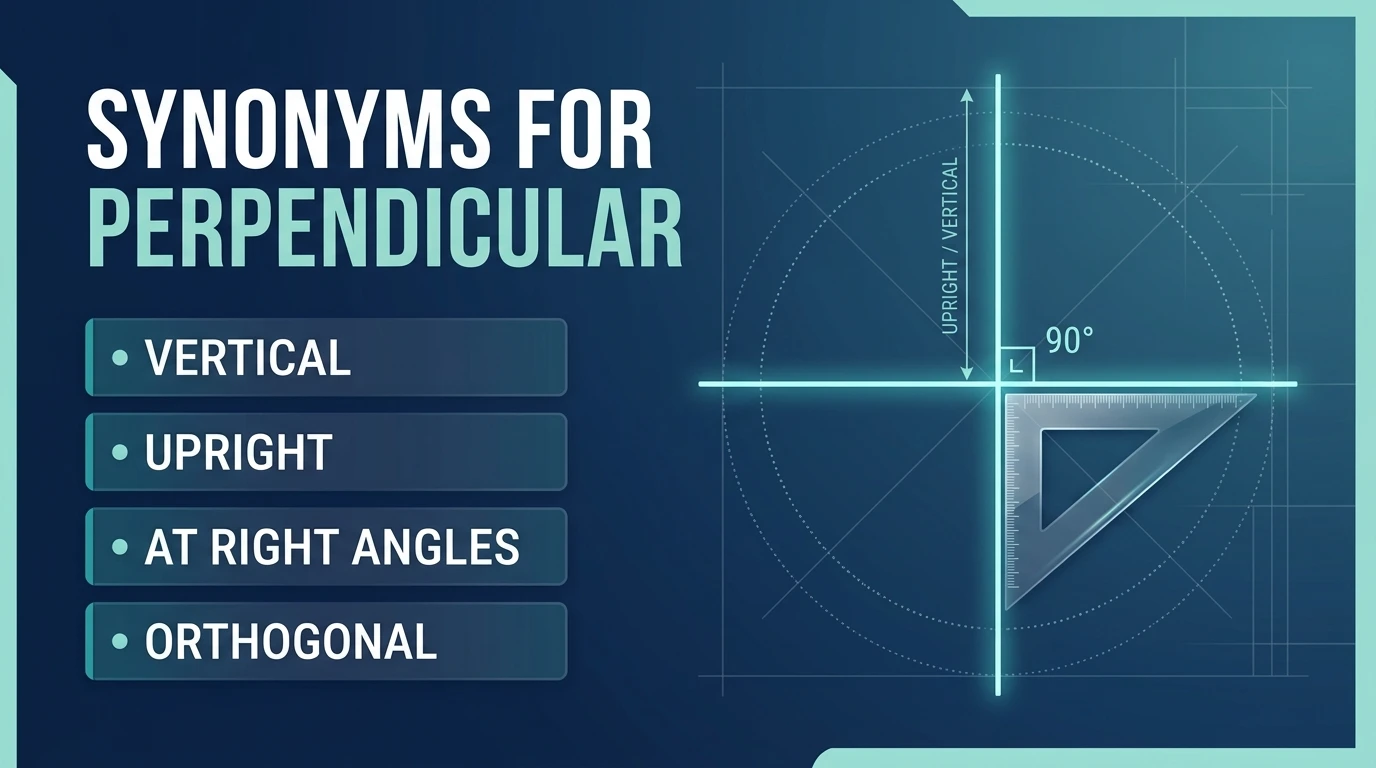
Synonyms for perpendicular can help you describe lines, surfaces, objects, or directions that meet at a right angle.
In geometry, perpendicular has a precise meaning. Two lines are perpendicular when they intersect at an angle of exactly 90 degrees.
In everyday English, however, perpendicular can also describe something standing upright or positioned at a right angle to another object.
Knowing the right synonyms for perpendicular is useful for students, teachers, writers, engineers, architects, and anyone who wants to describe direction or position accurately.
What Does Perpendicular Mean?
Perpendicular means meeting or crossing another line, surface, or direction at a 90-degree angle.
Part of speech: Adjective
It can also function as a noun in geometry.
For example:
- The two lines are perpendicular.
- The vertical wall is perpendicular to the floor.
- Draw a perpendicular line through the center of the circle.
The central idea is a right angle.
Perpendicular as an Adjective
As an adjective, perpendicular describes something that forms a right angle with another thing.
Example:
The vertical line is perpendicular to the horizontal line.
Here, the two lines meet at 90 degrees.
Perpendicular as a Noun
In mathematics, a perpendicular can refer to a line that forms a right angle with another line.
Example:
Draw a perpendicular from point A to line BC.
The word is especially common in geometry and technical writing.
Connotation of Perpendicular
Perpendicular is generally neutral and technical.
It does not usually express positive or negative emotion. Instead, it gives precise information about position, direction, or angle.
In everyday descriptions, words such as upright or vertical may be easier to understand.
In mathematics and geometry, however, perpendicular is much more precise.
Etymology of Perpendicular
The word perpendicular comes from Latin perpendicularis, meaning “straight down” or “vertical,” from perpendiculum, referring to a plumb line.
The word entered English through Old French and developed into its modern mathematical and descriptive sense.
Its historical connection with a plumb line helps explain why perpendicular became associated with vertical direction and right angles.
Pronunciation of Perpendicular
US: /ˌpɜːrpənˈdɪkjələr/
UK: /ˌpɜːpənˈdɪkjʊlə/
Syllables: per-pen-dic-u-lar
Number of syllables: 5
The main stress falls on “dic.”
Word Formation of Perpendicular
The word comes from Latin roots connected with perpendere, meaning “to weigh carefully” or “to hang straight.”
The historical idea of something hanging straight influenced the later sense of vertical or right-angled positioning.
The related noun is perpendicularity, meaning the condition of being perpendicular.
Synonyms for Perpendicular
The following alternatives are grouped broadly by meaning. Some are close equivalents, while others are appropriate only in specific contexts.
1. Orthogonal
US: /ɔːrˈθɑːɡənəl/
UK: /ɔːˈθɒɡənəl/
Meaning: Meeting at a right angle, especially in mathematics or geometry.
Examples:
- The two vectors are orthogonal.
- The axes are orthogonal to each other.
Orthogonal is one of the closest technical alternatives to perpendicular.
2. At Right Angles
US: /æt raɪt ˈæŋɡəlz/
UK: /ət raɪt ˈæŋɡəlz/
Meaning: Positioned so that two things meet at an angle of 90 degrees.
Examples:
- The lines intersect at right angles.
- The shelves are arranged at right angles to the wall.
This phrase is very clear and widely understood.
3. Right-Angled
US: /ˌraɪt ˈæŋɡəld/
UK: /ˌraɪt ˈæŋɡəld/
Meaning: Forming or containing a 90-degree angle.
Examples:
- The carpenter created a right-angled corner.
- The triangle has one right-angled corner.
It is especially common in British English and mathematical contexts.
4. Normal
US: /ˈnɔːrməl/
UK: /ˈnɔːməl/
Meaning: In geometry, positioned at a right angle to a line or surface.
Examples:
- Draw a normal to the curve at this point.
- The normal is perpendicular to the surface.
Normal is a technical geometry term, not a general replacement for perpendicular.
5. Vertical
US: /ˈvɜːrtɪkəl/
UK: /ˈvɜːtɪkəl/
Meaning: Extending straight upward or downward.
Examples:
- Keep the pole vertical.
- The vertical line crosses the horizontal line.
Vertical can overlap with perpendicular when something is upright relative to a horizontal reference, but they do not have identical meanings.
6. Upright
US: /ˈʌpraɪt/
UK: /ˈʌpraɪt/
Meaning: Standing or positioned straight up rather than leaning.
Examples:
- Keep the bottle upright.
- The chair remained upright after the impact.
Upright describes position rather than specifically indicating a 90-degree geometric relationship.
7. Plumb
US: /plʌm/
UK: /plʌm/
Meaning: Exactly vertical, especially in construction.
Examples:
- Check whether the wall is perfectly plumb.
- The builder adjusted the post until it was plumb.
This is useful when discussing construction and vertical alignment.
8. Square
US: /skwer/
UK: /skweə/
Meaning: Positioned at a right angle to another surface or line.
Examples:
- Make sure the frame is square.
- The carpenter checked whether the corners were square.
In construction, square can describe a 90-degree relationship.
9. At 90 Degrees
US: /æt ˈnaɪnti dɪˈɡriːz/
UK: /ət ˈnaɪnti dɪˈɡriːz/
Meaning: Positioned at an angle measuring exactly 90 degrees.
Examples:
- The two lines meet at 90 degrees.
- Place the support at 90 degrees to the base.
This is one of the clearest explanatory alternatives.
10. Normal to
US: /ˈnɔːrməl tuː/
UK: /ˈnɔːməl tuː/
Meaning: Perpendicular to a line, curve, plane, or surface.
Examples:
- The force is normal to the surface.
- Draw a line normal to the curve.
This phrase is common in geometry, physics, and engineering.
11. Orthogonal to
US: /ɔːrˈθɑːɡənəl tuː/
UK: /ɔːˈθɒɡənəl tuː/
Meaning: At a right angle to something else.
Examples:
- The two vectors are orthogonal to each other.
- The axis is orthogonal to the plane.
It is particularly useful in advanced mathematics and science.
12. At Right Angles To
US: /æt raɪt ˈæŋɡəlz tuː/
UK: /ət raɪt ˈæŋɡəlz tə/
Meaning: Positioned so that one thing forms a 90-degree angle with another.
Examples:
- The beam is at right angles to the wall.
- Draw the line at right angles to the base.
This is a natural phrase for explaining perpendicular in simple language.
13. Square To
US: /skwer tuː/
UK: /skweə tə/
Meaning: Positioned at a right angle to something.
Examples:
- Make sure the board is square to the edge.
- The frame must remain square to the surface.
This expression is particularly common in construction and practical work.
14. At Right Angles With
US: /æt raɪt ˈæŋɡəlz wɪð/
UK: /ət raɪt ˈæŋɡəlz wɪð/
Meaning: Forming a 90-degree relationship with another line or surface.
Examples:
- The two lines meet at right angles with each other.
- The support sits at right angles with the base.
In polished mathematical writing, perpendicular to or at right angles to is generally more natural.
15. Transverse
US: /trænzˈvɜːrs/
UK: /trænzˈvɜːs/
Meaning: Extending across something rather than along its main direction.
Examples:
- A transverse line crossed the structure.
- The study examined transverse movement.
Transverse is related to crossing directions, but it does not automatically mean 90 degrees. It should therefore be used carefully.
16. Crosswise
US: /ˈkrɔːswaɪz/
UK: /ˈkrɒswaɪz/
Meaning: Across something rather than along its length or main direction.
Examples:
- Place the boards crosswise.
- The branches grew crosswise across the path.
Crosswise is less mathematically precise than perpendicular.
17. Across
US: /əˈkrɔːs/
UK: /əˈkrɒs/
Meaning: From one side to another or across the direction of something.
Examples:
- A narrow beam ran across the structure.
- The bridge stretches across the river.
Across does not necessarily indicate a 90-degree angle, so it is only a contextual alternative.
18. Upright and Vertical
US: /ˈʌpraɪt ænd ˈvɜːrtɪkəl/
UK: /ˈʌpraɪt ənd ˈvɜːtɪkəl/
Meaning: Standing straight upward in a vertical position.
Examples:
- The post must remain upright and vertical.
- Keep the support upright and vertical during installation.
This phrase describes vertical position rather than geometric perpendicularity.
19. Plumb Vertical
US: /plʌm ˈvɜːrtɪkəl/
UK: /plʌm ˈvɜːtɪkəl/
Meaning: Precisely vertical, especially when checked against a reference line.
Examples:
- The contractor checked that the column was plumb vertical.
- The post needs to remain plumb vertical.
This is primarily useful in construction contexts.
20. Right-Angle
US: /ˈraɪt ˌæŋɡəl/
UK: /ˈraɪt ˌæŋɡəl/
Meaning: Relating to an angle of exactly 90 degrees.
Examples:
- The design contains a right-angle corner.
- The two surfaces form a right-angle intersection.
It describes the geometric relationship rather than necessarily replacing perpendicular grammatically.
21. Perpendicular to
US: /ˌpɜːrpənˈdɪkjələr tuː/
UK: /ˌpɜːpənˈdɪkjʊlə tə/
Meaning: Forming a 90-degree angle with something.
Examples:
- The line is perpendicular to the axis.
- The wall is perpendicular to the floor.
This is technically the standard construction when expressing the relationship between two objects.
22. At Ninety Degrees to
US: /æt ˈnaɪnti dɪˈɡriːz tuː/
UK: /ət ˈnaɪnti dɪˈɡriːz tə/
Meaning: Positioned so that two objects meet at exactly 90 degrees.
Examples:
- The beam is at ninety degrees to the floor.
- The two lines are at ninety degrees to each other.
It is an explicit mathematical explanation of perpendicularity.
23. Normal to the Surface
US: /ˈnɔːrməl tuː ðə ˈsɜːrfɪs/
UK: /ˈnɔːməl tə ðə ˈsɜːfɪs/
Meaning: Positioned at a right angle to a surface.
Examples:
- The force acts normal to the surface.
- The sensor must remain normal to the surface.
This expression is common in physics and engineering.
24. Right-Angled to
US: /ˌraɪt ˈæŋɡəld tuː/
UK: /ˌraɪt ˈæŋɡəld tə/
Meaning: Forming a 90-degree angle with something.
Examples:
- The side is right-angled to the base.
- The support is positioned right-angled to the main structure.
In standard modern usage, perpendicular to or at right angles to is usually more natural.
25. At a Right Angle
US: /æt ə raɪt ˈæŋɡəl/
UK: /ət ə raɪt ˈæŋɡəl/
Meaning: Positioned at exactly 90 degrees relative to another line or surface.
Examples:
- The two walls meet at a right angle.
- The support is fixed at a right angle to the base.
This is one of the clearest ways to explain perpendicularity without using the technical word itself.
Exact Synonyms vs. Contextual Alternatives
Not every word in a synonym list has exactly the same meaning as perpendicular.
Closest Technical Alternatives
These are the strongest choices when the context is geometry or mathematics:
- Orthogonal
- At right angles
- At 90 degrees
- Normal to
- Orthogonal to
- At a right angle
Vertical-Position Alternatives
These can work when perpendicular refers specifically to an upright position:
- Vertical
- Upright
- Plumb
However, vertical and perpendicular are not automatically interchangeable.
A vertical line is perpendicular to a horizontal line, but two perpendicular lines do not both have to be vertical.
Practical or Construction Alternatives
These can be useful when describing physical objects:
- Square
- Square to
- Plumb
- At a right angle
Their exact meaning depends on the construction context.
Perpendicular vs. Vertical
These two words are often confused.
Perpendicular means forming a 90-degree angle with a reference line or surface.
Vertical means extending upward and downward.
For example, a vertical wall can be perpendicular to a horizontal floor.
Therefore, something can be vertical without the sentence explicitly stating what it is perpendicular to.
Perpendicular vs. Orthogonal
In basic geometry, orthogonal and perpendicular often describe a 90-degree relationship.
However, orthogonal is especially common in advanced mathematics, vectors, linear algebra, and physics.
For everyday writing, perpendicular is usually easier to understand.
Perpendicular vs. Upright
Upright describes something standing straight rather than leaning.
Perpendicular describes an exact angular relationship.
For example:
- The pole is upright.
- The pole is perpendicular to the ground.
The second sentence provides a more precise geometric relationship.
Perpendicular vs. Normal
In geometry, a normal is a line or direction perpendicular to another line, curve, plane, or surface.
For example:
The normal is perpendicular to the surface.
So normal can be a technical alternative in certain mathematical and scientific contexts, but it is not a general synonym for perpendicular.
How to Use Perpendicular Synonyms in Different Contexts
In Mathematics
Use precise terms such as:
- Perpendicular
- Orthogonal
- At right angles
- At 90 degrees
- Normal to
Example:
The two lines are perpendicular.
In Construction
Useful terms include:
- Square
- Square to
- Plumb
- Vertical
- At a right angle
Example:
Check that the frame is square.
In Engineering
Technical language may include:
- Orthogonal
- Normal to
- Perpendicular to
- At right angles to
Example:
The force acts normal to the surface.
In Everyday English
Simpler descriptions are often better:
- Upright
- Vertical
- At a right angle
- Straight up
Example:
Keep the pole upright.
Common Mistakes With Perpendicular Synonyms
Using Vertical as a Universal Synonym
Vertical does not mean perpendicular in every situation.
A line can be perpendicular to another line without being vertical.
Using Horizontal as a Synonym
Horizontal is not a synonym for perpendicular.
Horizontal describes a direction parallel to the ground or horizon, while perpendicular describes a 90-degree relationship.
Assuming Crosswise Always Means Perpendicular
Something can cross another object without forming a 90-degree angle.
Therefore, crosswise is less precise.
Using Normal in Everyday Conversation
Although normal has a technical geometric meaning, people generally understand it as meaning ordinary or usual.
Use it as a synonym for perpendicular only when the mathematical or scientific context is clear.
Confusing Right-Angled With Perpendicular
Right-angled describes an angle or shape containing a 90-degree angle.
Perpendicular describes the relationship between two lines, directions, planes, or surfaces.
Frequently Asked Questions About Perpendicular Synonyms
What is the closest synonym for perpendicular?
Orthogonal is one of the closest technical synonyms, especially in mathematics and geometry. At right angles is another very clear equivalent phrase.
What is a simple synonym for perpendicular?
At a right angle is a simple explanatory alternative. Depending on context, vertical or upright may also work, but they are not exact synonyms.
Is vertical a synonym for perpendicular?
Not exactly. Vertical describes an upward-downward direction, while perpendicular describes a 90-degree relationship between two things.
Is orthogonal the same as perpendicular?
In many geometric contexts, yes. Both can describe a 90-degree relationship. Orthogonal is more common in advanced mathematical and scientific contexts.
What is the opposite of perpendicular?
The answer depends on the context. A line that is not perpendicular could be described as non-perpendicular, while a line running in the same direction as another line may be parallel.
What is another word for perpendicular in geometry?
Common technical alternatives include orthogonal, normal, at right angles, and at 90 degrees.
What is another word for perpendicular in construction?
Depending on the situation, plumb, square, vertical, or at a right angle may be appropriate.
Can I use upright instead of perpendicular?
Only when you are describing something standing straight up. Upright does not by itself communicate an exact 90-degree relationship.
Quick Reference
For quick selection, use:
- Orthogonal — advanced mathematics and science
- At right angles — clear geometric description
- At 90 degrees — explicit mathematical explanation
- Normal to — geometry, physics, and engineering
- Vertical — upward/downward direction
- Upright — standing straight
- Plumb — precisely vertical, especially construction
- Square — right-angle alignment in construction
- Right-angled — describing a 90-degree angle
- Crosswise — across a direction, but not necessarily at 90 degrees
Conclusion
Learning synonyms for perpendicular is useful when you need to describe angles, directions, surfaces, or physical positions more precisely.
For mathematics, orthogonal, normal to, and at right angles are strong choices. For practical descriptions, vertical, upright, plumb, and square may work depending on the context.
The key is to remember that these alternatives are not always interchangeable. Perpendicular specifically describes a 90-degree relationship, while words such as vertical and upright describe position.
Using the right term makes your writing clearer and more accurate, whether you are explaining geometry, describing construction, writing technical content, or simply talking about the position of an object.

Evelyn Hartwell is an English vocabulary writer who focuses on clear, practical language for learners and everyday readers. Her writing explores synonyms, word meanings, pronunciation, tone, and natural usage. She believes that learning vocabulary should be simple, useful, and enjoyable. Her articles are designed to help students, bloggers, and English learners choose the right words with greater confidence.