A speaker can be a person addressing a crowd, someone sharing ideas in a meeting, or a device producing sound. The right synonym depends on the situation.
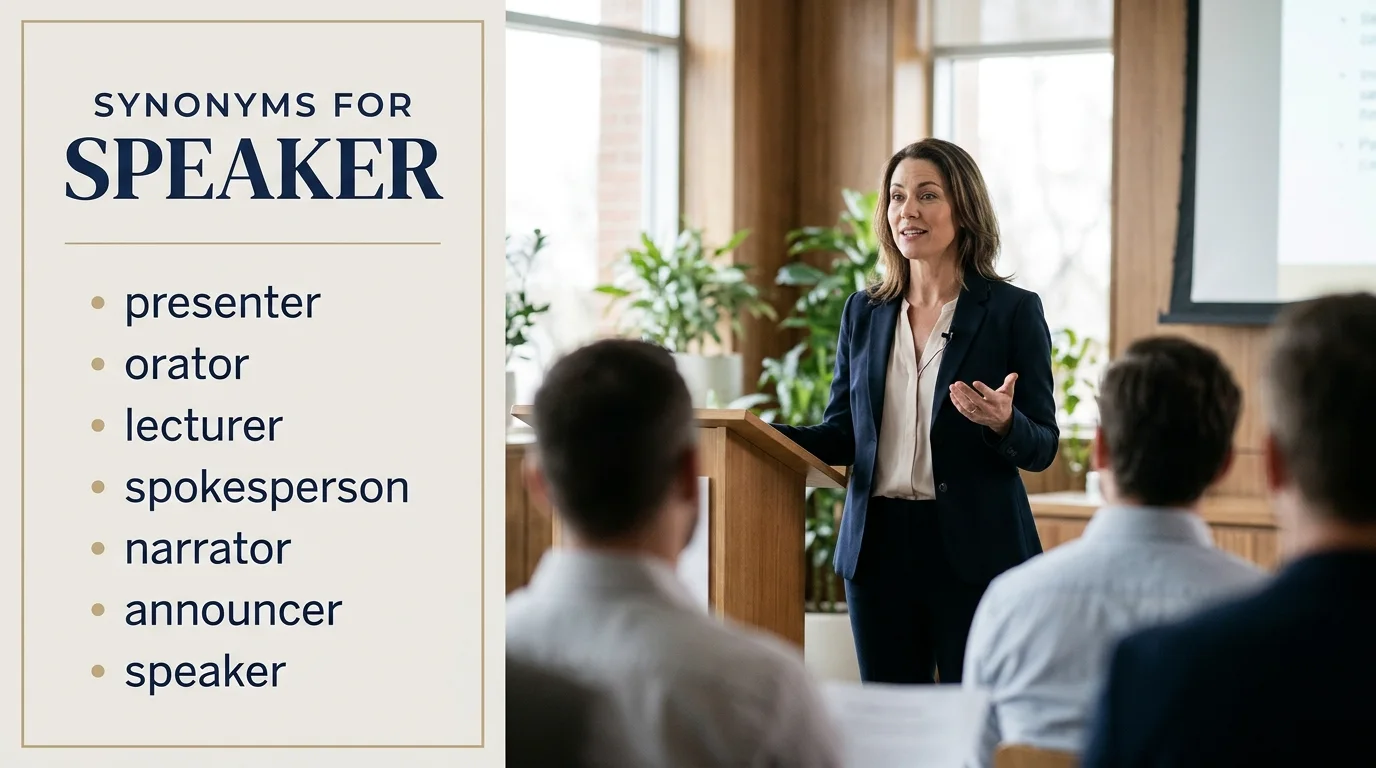
Synonyms for speaker include presenter, orator, lecturer, spokesperson, announcer, narrator, and talker. However, these words are not interchangeable in every context.
For example, a person delivering a speech at a conference is a presenter or speaker. Someone representing an organization is usually a spokesperson.
Learning synonyms for speaker helps students, bloggers, content writers, and everyday English users communicate more precisely. It also makes writing more natural and less repetitive.
What Does “Speaker” Really Mean?
A speaker is a person who talks, gives a speech, shares information with an audience, or represents a group through spoken communication. The word can also describe an electronic device that produces sound.
The meaning depends on the context. At a conference, a speaker usually delivers a presentation. In a classroom, the word may refer to a teacher or lecturer. In politics, a speaker may be a spokesperson who communicates a group’s position.
The word can also refer to a person who uses a language. For example, an English speaker is someone who speaks English. In technology, a speaker is a device that converts an audio signal into sound.
Part of speech: Noun.
Simple definition: A person who speaks, gives a talk, communicates a message, or a device that produces sound.
Connotative Meaning of Speaker
Connotation refers to the feelings, associations, or impressions a word creates beyond its basic dictionary meaning.
- Positive tone: A speaker may suggest confidence, knowledge, leadership, or excellent communication skills.
- Negative tone: In some situations, speaker may describe someone who talks too much or dominates a conversation, although the word itself is not inherently negative.
- Neutral tone: Speaker is usually a neutral word for someone talking, delivering a speech, or producing sound through a device.
Words such as orator and eloquent speaker often suggest strong speaking skills. Talker can sound casual, while mouthpiece may suggest that someone repeats another person’s views without expressing independent opinions.
Etymology of Speaker
The word speaker developed from the verb speak and the agent suffix -er, which commonly describes someone who performs an action.
The verb speak comes from Old English sprecan or specan, meaning to speak or utter words. Its deeper Germanic history connects it with related words in other Germanic languages.
Old English (450–1100)
Old English used forms such as sprecan to describe the act of speaking. The exact modern noun speaker should not be assumed to have had its current range of meanings throughout this period.
Middle English (1100–1500)
During Middle English, the verb developed toward the form speken. Nouns formed from verbs were commonly used to identify people who performed particular actions.
Modern English (1500–Present)
The form speaker became established for a person who speaks or addresses others. It also developed specialized meanings, including the presiding officer of a legislative body and an electronic sound-producing device.
Pronunciation
- US: /ˈspiːkər/
- UK: /ˈspiːkə/
Syllables
speak-er — 2 syllables.
Affixation Pattern
- Root/base: Speak
- Prefix: None
- Suffix: -er, meaning a person or thing that performs an action
Synonyms for Speaker
The best alternative depends on what the speaker is doing. Some words describe public speaking, while others identify a person’s role, communication style, or position.
The following alternatives cover common uses of speaker. Pronunciations are given in US and UK IPA where the pronunciations differ meaningfully; many words have the same pronunciation in both varieties.
1. Presenter
US: /prɪˈzentər/
UK: /prɪˈzentə/
Meaning: A person who introduces, explains, or delivers information to an audience.
Examples:
- The presenter explained the new research clearly.
- We invited a presenter to lead the workshop.
2. Orator
US: /ˈɔːrətər/
UK: /ˈɒrətə/
Meaning: A skilled public speaker known for delivering powerful or formal speeches.
Examples:
- The famous orator inspired the audience.
- She studied the speeches of a celebrated orator.
3. Lecturer
US: /ˈlektʃərər/
UK: /ˈlektʃərə/
Meaning: A person who gives educational talks, especially at a college or university.
Examples:
- The lecturer discussed the history of language.
- A guest lecturer visited our university.
4. Spokesperson
US: /ˈspoʊkspɜːrsən/
UK: /ˈspəʊkspɜːsən/
Meaning: A person authorized to communicate information or opinions on behalf of a group or organization.
Examples:
- A company spokesperson answered reporters’ questions.
- The spokesperson announced the organization’s decision.
5. Announcer
US: /əˈnaʊnsər/
UK: /əˈnaʊnsə/
Meaning: A person who introduces programs, events, or information to an audience.
Examples:
- The announcer introduced the next performer.
- A radio announcer shared the morning news.
6. Narrator
US: /nəˈreɪtər/
UK: /nəˈreɪtə/
Meaning: A person who tells a story or describes events in a book, film, or recording.
Examples:
- The narrator made the documentary engaging.
- A calm narrator read the audiobook.
7. Lecturer-instructor
US: /ˈlektʃər ɪnˈstrʌktər/
UK: /ˈlektʃərə ɪnˈstrʌktə/
Meaning: A person who teaches by explaining information or demonstrating skills.
Examples:
- The instructor explained the speaking exercise.
- Our course instructor answered every question.
Note: Instructor is a related alternative in teaching contexts, not an exact synonym for every kind of speaker.
8. Communicator
US: /kəˈmjuːnɪkeɪtər/
UK: /kəˈmjuːnɪkeɪtə/
Meaning: A person who shares information, thoughts, or feelings with others.
Examples:
- A good communicator listens as well as speaks.
- The manager is an effective communicator.
9. Talker
US: /ˈtɔːkər/
UK: /ˈtɔːkə/
Meaning: A person who talks, especially in ordinary conversation.
Examples:
- He is a confident talker in small groups.
- My sister is a lively talker at family dinners.
10. Debater
US: /dɪˈbeɪtər/
UK: /dɪˈbeɪtə/
Meaning: A person who presents and defends arguments during a discussion or debate.
Examples:
- The debater supported her position with evidence.
- Each debater had two minutes to respond.
11. Speechmaker
US: /ˈspiːtʃˌmeɪkər/
UK: /ˈspiːtʃˌmeɪkə/
Meaning: A person who delivers speeches, often at formal events.
Examples:
- The speechmaker addressed the graduating class.
- An experienced speechmaker opened the ceremony.
12. Public speaker
US: /ˈpʌblɪk ˈspiːkər/
UK: /ˈpʌblɪk ˈspiːkə/
Meaning: A person who speaks formally in front of an audience.
Examples:
- She became a confident public speaker.
- The public speaker discussed workplace communication.
13. Keynote speaker
US: /ˈkiːnoʊt ˈspiːkər/
UK: /ˈkiːnəʊt ˈspiːkə/
Meaning: A featured speaker who delivers a central speech at an event.
Examples:
- The keynote speaker discussed future technology.
- We listened to the keynote speaker after lunch.
14. Guest speaker
US: /ˈɡest ˈspiːkər/
UK: /ˈɡest ˈspiːkə/
Meaning: A person invited to speak at a meeting, class, or event.
Examples:
- A guest speaker visited our school.
- The guest speaker shared practical career advice.
15. Motivational speaker
US: /ˌmoʊtəˈveɪʃənəl ˈspiːkər/
UK: /ˌməʊtɪˈveɪʃənəl ˈspiːkə/
Meaning: A person who gives talks intended to encourage or inspire others.
Examples:
- The motivational speaker encouraged students to keep learning.
- We watched a motivational speaker discuss resilience.
16. Inspirational speaker
US: /ˌɪnspəˈreɪʃənəl ˈspiːkər/
UK: /ˌɪnspɪˈreɪʃənəl ˈspiːkə/
Meaning: A person whose talks aim to inspire hope, confidence, or action.
Examples:
- The inspirational speaker shared her personal journey.
- An inspirational speaker addressed the volunteers.
17. Commentator
US: /ˈkɑːmənˌteɪtər/
UK: /ˈkɒmənˌteɪtə/
Meaning: A person who explains or gives opinions about events, often in the media.
Examples:
- The commentator analyzed the match.
- A political commentator discussed the election.
18. Broadcaster
US: /ˈbrɔːdˌkæstər/
UK: /ˈbrɔːdˌkɑːstə/
Meaning: A person who presents or communicates content through radio, television, or other broadcast media.
Examples:
- The broadcaster introduced the evening program.
- She trained as a sports broadcaster.
19. Host
US: /hoʊst/
UK: /həʊst/
Meaning: A person who leads or presents a show, event, or program.
Examples:
- The host welcomed everyone to the podcast.
- Our event host introduced the panel.
20. Moderator
US: /ˈmɑːdəˌreɪtər/
UK: /ˈmɒdəˌreɪtə/
Meaning: A person who guides a discussion and helps participants take turns.
Examples:
- The moderator invited questions from the audience.
- A skilled moderator kept the panel focused.
21. Panelist
US: /ˈpænəlɪst/
UK: /ˈpænəlɪst/
Meaning: A person who participates in a panel discussion.
Examples:
- Each panelist offered a different perspective.
- The panelist answered a question about education.
22. Interviewer
US: /ˈɪntərˌvjuːər/
UK: /ˈɪntəˌvjuːə/
Meaning: A person who asks questions to obtain information from another person.
Examples:
- The interviewer asked about her first job.
- A skilled interviewer makes guests feel comfortable.
23. Interviewee
US: /ˌɪntərvjuˈiː/
UK: /ˌɪntəvjuˈiː/
Meaning: A person who answers questions during an interview.
Examples:
- The interviewee described his experience.
- Each interviewee answered the same questions.
Note: An interviewee is someone being interviewed, not the person conducting the interview.
24. Lecturer-speaker
US: /ˈlektʃər ˈspiːkər/
UK: /ˈlektʃə ˈspiːkə/
Meaning: A descriptive phrase for someone who both teaches and gives talks.
Examples:
- The lecturer-speaker addressed a group of trainees.
- Her role combined classroom teaching with public talks.
Note: This is a descriptive phrase rather than a standard one-word synonym. In most cases, use lecturer, teacher, or presenter.
25. Teacher
US: /ˈtiːtʃər/
UK: /ˈtiːtʃə/
Meaning: A person who helps others learn knowledge or skills.
Examples:
- The teacher explained the topic in simple words.
- Our teacher invited a writer to speak.
26. Instructor
US: /ɪnˈstrʌktər/
UK: /ɪnˈstrʌktə/
Meaning: A person who teaches a subject or practical skill.
Examples:
- The instructor demonstrated the correct technique.
- A driving instructor explained the rules.
27. Preacher
US: /ˈpriːtʃər/
UK: /ˈpriːtʃə/
Meaning: A person who delivers religious messages or sermons.
Examples:
- The preacher spoke about kindness.
- A local preacher addressed the congregation.
28. Evangelist
US: /ɪˈvændʒəlɪst/
UK: /ɪˈvændʒəlɪst/
Meaning: A person who promotes or teaches religious beliefs, particularly Christianity.
Examples:
- The evangelist spoke to a large congregation.
- An evangelist shared stories from the Bible.
Note: This word has a specific religious meaning and should not replace speaker in ordinary contexts.
29. Advocate
US: /ˈædvəkət/
UK: /ˈædvəkət/
Meaning: A person who publicly supports a cause, idea, or group.
Examples:
- The advocate spoke about accessible education.
- A climate advocate addressed the community.
30. Representative
US: /ˌreprɪˈzentətɪv/
UK: /ˌreprɪˈzentətɪv/
Meaning: A person who speaks or acts on behalf of another person or group.
Examples:
- A student representative shared the class’s concerns.
- The representative explained the organization’s position.
31. Delegate
US: /ˈdelɪɡət/
UK: /ˈdelɪɡət/
Meaning: A person chosen to represent others at a meeting or conference.
Examples:
- Each delegate presented a proposal.
- The delegate spoke on behalf of the association.
32. Envoy
US: /ˈenvɔɪ/
UK: /ˈenvɔɪ/
Meaning: A person sent to represent an organization or government, especially in official discussions.
Examples:
- The envoy delivered the government’s message.
- An envoy attended the international meeting.
33. Emcee
US: /ˌem siː/
UK: /ˌem siː/
Meaning: A person who introduces performers and guides an event; another spelling is MC.
Examples:
- The emcee introduced the band.
- Our emcee kept the celebration lively.
34. Master of ceremonies
US: /ˌmæstər əv ˈserəˌmoʊniz/
UK: /ˌmɑːstə əv ˈserɪməniz/
Meaning: A person who introduces acts and manages the flow of a formal event.
Examples:
- The master of ceremonies welcomed the guests.
- She served as master of ceremonies at the awards night.
35. Podcaster
US: /ˈpɑːdˌkæstər/
UK: /ˈpɒdˌkɑːstə/
Meaning: A person who creates or presents audio or video podcast episodes.
Examples:
- The podcaster interviewed a science teacher.
- A popular podcaster discussed daily habits.
36. Radio host
US: /ˈreɪdioʊ hoʊst/
UK: /ˈreɪdiəʊ həʊst/
Meaning: A person who presents a radio program.
Examples:
- The radio host took calls from listeners.
- A radio host announced the weather update.
37. News anchor
US: /ˈnuːz ˌæŋkər/
UK: /ˈnjuːz ˌæŋkə/
Meaning: A journalist who presents news on television or radio.
Examples:
- The news anchor introduced the main story.
- A news anchor reported the election results.
38. Voice-over artist
US: /ˈvɔɪsˌoʊvər ˈɑːrtɪst/
UK: /ˈvɔɪsˌəʊvə ˈɑːtɪst/
Meaning: A person who records spoken narration for videos, advertisements, or other media.
Examples:
- The voice-over artist recorded the documentary.
- We hired a voice-over artist for the training video.
39. Voice actor
US: /ˈvɔɪs ˌæktər/
UK: /ˈvɔɪs ˌæktə/
Meaning: A performer who uses their voice to portray characters or deliver dialogue.
Examples:
- The voice actor played three characters.
- A voice actor recorded the animated film.
40. Reciter
US: /rɪˈsaɪtər/
UK: /rɪˈsaɪtə/
Meaning: A person who says a poem, passage, or text aloud from memory or a script.
Examples:
- The reciter performed a famous poem.
- A young reciter presented the passage clearly.
41. Storyteller
US: /ˈstɔːriˌtelər/
UK: /ˈstɔːriˌtelə/
Meaning: A person who tells stories to entertain, inform, or teach others.
Examples:
- The storyteller captured the children’s attention.
- Her grandfather was a wonderful storyteller.
42. Spokesman
US: /ˈspoʊksmən/
UK: /ˈspəʊksmən/
Meaning: A man who speaks officially on behalf of a group or organization.
Examples:
- The spokesman answered questions from the press.
- A company spokesman confirmed the announcement.
Usage note: Spokesperson is a gender-neutral alternative and is often the better choice when gender is unknown or irrelevant.
43. Spokeswoman
US: /ˈspoʊksˌwʊmən/
UK: /ˈspəʊksˌwʊmən/
Meaning: A woman who speaks officially on behalf of a group or organization.
Examples:
- The spokeswoman explained the new policy.
- A spokeswoman addressed the journalists.
44. Lecturer at a conference / conference speaker
US: /ˈkɑːnfərəns ˈspiːkər/
UK: /ˈkɒnfərəns ˈspiːkə/
Meaning: A person who gives a talk during a conference.
Examples:
- The conference speaker presented new findings.
- We met a conference speaker after the session.
Note: Conference speaker is a useful contextual phrase, not a separate one-word synonym.
45. Sound system speaker
US: /ˈsaʊnd ˌsɪstəm ˈspiːkər/
UK: /ˈsaʊnd ˌsɪstəm ˈspiːkə/
Meaning: An electronic device that produces sound from an audio signal.
Examples:
- The sound system speaker stopped working.
- We placed another speaker beside the television.
Note: When speaker means an electronic device, words such as loudspeaker and audio speaker are more accurate alternatives than presenter or orator.
Synonyms for Speaker by Tone
Tone matters because the wrong word can make a message sound too formal, too casual, or inaccurate. Choose a word that matches the speaker’s role and the situation.
Positive or Respectful
- Orator: Emphasizes skill in public speaking.
- Communicator: Highlights the ability to share ideas effectively.
- Inspirational speaker: Suggests that the person encourages others.
- Motivational speaker: Emphasizes encouragement and action.
- Storyteller: Suggests an engaging way of communicating.
- Advocate: Highlights support for a cause.
Neutral or General
- Presenter: Someone who delivers information.
- Speaker: A general term for a person who speaks.
- Lecturer: Someone who gives educational talks.
- Announcer: Someone who introduces or reports information.
- Narrator: Someone who tells or describes events.
- Panelist: Someone who contributes to a panel discussion.
- Host: Someone who leads a program or event.
- Representative: Someone who speaks for a group.
Formal or Professional
- Spokesperson: An authorized voice for an organization.
- Keynote speaker: The featured speaker at an event.
- Delegate: A person representing a group at a meeting.
- Envoy: An official representative.
- Commentator: Someone who analyzes events.
- Debater: Someone who presents arguments.
- Moderator: Someone who guides a discussion.
Informal or Role-Specific
- Talker: Someone who talks in everyday situations.
- Emcee: Someone who introduces acts or manages an event.
- Podcaster: Someone who presents a podcast.
- Radio host: Someone who presents a radio show.
- Voice actor: Someone who performs spoken roles.
There is no universally best synonym. A keynote speaker is not necessarily a spokesperson, and a talker is not necessarily an orator. The specific role determines the most accurate word.
Speaker vs. Close Alternatives
Some alternatives sound similar but describe different responsibilities. Understanding these differences helps you choose the right term.
| Word | Main meaning | Best used when |
|---|---|---|
| Speaker | General term for someone who speaks or gives a talk | The person’s exact role is not important |
| Presenter | Someone who presents information or a program | Explaining a topic, showing findings, or hosting a presentation |
| Orator | A skilled public speaker | Emphasizing powerful or formal speechmaking |
| Spokesperson | An authorized representative who communicates a group’s position | Official announcements, press statements, or organizational communication |
| Lecturer | Someone who teaches through talks | Education, universities, and training sessions |
| Announcer | Someone who introduces or reports information | Broadcasting, ceremonies, and public announcements |
Speaker vs. Presenter
A speaker may give a speech, share an opinion, or contribute to a discussion. A presenter usually delivers organized information or leads a program.
For example, a guest at a meeting may be called a speaker. Someone presenting research slides is often called a presenter.
Speaker vs. Orator
A speaker is a broad, neutral term. An orator is usually someone recognized for skillful, persuasive, or impressive public speaking.
Use speaker for ordinary situations. Choose orator when the person’s speaking ability or the impact of the speech is important.
Speaker vs. Spokesperson
A speaker does not automatically represent an organization. A spokesperson is authorized to communicate a group’s views or official information.
For example, a guest giving a talk at a company event is a speaker. A company employee answering official questions from reporters may be a spokesperson.
Speaker vs. Lecturer
A lecturer generally teaches or explains a subject. A speaker may inform, entertain, persuade, or inspire an audience.
Use lecturer when the educational role matters. Use speaker when the person’s function is broader or less specific.
How “Speaker” Changes by Context
Daily Conversation
In everyday conversation, speaker, presenter, and talker are often the most natural choices. Use speaker when describing someone who gives a talk and talker when describing a person’s conversational habits.
For example, “She’s a confident speaker” sounds natural when discussing someone’s ability to talk in front of others. “He’s a friendly talker” describes someone who enjoys conversation.
Writing and Blogging
In articles, reports, and blog posts, select the word that accurately identifies the person’s role. Use presenter for demonstrations, narrator for storytelling, and spokesperson for official statements.
Avoid replacing every occurrence of speaker with a different word just to prevent repetition. Repeating a clear term is better than using an inaccurate synonym.
Professional and Academic Settings
Professional settings often require more specific terminology. A conference may feature keynote speakers, panelists, moderators, and guest lecturers. Each role has a different purpose.
In academic writing, lecturer usually refers to a teaching role, while presenter describes someone delivering a presentation. Use orator only when the context concerns public-speaking skill or rhetorical performance.
Creative and Informal Use
Creative writing offers more room for expressive choices. A storyteller can suggest warmth and imagination, while an orator may convey authority and dramatic power.
For a podcast, host or podcaster is often clearer than speaker. For a fictional character who speaks for a powerful leader, mouthpiece may fit if the intended meaning is that the character repeats someone else’s views.
Common Mistakes Learners Make
1. Using “Orator” for Every Speaker
An orator is not simply anyone who talks. The word usually suggests a skilled or formal public speaker.
Less suitable: The cashier was an excellent orator when explaining the receipt.
More natural: The cashier explained the receipt clearly.
2. Confusing a Speaker With a Spokesperson
A speaker may share personal ideas, but a spokesperson communicates on behalf of an organization or group.
Less suitable: A random guest acted as the company’s spokesperson without authorization.
More accurate: A guest speaker addressed the audience, while the authorized spokesperson answered official questions.
3. Using “Lecturer” for Every Presenter
A lecturer usually teaches. Someone introducing a music show or delivering a business presentation is not necessarily a lecturer.
Choose presenter, host, or announcer when the person’s role fits those terms better.
4. Treating “Talker” as a Formal Job Title
Talker is a common word, but it rarely describes a formal professional role. In a conference program, speaker, presenter, or panelist is generally more suitable.
5. Confusing Human Speakers With Audio Speakers
In technology, a speaker is a device that produces sound. A loudspeaker is a common alternative.
Example: The Bluetooth speaker produces clear sound.
Do not use presenter or orator when discussing an audio device.
6. Choosing a Word Only to Avoid Repetition
Synonyms do not always share exactly the same meaning. Replacing speaker with advocate, for instance, changes the meaning because an advocate supports a cause.
First identify the person’s role. Then choose a suitable word.
Register Notes: Formal vs. Informal English
Formal: Spokesperson, orator, keynote speaker, delegate, lecturer, and representative often suit professional or official settings.
Neutral: Speaker, presenter, host, announcer, and communicator work across many everyday and professional situations.
Informal: Talker is more conversational. Emcee is common for entertainment events, while MC is a shorter form.
Spoken English: Speaker, presenter, host, and talker are common in conversation.
Written English: Spokesperson, lecturer, keynote speaker, and representative can provide more precise descriptions in reports, articles, and event programs.
Register depends on context. A word can be appropriate in one situation and awkward in another, even if its meaning is related.
Real-Life Examples Using Synonyms for Speaker
Workplace
A manager invites a guest speaker to explain a new communication policy. Later, a spokesperson answers questions about the organization’s official position.
The two people both speak, but their responsibilities differ.
Social Situations
At a community gathering, an emcee introduces performers and keeps the event moving. A storyteller then shares an entertaining story with the audience.
The emcee manages the event, while the storyteller provides the story.
Media and Pop Culture
A news anchor presents the day’s headlines. A commentator analyzes a sports match, and a podcaster discusses a topic with invited guests.
Each term identifies a different media role.
Writing and Storytelling
A narrator describes the events of a novel or documentary. A voice actor performs a character’s dialogue, while a voice-over artist records narration for a video.
These terms are related to speaking but are not interchangeable.
Frequently Asked Questions
What is the most common synonym for speaker?
Presenter is a common alternative when someone delivers information to an audience. However, speaker remains the best general term when the person’s exact role is unknown.
What is a formal word for speaker?
Orator, lecturer, spokesperson, and keynote speaker can sound formal. The right choice depends on whether the person is giving a speech, teaching, representing an organization, or delivering a featured address.
What is another word for a public speaker?
Orator is a close alternative when the person is skilled at delivering speeches. Presenter may be better for a person who explains information to an audience.
What is another word for a person who speaks for a company?
Spokesperson is usually the most accurate term. Representative can also work when the person speaks or acts on behalf of the company, although it has a broader meaning.
What is the difference between a speaker and a talker?
A speaker often refers to someone delivering a speech or presentation. A talker usually refers to someone who talks in ordinary conversation, sometimes frequently.
What is another word for a speaker at a conference?
Depending on the person’s role, use presenter, guest speaker, keynote speaker, or panelist. A keynote speaker delivers a featured address, while a panelist contributes to a group discussion.
What is the synonym for a speaker in a sound system?
Loudspeaker is a common alternative for an electronic device that produces sound. Audio speaker is another descriptive term.
Is “orator” a positive word?
Usually, yes. Orator often suggests someone skilled at delivering persuasive or impressive speeches. However, the word can sound overly grand if used for an ordinary conversation.
Practice Exercise
Test your understanding of synonyms for speaker with these 15 real-life questions. Choose the word that best fits each situation.
Question 1: Speaking at a Conference
A person delivers the main speech at a large industry conference. What is the best term?
A. Talker
B. Keynote speaker
C. Interviewee
D. Narrator
Question 2: Representing a Company
A company employee answers journalists’ questions on behalf of the organization. Which word describes this person?
A. Spokesperson
B. Storyteller
C. Debater
D. Reciter
Question 3: Presenting Research
Someone explains a research project using slides at a meeting. What is the most suitable term?
A. Preacher
B. Envoy
C. Presenter
D. Interviewee
Question 4: Leading a Panel Discussion
A person guides a panel discussion and ensures everyone gets a chance to speak. What is this person called?
A. Moderator
B. Broadcaster
C. Orator
D. Voice actor
Question 5: Narrating an Audiobook
A person tells the story and describes events in an audiobook. Which term fits best?
A. Delegate
B. Narrator
C. Spokesman
D. Emcee
Question 6: Hosting an Awards Ceremony
A person introduces performers and keeps an awards ceremony running smoothly. What is the best term?
A. Lecturer
B. Interviewer
C. Emcee
D. Advocate
Question 7: Teaching at a University
A person teaches a university class by explaining a subject through formal talks. Which word is most appropriate?
A. Lecturer
B. News anchor
C. Talker
D. Commentator
Question 8: Conducting a Job Interview
A person asks a job candidate questions during an interview. What is this person called?
A. Interviewee
B. Interviewer
C. Keynote speaker
D. Delegate
Question 9: Delivering a Powerful Speech
A person is known for delivering impressive and persuasive public speeches. Which word describes this person best?
A. Orator
B. Panelist
C. Announcer
D. Podcaster
Question 10: Producing Sound
A device connected to a television produces sound. What is the most suitable term?
A. Presenter
B. Broadcaster
C. Loudspeaker
D. Spokesperson
Question 11: Representing a Group
A person is selected to represent an organization at an official meeting. Which word fits best?
A. Delegate
B. Narrator
C. Reciter
D. Host
Question 12: Performing an Animated Character
A performer uses their voice to bring an animated character to life. What is this person called?
A. Lecturer
B. Voice actor
C. Commentator
D. Moderator
Question 13: Inspiring an Audience
A person gives a speech to encourage people to pursue their goals and overcome challenges. Which term is most suitable?
A. Motivational speaker
B. Interviewer
C. Announcer
D. Representative
Question 14: Analyzing a Sports Match
A person explains a live sports match and shares analysis about the players’ performance. What is this person called?
A. Commentator
B. Spokeswoman
C. Lecturer
D. Envoy
Question 15: Participating in a Panel Discussion
A person joins a group of experts to share opinions and answer questions during a conference session. Which word describes this person?
A. Panelist
B. Narrator
C. Voice-over artist
D. Preacher
Answer Key
1-B, 2-A, 3-C, 4-A, 5-B, 6-C, 7-A, 8-B, 9-A, 10-C, 11-A, 12-B, 13-A, 14-A, 15-A.
Reflection Task
Choose any three synonyms for speaker from the article. Write one original sentence using each word in a different situation, such as a workplace meeting, a classroom, or a social event. Check whether each word accurately describes the person’s role.
Conclusion
Learning synonyms for speaker helps you describe people more accurately. A presenter delivers information, an orator gives a powerful speech, and a spokesperson communicates an organization’s position.
The best word depends on the person’s role, the audience, and the situation. Understanding these differences makes your vocabulary more precise and your writing more natural.
Students, bloggers, content writers, and everyday English users can all benefit from practicing these alternatives. They make essays, articles, presentations, and conversations clearer and more engaging.
Keep practicing by using a new word in an email, essay, or daily conversation. Review the examples and choose the word that fits the situation. Explore more synonyms for speaker to strengthen your vocabulary and communicate with confidence.

Evelyn Hartwell is an English vocabulary writer who focuses on clear, practical language for learners and everyday readers. Her writing explores synonyms, word meanings, pronunciation, tone, and natural usage. She believes that learning vocabulary should be simple, useful, and enjoyable. Her articles are designed to help students, bloggers, and English learners choose the right words with greater confidence.