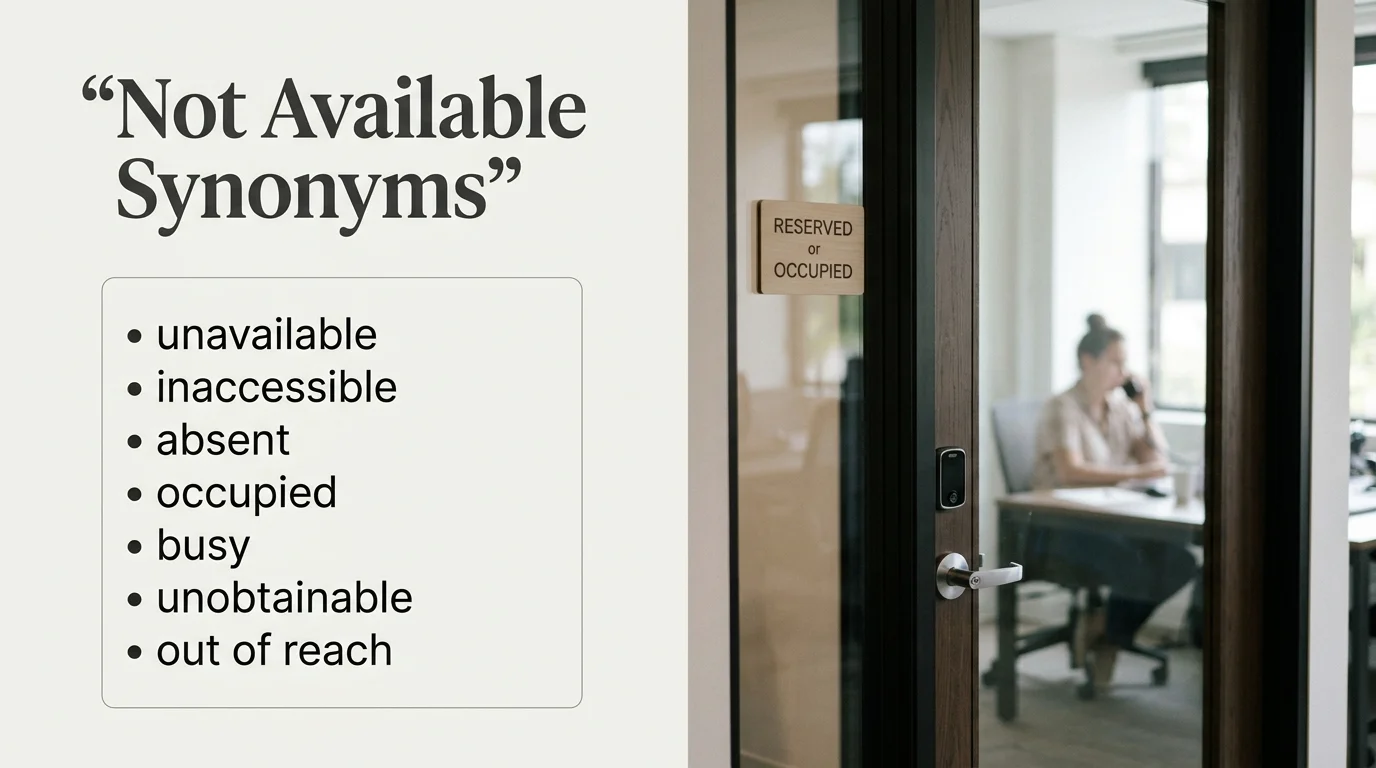
Not Available Synonyms can help when you need to explain that something cannot be found, accessed, used, or obtained. Imagine calling a friend, only to hear that they are not available. In another situation, a website may be unavailable because of a technical problem.
The phrase not available is common in everyday English. However, repeating it in every conversation or piece of writing can sound dull. Words such as unavailable, inaccessible, and out of stock can communicate the same general idea more precisely.
Learning not available synonyms helps you choose words that fit the situation. A person may be busy, a product may be sold out, or a document may be inaccessible. Each expression describes a different kind of unavailability.
Students, bloggers, content writers, and daily English users can all benefit from this vocabulary. The right alternative makes emails clearer, essays more natural, and conversations easier to understand.
What Does “Not Available” Really Mean?
“Not available” means that people cannot reach, obtain, use, access, or find someone or something at a particular time or in a particular situation.
The exact meaning depends on the noun it describes and the surrounding context. For example, an employee may be unavailable because they are busy. A book may be unavailable because no copies remain. A website may be unavailable because its server is down.
The phrase usually works as an adjective phrase. It contains the adverb not and the adjective available. The adjective describes whether something is ready for use, accessible, obtainable, or free for someone to use.
Simple examples
- “The manager is not available right now.” The manager cannot speak at the moment.
- “This size is not available.” The product cannot currently be obtained in that size.
- “The website is not available.” The website cannot currently be accessed.
- “The meeting room is not available.” Someone else may be using it, or it may be reserved.
Native English speakers use not available because it is flexible and polite. It does not always explain why something cannot be used. That can be helpful when the reason is unknown, private, or unimportant.
Connotative Meaning
Connotation means the feeling, attitude, or association a word or phrase communicates beyond its basic dictionary meaning.
- Positive tone: The phrase itself is not usually positive, but a more constructive alternative can soften the message. “The team is available tomorrow” offers a helpful next step.
- Negative tone: “The service is unavailable” may suggest inconvenience, a technical failure, or a lack of access.
- Neutral tone: “The doctor is not available this afternoon” simply states a scheduling fact.
The phrase does not automatically express a negative attitude. Its emotional effect depends on the situation. A polite refusal, a technical error, and an empty shelf can all involve unavailability for different reasons.
Etymology and Word History
The phrase not available combines two elements: not, which expresses negation, and available, which means ready or able to be used, obtained, or accessed.
The word available entered English through Anglo-French and Middle French forms related to the verb avail. That word has roots in the idea of being useful or having value. Its deeper history connects to Old French and ultimately Latin expressions associated with strength, worth, or effectiveness.
Old English (450–1100)
The modern phrase not available was not used in its present form during the Old English period. English speakers used other words and expressions to describe things that could not be obtained or used.
The word not developed from Old English forms such as nōt, used to express negation. The modern idea of availability existed, but it was expressed through different vocabulary.
Middle English (1100–1500)
During the Middle English period, English absorbed many words and forms from French following the Norman Conquest. Related forms of avail entered the language and developed meanings involving usefulness, benefit, or effectiveness.
The adjective available developed later from this family of words. It became useful for describing resources, people, and opportunities that could be used or obtained.
Modern English (1500–Present)
Over time, available became a common adjective in English. It now describes people who are free to speak or meet, products that can be purchased, information that can be accessed, and resources ready for use.
The phrase not available is widely used in everyday speech, business communication, customer service, technology, education, and online publishing.
Pronunciation (US and UK IPA)
The pronunciation of the phrase depends on the accent, especially the pronunciation of available.
- US: not available — /nɑːt əˈveɪləbəl/
- UK: not available — /nɒt əˈveɪləbəl/
Syllables: not-a-vail-a-ble
Affixation pattern:
- Root: avail, associated with usefulness or benefit.
- Prefix: not functions as a separate negating word, not as a prefix attached to available.
- Suffix: -able forms an adjective meaning capable of being used, obtained, or accessed in this word family.
The phrase is not a single derived word. It is a combination of a negator and an adjective.
Synonyms List
There is no single synonym for not available that fits every situation. The best replacement depends on whether you mean a person is busy, a product cannot be purchased, a service is not working, or information cannot be accessed.
The following alternatives cover common meanings. Some are close substitutes, while others fit only specific contexts. Check the example sentences before choosing one.
1. Unavailable
US: /ˌʌnəˈveɪləbəl/ | UK: /ˌʌnəˈveɪləbəl/
Meaning: Unavailable means that someone or something cannot be reached, obtained, accessed, or used at the moment.
Examples:
- The director is unavailable until noon.
- This feature is currently unavailable in your region.
2. Inaccessible
US: /ˌɪnækˈsɛsəbəl/ | UK: /ˌɪnəkˈsesəbəl/
Meaning: Inaccessible describes something that cannot be reached or entered, either physically or digitally.
Examples:
- The mountain road is inaccessible after heavy snow.
- The report is inaccessible without permission.
3. Unobtainable
US: /ˌʌnəbˈteɪnəbəl/ | UK: /ˌʌnəbˈteɪnəbəl/
Meaning: Unobtainable describes something that cannot be acquired or obtained.
Examples:
- That rare edition is almost unobtainable.
- The requested document was unobtainable from the archive.
4. Unattainable
US: /ˌʌnəˈteɪnəbəl/ | UK: /ˌʌnəˈteɪnəbəl/
Meaning: Unattainable means impossible or extremely difficult to achieve or reach.
Examples:
- The deadline seemed unattainable after the delay.
- Without the required access, that goal remained unattainable.
Note: Use this mainly for goals, standards, or objectives, not for ordinary items that are temporarily out of stock.
5. Out of Stock
US: /ˌaʊt əv ˈstɑːk/ | UK: /ˌaʊt əv ˈstɒk/
Meaning: Out of stock means a seller has no units of a particular product available to sell.
Examples:
- The blue headphones are out of stock.
- That book is out of stock at our local shop.
6. Sold Out
US: /ˌsoʊld ˈaʊt/ | UK: /ˌsəʊld ˈaʊt/
Meaning: Sold out means all available tickets, seats, or products have been sold.
Examples:
- The concert is sold out for Friday night.
- All copies of the new novel sold out in one day.
7. Not in Stock
US: /ˌnɑːt ɪn ˈstɑːk/ | UK: /ˌnɒt ɪn ˈstɒk/
Meaning: Not in stock means a shop does not currently have an item available in its inventory.
Examples:
- The larger size is not in stock today.
- This model is not in stock at our nearest branch.
8. Unobtainable at Present
US: /ˌʌnəbˈteɪnəbəl ət ˈprezənt/ | UK: /ˌʌnəbˈteɪnəbəl ət ˈprezənt/
Meaning: This phrase means that something cannot currently be obtained, although that may change later.
Examples:
- The original records are unobtainable at present.
- A replacement part is unobtainable at present.
9. Out of Reach
US: /ˌaʊt əv ˈriːtʃ/ | UK: /ˌaʊt əv ˈriːtʃ/
Meaning: Out of reach describes something that cannot be reached physically or accessed within someone’s current abilities or circumstances.
Examples:
- The controls were out of reach for the child.
- The archive remains out of reach without special permission.
10. Unreachable
US: /ˌʌnˈriːtʃəbəl/ | UK: /ˌʌnˈriːtʃəbəl/
Meaning: Unreachable means that someone or something cannot be contacted or reached.
Examples:
- I tried calling, but the technician was unreachable.
- The cabin was unreachable because the bridge had collapsed.
11. Uncontactable
US: /ˌʌnkənˈtæktəbəl/ | UK: /ˌʌnkɒnˈtæktəbəl/
Meaning: Uncontactable describes someone who cannot be contacted through the available communication methods.
Examples:
- The traveler was uncontactable during the flight.
- We marked the client as uncontactable after several attempts.
12. Absent
US: /ˈæbsənt/ | UK: /ˈæbsənt/
Meaning: Absent means that someone or something is not present where expected.
Examples:
- The teacher is absent this morning.
- Several important details were absent from the report.
13. Away
US: /əˈweɪ/ | UK: /əˈweɪ/
Meaning: Away means that a person is not at their usual place or location.
Examples:
- The receptionist is away from her desk.
- I’ll be away from the office until Monday.
14. Busy
US: /ˈbɪzi/ | UK: /ˈbɪzi/
Meaning: Busy describes someone who is occupied with a task and cannot give attention to something else.
Examples:
- I’m busy right now, but I can call you later.
- The doctor is busy with another patient.
15. Occupied
US: /ˈɑːkjəˌpaɪd/ | UK: /ˈɒkjʊpaɪd/
Meaning: Occupied means that a person is engaged in an activity or a place is being used.
Examples:
- The meeting room is occupied until three.
- She is occupied with an urgent assignment.
16. Engaged
US: /ɪnˈɡeɪdʒd/ | UK: /ɪnˈɡeɪdʒd/
Meaning: Engaged can mean busy with a task or unable to respond because attention is already committed.
Examples:
- The line is engaged, so please try again.
- The professor is engaged in a discussion.
17. Tied Up
US: /ˌtaɪd ˈʌp/ | UK: /ˌtaɪd ˈʌp/
Meaning: Tied up is an informal phrase meaning very busy or unable to leave a current task.
Examples:
- I’m tied up in meetings all afternoon.
- The support team is tied up with another issue.
18. Booked
US: /bʊkt/ | UK: /bʊkt/
Meaning: Booked means that a person, room, or service has been reserved for a particular time.
Examples:
- The consultant is booked until Thursday.
- The hotel room is already booked for the weekend.
19. Fully Booked
US: /ˌfʊli ˈbʊkt/ | UK: /ˌfʊli ˈbʊkt/
Meaning: Fully booked means that all available appointments, rooms, seats, or places have been reserved.
Examples:
- The clinic is fully booked this morning.
- Every table is fully booked for Saturday evening.
20. Reserved
US: /rɪˈzɝːvd/ | UK: /rɪˈzɜːvd/
Meaning: Reserved means that something has been set aside for a particular person or purpose.
Examples:
- These seats are reserved for invited guests.
- The conference room is reserved until lunchtime.
21. Taken
US: /ˈteɪkən/ | UK: /ˈteɪkən/
Meaning: Taken means that a place, item, or opportunity is already occupied, claimed, or being used.
Examples:
- Sorry, this seat is taken.
- The last appointment has been taken.
22. In Use
US: /ɪn ˈjuːs/ | UK: /ɪn ˈjuːs/
Meaning: In use means that something is currently being used and may not be free for someone else.
Examples:
- The printer is in use at the moment.
- That laboratory is in use until four o’clock.
23. Not Free
US: /ˌnɑːt ˈfriː/ | UK: /ˌnɒt ˈfriː/
Meaning: Not free means that someone cannot spare time or that a space is not available for use.
Examples:
- I’m not free this evening, but I’m available tomorrow.
- The parking space is not free right now.
24. Uncommitted
US: /ˌʌnkəˈmɪtɪd/ | UK: /ˌʌnkəˈmɪtɪd/
Meaning: Uncommitted describes time, resources, or people that have not yet been assigned or dedicated to a particular obligation.
Examples:
- We have no uncommitted staff for the evening shift.
- The final hour remains uncommitted on my calendar.
Note: This is not a general replacement for not available. It is useful when discussing resources or schedules that have not been assigned.
25. Off the Market
US: /ˌɔːf ðə ˈmɑːrkɪt/ | UK: /ˌɒf ðə ˈmɑːkɪt/
Meaning: Off the market means that an item or property is no longer being offered for sale or that someone is no longer seeking a romantic partner.
Examples:
- The apartment is off the market.
- After their wedding, he joked that he was officially off the market.
26. Discontinued
US: /ˌdɪskənˈtɪnjuːd/ | UK: /ˌdɪskənˈtɪnjuːd/
Meaning: Discontinued means that a product or service is no longer being produced or offered.
Examples:
- This phone model has been discontinued.
- The company discontinued that service last year.
27. Out of Service
US: /ˌaʊt əv ˈsɝːvɪs/ | UK: /ˌaʊt əv ˈsɜːvɪs/
Meaning: Out of service means that equipment, a facility, or a transport service is not operating or cannot currently be used.
Examples:
- The elevator is out of service today.
- That train route is temporarily out of service.
28. Out of Order
US: /ˌaʊt əv ˈɔːrdər/ | UK: /ˌaʊt əv ˈɔːdə/
Meaning: Out of order means that a machine or device is not working properly.
Examples:
- The ticket machine is out of order.
- One of the office printers is out of order again.
29. Down
US: /daʊn/ | UK: /daʊn/
Meaning: Down is an informal technical term meaning that a website, network, or system is not functioning.
Examples:
- The payment page is down at the moment.
- Our email server was down for an hour.
30. Offline
US: /ˌɔːfˈlaɪn/ | UK: /ˌɒfˈlaɪn/
Meaning: Offline means that a device or system is not connected to a network or is not operating online.
Examples:
- The support portal is offline for maintenance.
- My laptop stayed offline during the trip.
31. Closed
US: /kloʊzd/ | UK: /kləʊzd/
Meaning: Closed means that a place or service is not open for visitors or customers.
Examples:
- The library is closed on public holidays.
- The office is closed for staff training.
32. Not Open
US: /ˌnɑːt ˈoʊpən/ | UK: /ˌnɒt ˈəʊpən/
Meaning: Not open means that a place, service, or opportunity is currently unavailable for entry or use.
Examples:
- The registration period is not open yet.
- The café is not open until eight.
33. Vacant
US: /ˈveɪkənt/ | UK: /ˈveɪkənt/
Meaning: Vacant means that a room, position, or property is empty and not currently occupied.
Examples:
- There are no vacant rooms at the hotel.
- The company has a vacant position in its finance team.
Note: A vacant room or position may be available rather than unavailable. Use this word when describing whether a space or role is occupied, and check the context carefully.
34. Missing
US: /ˈmɪsɪŋ/ | UK: /ˈmɪsɪŋ/
Meaning: Missing means that something expected cannot be found or is not present.
Examples:
- The file is missing from the shared folder.
- One page is missing from the application.
35. Not Found
US: /ˌnɑːt ˈfaʊnd/ | UK: /ˌnɒt ˈfaʊnd/
Meaning: Not found means that a person, item, record, or piece of information could not be located.
Examples:
- The requested record was not found.
- I searched the drawer, but the receipt was not found.
36. Unlisted
US: /ʌnˈlɪstɪd/ | UK: /ʌnˈlɪstɪd/
Meaning: Unlisted means that something does not appear on a particular list, directory, or published record.
Examples:
- The number is unlisted in the public directory.
- That item is unlisted in the current catalogue.
Note: Unlisted does not necessarily mean unavailable. It means the item is not included in a list, so its availability may still need to be checked.
37. Not Provided
US: /ˌnɑːt prəˈvaɪdɪd/ | UK: /ˌnɒt prəˈvaɪdɪd/
Meaning: Not provided means that a person or organization has not supplied something that may be needed.
Examples:
- A translation is not provided with this edition.
- The form was returned because proof of address was not provided.
38. Not Offered
US: /ˌnɑːt ˈɔːfərd/ | UK: /ˌnɒt ˈɒfəd/
Meaning: Not offered means that a service, option, or product is not being made available by a particular provider.
Examples:
- Weekend appointments are not offered at this clinic.
- This course is not offered during the summer term.
39. Temporarily Unavailable
US: /ˌtempəˌrerəli ˌʌnəˈveɪləbəl/ | UK: /ˌtempərərəli ˌʌnəˈveɪləbəl/
Meaning: Temporarily unavailable means that something cannot be used or obtained now but may become available again.
Examples:
- The service is temporarily unavailable while we update the system.
- The item is temporarily unavailable at our local branch.
40. No Longer Available
US: /ˌnoʊ ˈlɔːŋɡər əˈveɪləbəl/ | UK: /ˌnəʊ ˈlɒŋɡə əˈveɪləbəl/
Meaning: No longer available means that something that was once obtainable, accessible, or offered cannot be obtained or used anymore.
Examples:
- The older version is no longer available.
- That scholarship is no longer available for new applicants.
Synonyms for “Not Available” by Tone
Choosing the right alternative is not only about meaning. Tone matters because the wrong expression can sound too formal, too blunt, or simply inaccurate.
Neutral Synonyms
These options communicate a situation without adding much emotion.
- Unavailable: A broad, useful choice for people, services, information, and products.
- Inaccessible: Best when something cannot be reached or accessed.
- Absent: Useful when a person or expected element is not present.
- Not in stock: Specific to products and retail inventory.
- Not found: Suitable for missing records, files, or search results.
- Not provided: Appropriate when something has not been supplied.
- Not offered: Useful for services, features, and options.
Example: “The document is inaccessible” is more precise than “The document is not available” when the problem is restricted access.
Positive or Polite Alternatives
There are few genuinely positive synonyms for not available, because the phrase describes a limitation. However, you can communicate the same situation in a more helpful way.
- Unavailable at the moment: Polite and neutral.
- Available at another time: Focuses on a future opportunity.
- Fully booked: Clearly explains a scheduling limitation.
- Currently occupied: Gives a neutral reason for a room or person being unavailable.
- Temporarily unavailable: Reassures the reader that the limitation may not be permanent.
Examples:
- “I’m unavailable at the moment, but I can call you this afternoon.”
- “The team is fully booked today. We have appointments tomorrow.”
Negative or Problem-Focused Alternatives
These expressions suggest a restriction, failure, or difficulty.
- Out of stock: No inventory is currently available.
- Sold out: All available units, seats, or tickets have been sold.
- Out of order: A machine or device is not functioning.
- Out of service: Equipment or a service cannot currently be used.
- Down: A digital system is not working.
- Discontinued: A product or service is no longer being offered.
- Unobtainable: Something cannot be obtained.
Examples:
- “The ticket machine is out of order.”
- “The model has been discontinued.”
Use negative expressions when they describe the facts. Do not use discontinued merely because a product is temporarily unavailable; the word suggests a longer-term decision to stop offering it.
Playful or Informal Alternatives
Some expressions make everyday conversations sound more natural, especially when talking about your schedule.
- Tied up: Busy with something else.
- Booked solid: Fully occupied with appointments or commitments.
- Not free: Unable to make time for something.
- Taken: Already occupied or claimed.
- Away from my desk: Not currently at one’s workstation.
Examples:
- “I’m tied up until lunch, so let’s talk later.”
- “Sorry, that seat is taken.”
These are not interchangeable in every situation. For example, tied up usually describes a busy person, while out of stock describes a product.
“Not Available” vs. Close Alternatives
The expressions below overlap with not available, but each has a distinct use. Choosing the more precise word can make your writing clearer.
| Word or phrase | Main meaning | Best used for |
|---|---|---|
| Unavailable | Cannot be used, reached, or obtained | People, services, products, information |
| Inaccessible | Cannot be reached or accessed | Websites, locations, files, restricted information |
| Unobtainable | Cannot be acquired | Rare items, records, resources |
| Busy | Occupied with a task | People and schedules |
| Out of stock | No units are available for sale | Retail products |
| Sold out | All available units or places have been sold | Tickets, events, products |
| Out of order | Not functioning properly | Machines and equipment |
| Discontinued | No longer produced or offered | Products and services |
| Absent | Not present | People, details, or expected elements |
| Temporarily unavailable | Not available now but potentially available later | Services, websites, products |
When should you use “unavailable”?
Use unavailable when you need a broad, neutral expression and do not need to explain the exact reason.
- “The information is unavailable.”
- “The manager is unavailable.”
- “The service is unavailable.”
When should you use “inaccessible”?
Choose inaccessible when the issue is access rather than general availability.
- “The file is inaccessible without a password.”
- “The village became inaccessible after the landslide.”
When should you use “out of stock”?
Choose out of stock when a seller does not currently have the item in inventory.
- “The black shoes are out of stock.”
- “The replacement filter is out of stock at the moment.”
The key difference is simple: unavailable is broad, inaccessible focuses on access, and out of stock specifically describes inventory.
How “Not Available” Changes by Context
A synonym that sounds natural in conversation may be unsuitable for a formal email. Consider the audience, the reason for unavailability, and the result you want to communicate.
1. Daily Conversation
In casual conversation, people often use simple expressions such as busy, away, not free, or tied up.
Instead of saying, “I am not available for a conversation right now,” you could say:
- “I’m busy right now.”
- “I’m tied up at the moment.”
- “I’m not free this evening.”
If you are talking about a seat or parking space, taken is usually more natural.
- “Sorry, that seat is taken.”
- “That parking spot is already occupied.”
2. Writing and Blogging
Bloggers and content writers should choose alternatives that identify the actual problem. This improves clarity and avoids vague statements.
For example, “The information is not available” could mean the information is missing, restricted, or not yet published.
More precise options include:
- “The information is unavailable in the public record.”
- “The article is inaccessible without a subscription.”
- “The details were not provided in the original announcement.”
- “The product is no longer available.”
Do not replace every instance of not available with a different phrase just to vary the wording. Relevance matters more than variety.
3. Professional and Academic English
Professional writing often benefits from neutral and precise language. Unavailable, inaccessible, not provided, and not offered can work well in reports and formal correspondence.
Examples:
- “The requested data is currently unavailable.”
- “The source document was inaccessible during the review.”
- “Supporting evidence was not provided.”
- “This module is not offered in the current academic year.”
In formal writing, explain the reason when it is known and relevant. If a service is unavailable because of maintenance, say so rather than leaving the reader to guess.
4. Customer Service and Business Communication
Customer-facing messages should state the limitation clearly and, when possible, explain what happens next.
Less helpful: “Your appointment is not available.”
Clearer: “That appointment slot is fully booked. We can offer you a time tomorrow.”
Other useful examples include:
- “The requested size is currently out of stock.”
- “The service is temporarily unavailable while maintenance is underway.”
- “That option is not offered at this location.”
Avoid promising a return date unless it has been confirmed.
5. Technology and Websites
Technical contexts have their own common vocabulary. A website may be down, a device may be offline, and a file may be inaccessible.
Examples:
- “The website is temporarily unavailable.”
- “The server is down.”
- “The device is offline.”
- “The account page is inaccessible without authentication.”
These phrases are related but not identical. A device can be offline even when it is working properly, while a device that is out of order may have a mechanical or technical fault.
6. Creative and Informal Writing
Writers can use expressions that match the voice of a character or narrator.
- “He was nowhere to be found.” This suggests that someone could not be located.
- “Every seat was taken.” This paints a simple picture of a crowded place.
- “The old shop was closed for good.” This suggests a permanent closure.
- “She was tied up with family matters.” This sounds conversational and personal.
Creative language should still preserve the intended meaning.
“Nowhere to be found” describes a situation in which someone cannot locate a person or thing; it does not necessarily mean they cannot obtain it.
Common Mistakes Learners Make
Learning synonyms is useful, but replacing one phrase with another without checking the context can change the meaning.
Mistake 1: Treating Every Alternative as Interchangeable
Busy, sold out, inaccessible, and discontinued describe different situations.
Incorrect: “The website is sold out.”
Better: “The website is down” or “The website is temporarily unavailable,” depending on the problem.
People use “sold out” to describe items or tickets that sellers have sold, not a website that has stopped working.
Mistake 2: Confusing “Unavailable” With “Discontinued”
Unavailable may describe a temporary problem.
A manufacturer or company usually discontinues a product or service when it stops producing or offering it.
- Temporary: “The model is unavailable this week.”
- Discontinued: “The manufacturer has discontinued the model.”
Use “discontinued” only when a company no longer offers the item or service.
Mistake 3: Using “Inaccessible” When You Mean “Out of Stock”
A product can be out of stock even if its product page is easy to access.
- “The shoes are out of stock” means the shop has no units available.
- “The product page is inaccessible” means you cannot access the page.
Check whether the problem concerns the item itself or the ability to reach information about it.
Mistake 4:Using “Absent” to Describe Everything You Cannot Find
Absent usually means not present. It does not automatically mean that something is impossible to obtain.
- Natural: “The manager is absent today.”
- More precise for a missing file: “The file is missing from the folder.”
Use absent when presence is the main issue.
Mistake 5: Making a Polite Message Sound Too Blunt
A short message such as “I’m unavailable” is correct, but it can sound abrupt if the situation calls for a friendly response.
Consider adding an alternative:
- “I’m unavailable this afternoon, but tomorrow morning works for me.”
- “I’m tied up right now. Could we speak after lunch?”
This keeps the message clear while showing willingness to communicate.
Mistake 6: Saying “Booked” When You Mean “Busy”
Booked usually suggests a scheduled appointment or reservation. Busy is broader.
- “The doctor is fully booked today.” There are no appointment slots left.
- “The doctor is busy with a patient.” The doctor is occupied right now.
The difference can matter when you are trying to arrange a meeting or appointment.
Mistake 7: Using “Vacant” to Mean “Unavailable”
Vacant means empty or unoccupied. A vacant room or job position may actually be available.
- “The room is vacant” means no one is occupying it.
- “The hotel cannot currently let guests use or book the room.”
Always consider whether the word describes the current state of a place or whether it explains whether someone can use it.
Register Notes: Formal vs. Informal
| Register | Useful expressions |
|---|---|
| Formal | Unavailable, inaccessible, unobtainable, not provided |
| Neutral | Absent, not found, not offered, temporarily unavailable |
| Informal | Busy, tied up, not free, taken |
| Retail | Out of stock, sold out, discontinued |
| Technical | Offline, down, out of service, out of order |
| Scheduling | Booked, fully booked, occupied, reserved |
In spoken English, busy and tied up often sound natural. In reports, unavailable or inaccessible may be more suitable. For customer notices, expressions such as temporarily unavailable and out of stock explain the situation directly.
Real-Life Mini Scenarios Using “Not Available” Synonyms
These short scenarios show how context helps you choose the right phrase.
Workplace Scenario
Maya wants to speak with her supervisor about a report, but he is already in a meeting.
Natural expression: “The supervisor is occupied right now.”
If the supervisor has scheduled meetings throughout the day, you could say, “The supervisor has filled his schedule with meetings today.”
Social Scenario
A friend invites Daniel to dinner, but he has already made plans.
Natural expression: “Daniel is not free tonight.”
For a more conversational reply, Daniel might say, “I have a lot to do this evening, so I can’t meet you. ”Can we meet tomorrow?”
Shopping Scenario
A customer wants to buy a jacket, but the shop has sold every unit in the required size.
Natural expression: “That size is out of stock.”
If the shop has sold every jacket, you can say, “The shop has sold out of the jackets.” If the manufacturer has stopped making the jacket, say, “The manufacturer has discontinued it.”
Technology Scenario
A student tries to open an online learning platform, but the page will not load because the server is experiencing problems.
Natural expression: “The platform is down.”
If the team deliberately switches off the system for maintenance, “The team has temporarily taken the platform offline” may be more suitable.
Academic Scenario
A researcher looks for a historical document, but the archive does not have a copy.
Natural expression: “The document is unobtainable from the archive.”
If the document exists but requires special authorization, say it is inaccessible without permission.
Storytelling Scenario
A character returns to a familiar café, only to discover that it has permanently closed.
Natural expression: “The café is no longer open.”
For a more dramatic narrative, you could write, “The café had closed for good.”
Practice Exercise: Choose the Best Synonym
Choose the expression that best fits each situation. Focus on meaning, tone, and context.
Question 1
A colleague cannot speak because they are handling an urgent task. Which phrase fits best?
A. Sold out B. Tied up C. Discontinued D. Inaccessible
Question 2
A shop has no remaining units of a particular phone model. What should it say?
A. The phone is absent. B. The phone is occupied. C. The phone is out of stock. D. The phone is offline.
Question 3
The machine has stopped working, so people cannot use it. Which expression is most suitable?
A. Fully booked B. Out of order C. Away D. Unlisted
Question 4
A website is not functioning because of a server problem. Which phrase is common in technical conversation?
A. The website is down. B. The website is sold out. C. The website is vacant. D. The website is booked.
Question 5
Someone has reserved every appointment slot at a clinic. Which phrase describes the schedule?
A. Fully booked B. Unreachable C. Discontinued D. Missing
Question 6
A document exists, but you cannot open it without authorization. Which word is most precise?
A. Absent B. Busy C. Inaccessible D. Sold out
Question 7
The manufacturer no longer makes or offers the product. Which word fits best?
A. Occupied B. Discontinued C. Temporarily unavailable D. Taken
Question 8
You cannot find the file in the folder where someone should have stored it. What is the clearest description?
A. The file is booked. B. The file is missing. C. The file is busy. D. The file is sold out.
Question 9
You cannot attend dinner because you already have plans. Which expression sounds natural in everyday English?
A. I’m out of order. B. I’m discontinued. C. I’m not free tonight. D. I’m out of stock.
Question 10
Guests have reserved every room in the hotel for the weekend. What should the receptionist say?
A. The hotel is fully booked. B. The hotel is offline.
C. The hotel is missing. D. The hotel is unlisted.
Question 11
The team expects to restore the service after maintenance, but it is unavailable right now. Which phrase communicates this best?
A. Permanently absent B. Temporarily unavailable C. Sold out D. Unattainable
Question 12
A public directory does not include a particular telephone number. Which word best describes the number’s status in that directory?
A. Occupied B. Tied up C. Unlisted D. Out of order
Question 13
A company does not offer a particular course during the summer term. Which phrase is most accurate?
A. The course is taken. B. The course is not offered. C. The course is out of order. D. The course is unreachable.
Reflection Task
Write two original sentences using different alternatives for not available.
- In the first sentence, describe a person who cannot meet you.
- In the second sentence, describe a product, website, or service that people cannot use or obtain.
Then check whether each synonym matches the exact situation.
Answer key: 1-B, 2-C, 3-B, 4-A, 5-A, 6-C, 7-B, 8-B, 9-C, 10-A, 11-B, 12-C, 13-B.
Conclusion
Learning not available synonyms helps you explain everyday situations with greater accuracy. A person may be busy, a product may be out of stock, and a website may be inaccessible. The right word makes the difference clear.
Synonyms also improve writing, blogging, speaking, and communication. They help you avoid repetition while choosing language that suits the reader, the setting, and the message you want to convey.
Start practicing these alternatives in emails, essays, work messages, and daily conversations. Pay attention to the context before choosing a replacement, because similar expressions do not always mean exactly the same thing.
Keep exploring not available synonyms and use a new expression whenever it fits naturally. A little practice can make your English clearer, more precise, and more confident.

Evelyn Hartwell is an English vocabulary writer who focuses on clear, practical language for learners and everyday readers. Her writing explores synonyms, word meanings, pronunciation, tone, and natural usage. She believes that learning vocabulary should be simple, useful, and enjoyable. Her articles are designed to help students, bloggers, and English learners choose the right words with greater confidence.