Synonyms for papyrus can be useful when you are describing ancient writing, Egyptian history, manuscripts, or materials similar to early paper.
Imagine reading about an ancient Egyptian document and seeing the word papyrus again and again. A related word can make your writing smoother.
For students, bloggers, and content writers, synonyms for papyrus can add variety. Daily English users can also understand historical texts more easily.
Learning synonyms for papyrus also shows how one word can describe a plant, writing material, sheet, or ancient document depending on context.
What Does “Papyrus” Really Mean?
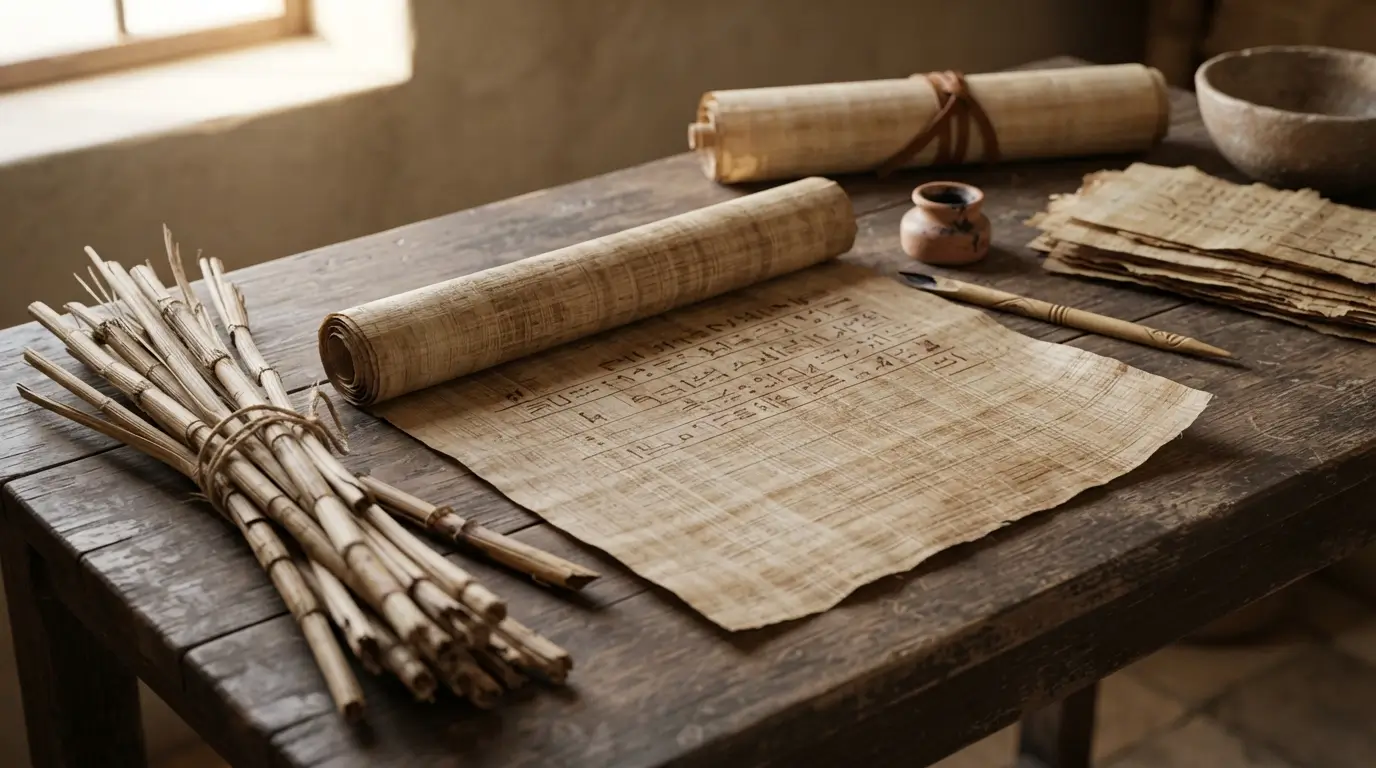
Papyrus is a noun that usually refers to a writing material made from the stems of the papyrus plant.
The plant traditionally grew in wet areas, especially around the Nile region. Ancient Egyptians and other civilizations used it to make sheets for writing and record-keeping.
The word can also refer to a document or manuscript written on papyrus.
For example:
- The museum displayed an ancient papyrus.
- Scholars studied the papyrus for information about ancient life.
Native English speakers usually understand papyrus as a historical writing material or an ancient written document.
The word commonly appears in:
- Ancient Egyptian history
- Archaeology
- Museums
- Historical writing
- Literature
- Religious studies
- Manuscript studies
- Art history
- Ancient languages
Unlike words that describe emotions or opinions, papyrus normally has a neutral, factual tone.
Connotative Meaning
Connotation (the feelings, associations, or ideas a word can suggest beyond its basic dictionary meaning) can affect how a word feels in context.
Positive Tone
Papyrus can suggest history, knowledge, preservation, scholarship, and cultural heritage.
Neutral Tone
In academic or historical writing, papyrus is mainly a factual term for the material or a document made from it.
Negative Tone
The word itself has no strong negative connotation. A negative feeling may come from the context, such as discussing damaged, destroyed, or lost historical records.
Etymology of Papyrus
The history of papyrus is closely connected with the ancient Mediterranean world.
The English word ultimately comes from Greek pápyros, which referred to the papyrus plant or material made from it. Latin papyrus also influenced the word’s development in European languages.
Old English: 450–1100
Papyrus was not a normal Old English word. English speakers at that time did not commonly use the modern English term because the language and written traditions were different.
Middle English: 1100–1500
The word remained associated with learned and classical traditions rather than ordinary English vocabulary. Knowledge of ancient Mediterranean writing materials was often transmitted through Latin and scholarly texts.
Modern English: 1500–Present
During the Modern English period, papyrus became established as a historical and scholarly term.
Today, it refers both to the plant and to the writing material produced from it. It can also describe ancient documents written on that material.
Pronunciation
US: /pəˈpaɪrəs/
UK: /pəˈpaɪrəs/
Syllables
pa-py-rus
Affixation Pattern of Papyrus
Root: papyrus
Prefix: None in modern English
Suffix: None in modern English
Papyrus is a borrowed word rather than a modern English word formed by adding a productive prefix or suffix.
Synonyms List
Before looking at the list, one important distinction matters.
Papyrus has relatively few true one-word synonyms. It names a specific plant and a specific historical writing material. Words such as parchment, paper, and manuscript are related terms, but they are not exact synonyms.
To avoid misleading learners, the list below identifies direct synonyms, close alternatives, material terms, document terms, and context-specific alternatives where appropriate.
Paper — Noun
Meaning: A thin material commonly used for writing, printing, or drawing.
Examples:
- The student wrote the notes on paper.
- Ancient papyrus is often compared with early forms of paper.
Usage note: Paper is a close functional alternative, not an exact synonym for historical papyrus.
Writing Material — Noun Phrase
Meaning: A material used to record written information.
Examples:
- Papyrus was an important writing material in the ancient world.
- The researcher examined the old writing material carefully.
Writing Medium — Noun Phrase
Meaning: A physical or digital form used to record written information.
Examples:
- Stone was another ancient writing medium.
- Papyrus became an important writing medium in Egypt.
Writing Surface — Noun Phrase
Meaning: A surface on which words, symbols, or images can be written.
Examples:
- The scribe prepared the writing surface.
- The fragile writing surface contained faded symbols.
Manuscript — Noun
Meaning: A handwritten or historically produced document.
Examples:
- The museum preserved an ancient manuscript.
- Scholars examined the manuscript for clues about its origin.
Usage note: A manuscript can be written on papyrus, parchment, paper, or another surface.
Document — Noun
Meaning: A written or recorded piece of information.
Examples:
- The archaeologists discovered an ancient document.
- The document contained several lines of text.
Text — Noun
Meaning: Written words that communicate information or ideas.
Examples:
- The text was difficult to read.
- Researchers translated the ancient text.
Record — Noun
Meaning: Information preserved in written or another recorded form.
Examples:
- The papyrus provides a valuable record of daily life.
- Historians used the record to study the period.
Scroll — Noun
Meaning: A document made from a long sheet of material that is rolled up.
Examples:
- The museum displayed an ancient scroll.
- The scroll contained religious writing.
Usage note: A scroll describes the form of a document, not necessarily its material.
Manuscript Scroll — Noun Phrase
Meaning: A scroll containing handwritten or copied text.
Examples:
- The scholar studied the manuscript scroll.
- The manuscript scroll contained several damaged sections.
Sheet — Noun
Meaning: A flat, thin piece of material.
Examples:
- The scribe worked on a thin sheet.
- Several sheets were joined together.
Leaf — Noun
Meaning: A single sheet or page of a manuscript or book.
Examples:
- The researcher turned the manuscript’s first leaf.
- One leaf had several missing sections.
Folio — Noun
Meaning: A single leaf or sheet of a manuscript or book.
Examples:
- The note appears on the second folio.
- The damaged folio was carefully preserved.
Usage note: Folio is a technical manuscript term, not an exact synonym for papyrus.
Page — Noun
Meaning: One side or section of a written document or book.
Examples:
- The information appears on the final page.
- The researcher photographed each page.
Tablet — Noun
Meaning: A flat surface used for writing, especially in ancient times.
Examples:
- The archaeologists found a clay tablet.
- The tablet contained ancient writing.
Usage note: A tablet is usually made from a different material, such as clay.
Parchment — Noun
Meaning: A writing material traditionally made from prepared animal skin.
Examples:
- The medieval text was written on parchment.
- The museum protects the fragile parchment.
Usage note: Parchment is a close historical writing-material alternative, but it is not papyrus.
Vellum — Noun
Meaning: A fine form of parchment traditionally made from animal skin.
Examples:
- The illuminated manuscript used vellum.
- The vellum remained remarkably well preserved.
Membrane — Noun
Meaning: A thin layer or sheet of material.
Examples:
- The ancient material formed a thin membrane.
- The researcher examined the delicate membrane.
Usage note: This is a descriptive material term, not a direct synonym.
Fiber — Noun
Meaning: A thin thread-like part of a natural or manufactured material.
Examples:
- The plant contains strong fibers.
- Researchers examined the papyrus fibers under magnification.
Plant Fiber — Noun Phrase
Meaning: A fibrous material obtained from a plant.
Examples:
- Ancient craftsmen worked with plant fiber.
- The material was made from processed plant fibers.
Reed — Noun
Meaning: A tall plant with a long, slender stem that grows in or near water.
Examples:
- The ancient material came from a reed-like plant.
- The artist included reeds in the historical illustration.
Usage note: Reed describes the plant source or appearance and is not an exact synonym for papyrus.
Papyrus Plant — Noun Phrase
Meaning: The plant from which traditional papyrus material was produced.
Examples:
- The papyrus plant grows naturally in wet environments.
- Ancient workers processed the papyrus plant to make writing sheets.
Cyperus Papyrus — Proper Noun
Meaning: The scientific name of the plant species traditionally associated with papyrus production.
Examples:
- Cyperus papyrus is associated with ancient Egyptian culture.
- Botanists study Cyperus papyrus as a wetland plant.
Reed Paper — Noun Phrase
Meaning: A paper-like material made from reed or similar plant material.
Examples:
- The project used reed paper for its historical demonstration.
- The artist selected reed paper for its natural texture.
Plant-Based Writing Material — Noun Phrase
Meaning: Writing material produced from plant matter.
Examples:
- Papyrus was an early plant-based writing material.
- The exhibit explains how this plant-based writing material was prepared.
Natural Writing Material — Noun Phrase
Meaning: A writing surface made from naturally occurring materials.
Examples:
- Papyrus was a valuable natural writing material.
- The display compares several natural writing materials.
Ancient Writing Material — Noun Phrase
Meaning: A material used for writing in ancient societies.
Examples:
- Papyrus was a major ancient writing material.
- The museum compares different ancient writing materials.
Historical Writing Material — Noun Phrase
Meaning: A material historically used to record written information.
Examples:
- Papyrus is an important historical writing material.
- Students learned how the historical writing material was produced.
Ancient Record — Noun Phrase
Meaning: A preserved record originating from an ancient period.
Examples:
- The papyrus serves as an ancient record.
- The ancient record provides information about trade.
Historical Record — Noun Phrase
Meaning: A preserved source containing information about the past.
Examples:
- The document is an important historical record.
- Researchers compared the historical record with other evidence.
Written Record — Noun Phrase
Meaning: Information preserved through writing.
Examples:
- The papyrus provides a written record of the transaction.
- The written record helped historians understand the event.
Ancient Text — Noun Phrase
Meaning: Written material originating from an ancient period.
Examples:
- Scholars translated the ancient text.
- The ancient text describes a religious ceremony.
Historical Text — Noun Phrase
Meaning: A written source connected with a past period.
Examples:
- The researcher analyzed the historical text.
- The historical text offers valuable cultural information.
Religious Text — Noun Phrase
Meaning: A written work connected with religious beliefs, teachings, or practices.
Examples:
- The museum preserves an ancient religious text.
- Scholars translated the religious text carefully.
Literary Text — Noun Phrase
Meaning: Written material valued for its literary content or form.
Examples:
- The papyrus contains a fascinating literary text.
- Researchers studied the literary text for its language.
Archival Document — Noun Phrase
Meaning: A document preserved as part of a historical or institutional collection.
Examples:
- The museum cataloged the archival document.
- The archival document revealed new information.
Primary Source — Noun Phrase
Meaning: Original evidence created during the period being studied.
Examples:
- The papyrus can serve as a primary source.
- Students analyzed the primary source in class.
Usage note: A papyrus can be a primary source, but primary source describes its research function rather than its physical material.
Historical Source — Noun Phrase
Meaning: Evidence used to learn about the past.
Examples:
- The papyrus is an important historical source.
- Historians compared the historical source with archaeological evidence.
Archaeological Document — Noun Phrase
Meaning: A document discovered or studied as archaeological evidence.
Examples:
- The team preserved the archaeological document.
- The archaeological document contained faded writing.
Ancient Manuscript — Noun Phrase
Meaning: A handwritten document produced in an ancient period.
Examples:
- The library holds an ancient manuscript.
- Experts examined the ancient manuscript for damage.
Manuscript Fragment — Noun Phrase
Meaning: A surviving piece of a larger manuscript.
Examples:
- Researchers discovered a manuscript fragment.
- The manuscript fragment contained only a few lines.
Papyrus Fragment — Noun Phrase
Meaning: A surviving piece of papyrus material or a papyrus document.
Examples:
- The museum preserved a small papyrus fragment.
- The papyrus fragment contains several ancient symbols.
Papyrus Sheet — Noun Phrase
Meaning: A sheet made from processed papyrus material.
Examples:
- The scribe wrote on a papyrus sheet.
- The damaged papyrus sheet required careful handling.
Papyrus Document — Noun Phrase
Meaning: A written document produced on papyrus.
Examples:
- The archive contains an ancient papyrus document.
- Scholars translated the papyrus document.
Papyrus Manuscript — Noun Phrase
Meaning: A manuscript written or preserved on papyrus.
Examples:
- The museum displayed a papyrus manuscript.
- The papyrus manuscript contains several pages of text.
Synonyms for “Papyrus” by Tone
Because papyrus is mainly a historical and material term, its alternatives are better grouped by register and function than by emotional tone.
Positive
These terms can suggest cultural value, preservation, and historical importance:
- Historical record
- Primary source
- Ancient manuscript
- Historical source
- Cultural record
Neutral
These are useful for straightforward descriptions:
- Writing material
- Writing medium
- Writing surface
- Sheet
- Document
- Manuscript
- Text
- Record
- Scroll
- Papyrus sheet
Negative
There are no common negative synonyms for papyrus itself.
A negative meaning usually comes from an adjective or surrounding context, such as:
- Damaged manuscript
- Destroyed document
- Fragmentary text
- Lost record
These describe the condition or history of the material rather than replacing papyrus.
Playful / Informal
There are few natural informal synonyms for papyrus. In casual conversation, people normally continue using papyrus rather than substituting a slang term.
Why Tone Matters
Choosing the right alternative helps readers understand exactly what you mean.
For example, writing material focuses on physical use, while ancient manuscript focuses on the written document.
Likewise, primary source emphasizes research value rather than physical appearance.
“Papyrus” vs Close Alternatives
Papyrus vs. Parchment
The term Papyrus is traditionally made from the papyrus plant.
Parchment is traditionally made from prepared animal skin.
Both served as writing materials, but they are physically and historically different.
Papyrus vs. Paper
Paper is a broad modern term for a thin writing or printing material.
Papyrus is a specific historical material made from the papyrus plant.
So, paper can be a functional comparison, but it should not automatically replace papyrus in historical writing.
Papyrus vs. Manuscript
Papyrus identifies the material or, by extension, a document written on that material.
Manuscript identifies a handwritten or historically produced document.
A manuscript can therefore be made from papyrus, parchment, or another material.
How “Papyrus” Changes by Context
Daily Conversation
In everyday conversation, papyrus usually appears when someone is discussing history, museums, archaeology, or ancient Egypt.
For example:
We saw an ancient papyrus at the museum.
A simpler phrase such as ancient document may work when the material itself is not important.
Writing or Blogging
Bloggers can use related terms to avoid unnecessary repetition.
For example, an article might move naturally between papyrus, ancient writing material, papyrus sheet, and historical document.
However, each replacement should preserve the intended meaning.
Professional or Academic Tone
Academic writing often benefits from precise terms such as:
- Papyrus material
- Papyrus manuscript
- Manuscript fragment
- Primary source
- Historical record
- Writing medium
These terms tell readers what aspect of the object matters.
Creative or Informal Use
Creative writing may describe papyrus as an ancient sheet, fragile manuscript, or old writing surface when visual atmosphere matters.
These are descriptive alternatives rather than exact synonyms.
Common Mistakes Learners Make
Calling Parchment Papyrus
Parchment and papyrus are different materials.
Using one as a direct replacement for the other can create a historical error.
Calling Every Ancient Document Papyrus
Not every ancient document was written on papyrus.
Ancient societies also used clay tablets, stone, metal, wood, parchment, and other surfaces.
Treating Paper as an Exact Synonym
Modern paper and ancient papyrus serve similar purposes, but they are not the same material.
Using Manuscript as a Material Term
A manuscript describes a written document.
It does not tell you what material the document is made from.
Using Scroll as a Direct Replacement
A scroll describes how a document is formed or stored.
A scroll can be made from papyrus, parchment, or other materials.
Overusing Historical Terms
Words such as primary source and historical record are useful in academic contexts, but they can sound unnatural in a simple sentence.
Always choose the term that matches your intended meaning.
Register Notes
Papyrus: neutral, historical, academic
Writing material: neutral and explanatory
Manuscript: neutral to formal
Primary source: academic
Historical record: neutral to formal
Parchment: historical and material-specific
Vellum: formal and specialized
Scroll: neutral and descriptive
Sheet: simple and general
Text: neutral and widely used
In spoken English, papyrus itself is perfectly acceptable when the historical material matters.
In academic writing, more specific phrases often provide greater precision.
Real-Life Examples Using “Papyrus”
Workplace
A museum employee prepares information for an exhibition about ancient writing.
The exhibition includes several examples of papyrus.
Here, papyrus identifies the historical material.
Social Situation
Someone visits an archaeology museum with friends.
I didn’t realize how important papyrus was to ancient record-keeping.
The word sounds natural because the conversation involves history.
Media and Pop Culture
A documentary discusses ancient Egypt.
The narrator explains how papyrus was prepared for writing.
The material itself is central to the explanation.
Writing and Storytelling
A historical novelist describes a scholar discovering an ancient document.
She carefully unfolded the fragile papyrus.
Here, papyrus creates a clear historical image without needing a longer explanation.
Frequently Asked Questions
What is another word for papyrus?
There is no single perfect synonym for papyrus. Depending on context, writing material, writing medium, ancient writing material, or papyrus sheet can work. Parchment and paper are related materials but are not exact synonyms.
What is the closest synonym for papyrus?
Writing material is one of the closest general alternatives because papyrus was historically used as a writing material. However, it is broader than papyrus and does not identify the specific plant-based material.
Is parchment a synonym for papyrus?
No. Parchment and papyrus were both important historical writing materials, but they were made differently. Papyrus came from the papyrus plant, while parchment was traditionally prepared from animal skin.
Is paper another word for papyrus?
Not exactly. Paper is a broad term for a thin writing material, while papyrus refers to a specific ancient plant-based material. They have similar functions but different origins and properties.
What is the synonym for papyrus in ancient Egypt?
There is no perfect English synonym that preserves every meaning. Terms such as ancient writing material, papyrus sheet, and papyrus document can explain its role, depending on context.
What is a synonym for a papyrus document?
Depending on the context, manuscript, ancient manuscript, historical document, ancient text, or written record may work. The best choice depends on whether you are emphasizing the document, its age, or its content.
What is the difference between papyrus and manuscript?
Papyrus can describe a material and can also refer to a document written on that material. Manuscript refers to the written document itself. A manuscript can exist on papyrus, parchment, paper, or another surface.
Practice Exercise
Choose the Best Word
- The ancient document was written on a plant-based material called ___.
A. papyrus
B. vellum
C. tablet
D. medal - The medieval manuscript was written on animal-skin material called ___.
A. papyrus
B. parchment
C. reed
D. paper - The researcher examined an ancient handwritten ___.
A. manuscript
B. currency
C. fiber
D. reed - The museum displayed a long rolled-up ancient ___.
A. scroll
B. sheet
C. fiber
D. tablet - A papyrus can serve as a valuable ___ for historians.
A. primary source
B. currency
C. suffix
D. medal - The researcher focused on the physical material used as a ___.
A. writing medium
B. denomination
C. currency
D. title - A surviving piece of an ancient manuscript is a ___.
A. manuscript fragment
B. currency
C. paragraph
D. prefix - Which term describes a broad modern writing material?
A. paper
B. papyrus
C. scroll
D. folio - Which word describes a single manuscript leaf?
A. folio
B. reed
C. fiber
D. parchment - The ancient ___ contained information about trade.
A. document
B. currency
C. plant
D. suffix - Which term focuses on the research value of an original historical document?
A. primary source
B. sheet
C. reed
D. page - Which word specifically refers to the papyrus plant’s scientific name?
A. Cyperus papyrus
B. parchment
C. manuscript
D. vellum
Answer Key: 1-A | 2-B | 3-A | 4-A | 5-A | 6-A | 7-A | 8-A | 9-A | 10-A | 11-A | 12-A
Reflection Task
Write five short sentences using papyrus, manuscript, parchment, scroll, and primary source. Make each sentence show a different meaning or context.
Conclusion
Synonyms for papyrus are easiest to understand when you first decide whether you mean the plant, writing material, or document made from it.
Words such as manuscript, writing material, and scroll can be useful, but they describe different aspects of papyrus.
For accurate writing, avoid treating paper or parchment as exact synonyms. Their similarities are useful, but their materials and histories differ.
Practice these words in essays, articles, notes, and conversations. Better synonym choices can make your English clearer, richer, and more precise.

Evelyn Hartwell is an English vocabulary writer who focuses on clear, practical language for learners and everyday readers. Her writing explores synonyms, word meanings, pronunciation, tone, and natural usage. She believes that learning vocabulary should be simple, useful, and enjoyable. Her articles are designed to help students, bloggers, and English learners choose the right words with greater confidence.