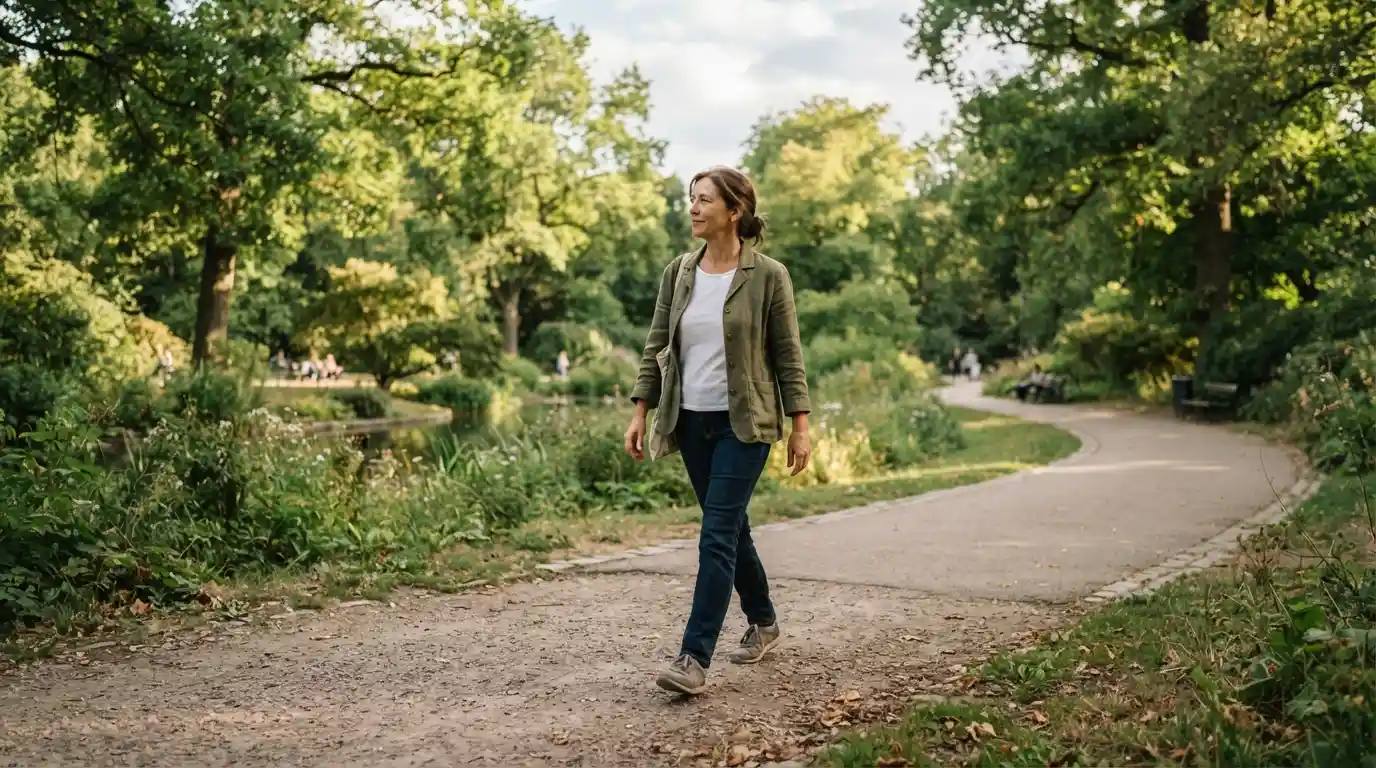
Synonyms for amble can make ordinary descriptions more vivid. Imagine walking through a quiet park without rushing, enjoying each step while watching the trees and people nearby.
Synonyms for amble help you describe that relaxed movement more precisely. You might stroll through town, saunter into a café, or wander around a garden.
Learning synonyms for amble also improves vocabulary. Students, bloggers, writers, and daily English users can choose words that match the exact mood and situation.
The word amble is useful because it describes an easy, unhurried way of walking. Its alternatives help you avoid repetition and make everyday English sound more natural.
What Does “Amble” Really Mean?
Amble is a verb and a noun.
As a verb, amble means to walk slowly and comfortably, usually without any sense of hurry.
As a noun, amble refers to a slow, relaxed walk.
A simple definition is:
Amble: to walk at a relaxed and unhurried pace.
Native speakers usually understand amble as a pleasant or casual kind of walking. It does not normally suggest effort, urgency, or speed.
For example, someone may amble along the beach, amble through a park, or amble home after dinner.
The word often creates a calm mental picture. It can describe people, and in some contexts, animals such as horses.
Category of “Amble”
Category: Movement and walking vocabulary; specifically, relaxed or unhurried movement.
Connotative Meaning
What is connotation? (Connotation is the feeling, attitude, or extra meaning that a word suggests beyond its basic dictionary meaning.)
Positive Tone
Amble often has a pleasant, peaceful, and relaxed feeling. It can suggest that someone is enjoying the journey rather than trying to reach a destination quickly.
Negative Tone
The word itself is usually not negative. However, context can make it sound slightly critical if someone needs to hurry but continues to walk slowly.
Neutral Tone
In a neutral context, amble simply describes slow, comfortable walking without adding a strong emotional judgment.
Etymology of “Amble”
The word amble entered English through Anglo-French and Middle English forms related to walking in an easy or leisurely manner. It ultimately traces back to Latin ambulare, meaning “to walk.”
Old English: 450–1100
The modern word amble was not an established Old English word in its present form. Old English had other vocabulary for walking and movement.
Middle English: 1100–1500
Forms related to Anglo-French ambler entered Middle English. The word developed around the idea of moving or walking in an easy, distinctive manner.
Modern English: 1500–Present
Over time, amble became established in English as a word for slow, relaxed walking. Modern usage commonly presents it as a calm alternative to simply saying walk slowly.
Pronunciation
- US: /ˈæm.bəl/
- UK: /ˈæm.bəl/
Syllables
am-ble
Affixation Pattern of “Amble”
Root: amble
Prefix: None
Suffix: None in the modern word
Amble is a simple lexical word rather than a modern prefixed or suffixed formation.
Synonyms List
The list below includes direct synonyms and close contextual alternatives. Some words overlap strongly with amble, while others describe a particular kind of slow, relaxed, wandering, or deliberate walking. Context matters.
1. Stroll
Stroll (Verb/Noun) — US IPA /stroʊl/ | UK IPA /strəʊl/
Meaning: To walk slowly and casually, usually for pleasure or relaxation.
Examples
- We strolled along the river after lunch.
- She likes to stroll around the neighborhood in the evening.
2. Saunter
Saunter (Verb/Noun) — US IPA /ˈsɔːn.tɚ/ | UK IPA /ˈsɔːn.tə/
Meaning: To walk in a slow, relaxed, and confident way.
Examples
- He sauntered into the room with a smile.
- They sauntered down the street without a clear destination.
3. Wander
Wander (Verb/Noun) — US IPA /ˈwɑːn.dɚ/ | UK IPA /ˈwɒn.də/
Meaning: To walk around without a fixed direction or destination.
Examples
- I wandered through the old market for an hour.
- We wandered around the village before dinner.
4. Ramble
Ramble (Verb/Noun) — US IPA /ˈræm.bəl/ | UK IPA /ˈræm.bəl/
Meaning: To walk for pleasure, especially through the countryside.
Examples
- We rambled through the hills on Sunday.
- My grandparents enjoy a morning ramble.
5. Meander
Meander (Verb/Noun) — US IPA /miˈæn.dɚ/ | UK IPA /miˈæn.də/
Meaning: To move or walk without a direct route, often following a winding path.
Examples
- We meandered through the narrow village streets.
- She meandered along the garden path.
6. Mosey
Mosey (Verb) — US IPA /ˈmoʊ.zi/ | UK IPA /ˈməʊ.zi/
Meaning: To move or walk slowly and casually.
Examples
- He moseyed over to the kitchen.
- We moseyed down to the beach after breakfast.
7. Perambulate
Perambulate (Verb) — US IPA /pəˈræm.bjə.leɪt/ | UK IPA /pəˈræm.bjʊ.leɪt/
Meaning: To walk around or through a place, usually in a leisurely way.
Examples
- The visitors perambulated around the historic grounds.
- He spent the afternoon perambulating through the town.
8. Promenade
Promenade (Verb/Noun) — US IPA /ˌprɑː.məˈneɪd/ | UK IPA /ˌprɒm.əˈnɑːd/
Meaning: To walk slowly in a public place, often for pleasure or display.
Examples
- Couples promenaded along the waterfront.
- We promenaded beside the lake at sunset.
9. Dawdle
Dawdle (Verb) — US IPA /ˈdɔː.dəl/ | UK IPA /ˈdɔː.dəl/
Meaning: To move or walk slowly, often because you are wasting time.
Examples
- Stop dawdling and come inside.
- The children dawdled along the path after school.
10. Loiter
Loiter (Verb) — US IPA /ˈlɔɪ.tɚ/ | UK IPA /ˈlɔɪ.tə/
Meaning: To remain or move around a place without an obvious purpose.
Examples
- A few people loitered outside the store.
- The teenager loitered near the entrance.
11. Traipse
Traipse (Verb) — US IPA /treɪps/ | UK IPA /treɪps/
Meaning: To walk from place to place, often in a tiring or casual way.
Examples
- We traipsed around the shops all afternoon.
- She traipsed through the muddy field.
12. Drift
Drift (Verb/Noun) — US IPA /drɪft/ | UK IPA /drɪft/
Meaning: To move slowly and without a clear direction.
Examples
- We drifted around the festival for hours.
- He drifted toward the garden without saying anything.
13. Plod
Plod (Verb/Noun) — US IPA /plɑːd/ | UK IPA /plɒd/
Meaning: To walk slowly and heavily, often because of tiredness.
Examples
- We plodded home after the long hike.
- He plodded along the road in the rain.
14. Trudge
Trudge (Verb/Noun) — US IPA /trʌdʒ/ | UK IPA /trʌdʒ/
Meaning: To walk slowly with effort, especially when tired or facing difficult conditions.
Examples
- They trudged through the snow.
- I trudged home after a tiring day.
15. Amble Along
Amble Along (Verb Phrase) — US IPA /ˈæm.bəl əˈlɔːŋ/ | UK IPA /ˈæm.bəl əˈlɒŋ/
Meaning: To continue walking at a relaxed and unhurried pace.
Examples
- We ambled along the quiet road.
- He ambled along beside his friend.
16. Stroll Along
Stroll Along (Verb Phrase) — US IPA /stroʊl əˈlɔːŋ/ | UK IPA /strəʊl əˈlɒŋ/
Meaning: To walk casually and pleasantly along a route.
Examples
- We strolled along the beach.
- She strolled along the path with her dog.
17. Saunter Along
Saunter Along (Verb Phrase) — US IPA /ˈsɔːn.tɚ əˈlɔːŋ/ | UK IPA /ˈsɔːn.tə əˈlɒŋ/
Meaning: To walk along slowly with a relaxed, confident manner.
Examples
- He sauntered along the sidewalk.
- She sauntered along as though she had nowhere to be.
18. Mosey Along
Mosey Along (Verb Phrase) — US IPA /ˈmoʊ.zi əˈlɔːŋ/ | UK IPA /ˈməʊ.zi əˈlɒŋ/
Meaning: To move along slowly and casually.
Examples
- We moseyed along toward the café.
- He moseyed along the trail after breakfast.
19. Meander Along
Meander Along (Verb Phrase) — US IPA /miˈæn.dɚ əˈlɔːŋ/ | UK IPA /miˈæn.də əˈlɒŋ/
Meaning: To move along slowly while following an indirect route.
Examples
- We meandered along the coastal path.
- They meandered along the lanes of the old town.
20. Wander Along
Wander Along (Verb Phrase) — US IPA /ˈwɑːn.dɚ əˈlɔːŋ/ | UK IPA /ˈwɒn.də əˈlɒŋ/
Meaning: To walk along without following a strict destination or route.
Examples
- We wandered along the market street.
- She wandered along until she found a quiet café.
21. Roam
Roam (Verb/Noun) — US IPA /roʊm/ | UK IPA /rəʊm/
Meaning: To move freely around a wide area without a fixed route.
Examples
- We roamed around the countryside all day.
- The children roamed freely around the garden.
22. Stray
Stray (Verb/Adjective) — US IPA /streɪ/ | UK IPA /streɪ/
Meaning: To move away from a planned route or intended direction.
Examples
- We strayed from the main path.
- He strayed into a quiet side street.
23. Pace
Pace (Verb/Noun) — US IPA /peɪs/ | UK IPA /peɪs/
Meaning: To walk back and forth at a measured speed.
Examples
- She paced around the room while thinking.
- He paced slowly beside the window.
Usage note: Pace is not normally as relaxed as amble. It often suggests repeated movement or thoughtfulness.
24. Walk
Walk (Verb/Noun) — US IPA /wɔːk/ | UK IPA /wɔːk/
Meaning: To move on your feet by taking steps.
Examples
- We walked home after dinner.
- I walk through the park every morning.
Usage note: Walk is the broadest and most neutral term. Amble specifically suggests an unhurried pace.
25. Proceed
Proceed (Verb) — US IPA /prəˈsiːd/ | UK IPA /prəˈsiːd/
Meaning: To continue moving or go forward, usually in a more formal context.
Examples
- The guests proceeded toward the garden.
- We proceeded slowly along the narrow path.
26. Move
Move (Verb/Noun) — US IPA /muːv/ | UK IPA /muːv/
Meaning: To change position or travel from one place to another.
Examples
- He moved slowly toward the door.
- We moved around the park for an hour.
Usage note: Move is much broader than amble and does not automatically imply walking.
27. Go
Go (Verb/Noun) — US IPA /ɡoʊ/ | UK IPA /ɡəʊ/
Meaning: To travel or move from one place to another.
Examples
- We went along the river path.
- She went slowly toward the station.
28. Travel
Travel (Verb/Noun) — US IPA /ˈtrævəl/ | UK IPA /ˈtrævəl/
Meaning: To move from one place to another, especially over some distance.
Examples
- We traveled through the countryside on foot.
- They traveled slowly along the coastal route.
Usage note: Travel usually covers greater distances than amble.
29. Hike
Hike (Verb/Noun) — US IPA /haɪk/ | UK IPA /haɪk/
Meaning: To take a long walk, especially in the countryside or mountains.
Examples
- We hiked through the forest yesterday.
- They hiked along the mountain trail.
Usage note: A hike can be slow, but it often involves more effort than an amble.
30. Trek
Trek (Verb/Noun) — US IPA /trek/ | UK IPA /trek/
Meaning: To walk or travel a long distance, often with some difficulty.
Examples
- We trekked across the valley.
- They trekked for hours before reaching the village.
31. March
March (Verb/Noun) — US IPA /mɑːrtʃ/ | UK IPA /mɑːtʃ/
Meaning: To walk with regular, deliberate steps.
Examples
- The students marched toward the field.
- The group marched steadily along the road.
Usage note: March is controlled and purposeful, so it usually lacks the relaxed feeling of amble.
32. Shuffle
Shuffle (Verb/Noun) — US IPA /ˈʃʌfəl/ | UK IPA /ˈʃʌfəl/
Meaning: To walk slowly while barely lifting your feet.
Examples
- He shuffled across the kitchen in slippers.
- The tired passengers shuffled toward the exit.
33. Toddle
Toddle (Verb/Noun) — US IPA /ˈtɑːdəl/ | UK IPA /ˈtɒdəl/
Meaning: To walk with short, unsteady steps, especially like a young child.
Examples
- The toddler toddled across the room.
- She watched her son toddle toward the garden.
Usage note: Toddle refers to a specific style of walking and is not a general replacement for amble.
34. Potter
Potter (Verb) — US IPA /ˈpɑːtɚ/ | UK IPA /ˈpɒtə/
Meaning: To move around slowly while doing small or ordinary activities.
Examples
- She pottered around the garden all morning.
- He pottered about the house before breakfast.
Usage note: This is especially common in British English.
35. Lope
Lope (Verb/Noun) — US IPA /loʊp/ | UK IPA /ləʊp/
Meaning: To move with long, easy steps, usually at a faster pace than an amble.
Examples
- The dog loped across the field.
- The horse loped toward the fence.
Usage note: Lope often describes animals and suggests an easy but relatively quick movement.
36. Saunter
Saunter (Verb/Noun) — US IPA /ˈsɔːn.tɚ/ | UK IPA /ˈsɔːn.tə/
Meaning: To walk slowly in a relaxed, often confident manner.
Examples
- She sauntered toward the fountain.
- He sauntered into the café after noon.
Usage note: Saunter is one of the closest everyday alternatives to amble.
37. Stroll
Stroll (Verb/Noun) — US IPA /stroʊl/ | UK IPA /strəʊl/
Meaning: To walk casually and slowly, usually for enjoyment.
Examples
- Dad strolled through the garden.
- We took a short stroll after dinner.
Usage note: Stroll is extremely natural when describing a pleasant walk.
38. Ramble
Ramble (Verb/Noun) — US IPA /ˈræm.bəl/ | UK IPA /ˈræm.bəl/
Meaning: To take a long, informal walk, especially outdoors.
Examples
- They rambled across the countryside.
- I went for a ramble before sunset.
39. Wander
Wander (Verb/Noun) — US IPA /ˈwɑːn.dɚ/ | UK IPA /ˈwɒn.də/
Meaning: To move around freely without a definite direction.
Examples
- He wandered through the museum.
- We wandered around the old neighborhood.
Usage note: Wander focuses more on direction than pace, while amble focuses more on relaxed speed.
40. Rove
Rove (Verb/Noun) — US IPA /roʊv/ | UK IPA /rəʊv/
Meaning: To travel or move from place to place without a fixed route.
Examples
- They roved around the countryside.
- The travelers roved from village to village.
41. Saunter Off
Saunter Off (Verb Phrase) — US IPA /ˈsɔːn.tɚ ɔːf/ | UK IPA /ˈsɔːn.tə ɒf/
Meaning: To leave by walking away slowly and casually.
Examples
- He sauntered off after finishing his coffee.
- She sauntered off toward the garden.
42. Stroll Away
Stroll Away (Verb Phrase) — US IPA /stroʊl əˈweɪ/ | UK IPA /strəʊl əˈweɪ/
Meaning: To walk away slowly and casually.
Examples
- She strolled away from the crowd.
- He strolled away with his hands in his pockets.
43. Walk Leisurely
Walk Leisurely (Verb Phrase) — US IPA /wɔːk ˈliːʒɚli/ | UK IPA /wɔːk ˈleʒəli/
Meaning: To walk at a comfortable pace without rushing.
Examples
- We walked leisurely beside the lake.
- They walked leisurely through the village.
44. Walk Slowly
Walk Slowly (Verb Phrase) — US IPA /wɔːk ˈsloʊli/ | UK IPA /wɔːk ˈsləʊli/
Meaning: To move on foot at a low speed.
Examples
- She walked slowly toward the station.
- He walked slowly through the crowded street.
45. Move Leisurely
Move Leisurely (Verb Phrase) — US IPA /muːv ˈliːʒɚli/ | UK IPA /muːv ˈleʒəli/
Meaning: To move at an easy pace without urgency.
Examples
- The group moved leisurely toward the river.
- He moved leisurely around the garden.
Important usage note: Not every item above is a perfect dictionary substitute for amble. Words such as stroll, saunter, mosey, and perambulate are much closer. Terms such as trudge, march, hike, and wander add different ideas about effort, purpose, distance, or direction. Good vocabulary choice depends on context.
Synonyms for “Amble” by Tone
Positive
These words often create a pleasant or relaxed impression:
- Stroll
- Saunter
- Ramble
- Promenade
- Mosey
- Amble along
- Stroll along
- Walk leisurely
They work well when you want the reader to imagine comfort, enjoyment, or a peaceful pace.
Neutral
These words describe movement without strongly expressing approval or criticism:
- Walk
- Wander
- Meander
- Roam
- Move
- Proceed
- Travel
- Rove
The exact meaning depends heavily on the surrounding sentence.
Negative or Critical
These words can suggest delay, tiredness, difficulty, or lack of purpose:
- Dawdle
- Loiter
- Trudge
- Plod
- Shuffle
For example, dawdle can imply that someone should be moving faster.
Playful or Informal
These options can sound casual or conversational:
- Mosey
- Potter
- Toddle
- Traipse
- Saunter
Mosey is particularly useful in relaxed American English.
“Amble” vs Close Alternatives
Amble vs Stroll
Both words describe slow, relaxed walking.
Amble emphasizes an easy, unhurried pace. Stroll often emphasizes walking for pleasure.
Use amble when the pace matters. Use stroll when the leisurely activity itself matters.
Amble vs Saunter
Both suggest relaxed movement.
Saunter can add confidence or an almost casual attitude. Amble sounds gentler and more neutral.
For example, a person may saunter into a room with confidence, while someone may amble through a park peacefully.
Amble vs Wander
Amble focuses on how someone walks. Wander focuses more on where or how someone moves without a fixed direction.
Someone can wander quickly or slowly. Someone who ambles normally moves at an unhurried pace.
How “Amble” Changes by Context
Daily Conversation
In everyday English, stroll, walk, wander, and saunter often sound natural.
For example, you might say, “We went for a stroll after dinner.” You could also say, “We ambled home after dinner.”
The second version gives a slightly stronger sense of relaxed movement.
Writing or Blogging
Writers can use amble to create a visual scene without using a long explanation.
Instead of saying that a character “walked slowly and comfortably through the garden,” you can write that the character ambled through the garden.
This makes descriptions shorter and more vivid.
Professional or Academic Tone
In professional writing, walk is usually clearer and more direct.
Amble can work in descriptive writing, but it may sound too informal or literary in technical instructions.
For example, a report may say that visitors “walked through the facility” rather than “ambled through the facility.”
Creative or Informal Use
Creative writing gives amble more room to shine.
It can establish a peaceful mood, slow down a scene, or show that a character has no reason to hurry.
Informal alternatives such as mosey can create a more relaxed or playful voice.
Common Mistakes & Native Usage
Mistake 1: Treating Every Alternative as Identical
Words such as trudge, march, and hike should not automatically replace amble.
They describe different types of movement.
Mistake 2: Using “Dawdle” as a Positive Word
Dawdle usually suggests unnecessary slowness or wasted time.
If you want a positive tone, choose stroll, saunter, or amble instead.
Mistake 3: Confusing “Wander” With “Amble”
Wander emphasizes a lack of direction. Amble emphasizes a relaxed pace.
A person can wander quickly, but an ambling person normally moves slowly.
Mistake 4: Using “March” for Relaxed Walking
March suggests deliberate, regular, purposeful steps. It does not normally create the peaceful image associated with amble.
Mistake 5: Overusing “Amble”
Although amble is expressive, repeating it several times can make prose feel unnatural.
Use alternatives when they add a genuine difference in meaning.
Register Notes
Formal: perambulate can sound formal or literary.
Neutral: walk, stroll, wander, and meander are widely understood.
Informal: mosey has a casual conversational flavor.
British English: potter is especially useful in British contexts.
Literary: amble, saunter, ramble, and roam can add descriptive or narrative color.
Real-Life Examples Using “Amble”
Workplace
After finishing his tasks, Daniel ambled back to his desk instead of rushing.
Social Situation
The friends ambled through the neighborhood while talking about their weekend plans.
Media and Pop Culture
A relaxed character may be shown ambling into a scene to suggest confidence or a lack of urgency.
Writing and Storytelling
A novelist might write, “She ambled down the garden path,” to create a calm and unhurried image without explaining the character’s pace in detail.
Why Synonyms for Amble Matter
Knowing synonyms is not simply about memorizing long vocabulary lists.
Each word gives you another way to express pace, mood, direction, effort, or attitude.
Compare these sentences:
- He ambled toward the door.
- He strolled toward the door.
- He sauntered toward the door.
- He dawdled toward the door.
- He trudged toward the door.
The basic action remains walking, but the mental image changes.
That difference is exactly why synonyms matter in strong English.
Practice Exercise: Choose the Best Word
Choose the option that fits the situation most naturally.
1. You are describing a peaceful evening walk in a park.
A. Trudge
B. Stroll
C. March
D. Shuffle
2. A person is walking slowly because they are wasting time.
A. Dawdle
B. Hike
C. Trek
D. Promenade
3. Someone enters a room with a relaxed and confident attitude.
A. Trudge
B. Saunter
C. Shuffle
D. Plod
4. A family walks through the countryside for pleasure.
A. Ramble
B. March
C. Stray
D. Proceed
5. A person moves around without knowing exactly where they want to go.
A. Wander
B. March
C. Pace
D. Trek
6. Someone walks heavily after becoming exhausted.
A. Promenade
B. Saunter
C. Plod
D. Mosey
7. Which word is most neutral?
A. Walk
B. Dawdle
C. Trudge
D. Saunter
8. Which informal word means to move slowly and casually?
A. Mosey
B. March
C. Trek
D. Proceed
9. Which word suggests walking while following a winding route?
A. Meander
B. March
C. Pace
D. Shuffle
10. Which word can suggest walking because you are tired or facing difficult conditions?
A. Trudge
B. Promenade
C. Stroll
D. Saunter
11. Which word is especially associated with long countryside walking?
A. Ramble
B. Shuffle
C. Loiter
D. Pace
12. Which word describes walking with short, unsteady steps, especially for a young child?
A. Toddle
B. Trek
C. Roam
D. Proceed
13. Which alternative focuses more on having no fixed direction than on walking speed?
A. Wander
B. Amble
C. Stroll
D. Saunter
14. Which word can suggest staying or moving around without an obvious purpose?
A. Loiter
B. Hike
C. March
D. Promenade
15. Which sentence best fits a peaceful descriptive story?
A. She trudged through the sunny garden.
B. She marched through the sunny garden.
C. She ambled through the sunny garden.
D. She shuffled through the sunny garden.
Reflection Task
Think About Your Own Vocabulary
Choose three words from this list that you would naturally use in conversation. Then write one original sentence for each word.
Answer Key: 1-B | 2-A | 3-B | 4-A | 5-A | 6-C | 7-A | 8-A | 9-A | 10-A | 11-A | 12-A | 13-A | 14-A | 15-C
Conclusion
Synonyms for amble give you more than alternative vocabulary. They help you show pace, mood, direction, and attitude with greater precision.
Words such as stroll, saunter, wander, ramble, mosey, and meander can make everyday English more expressive and natural.
For students and writers, these distinctions can improve essays, stories, blog posts, and conversations. The right synonym makes your meaning easier to picture.
Keep practicing these words in emails, essays, stories, and daily conversations. Try one new synonym today, then notice how its tone changes your sentence.

Evelyn Hartwell is an English vocabulary writer who focuses on clear, practical language for learners and everyday readers. Her writing explores synonyms, word meanings, pronunciation, tone, and natural usage. She believes that learning vocabulary should be simple, useful, and enjoyable. Her articles are designed to help students, bloggers, and English learners choose the right words with greater confidence.