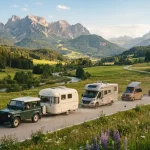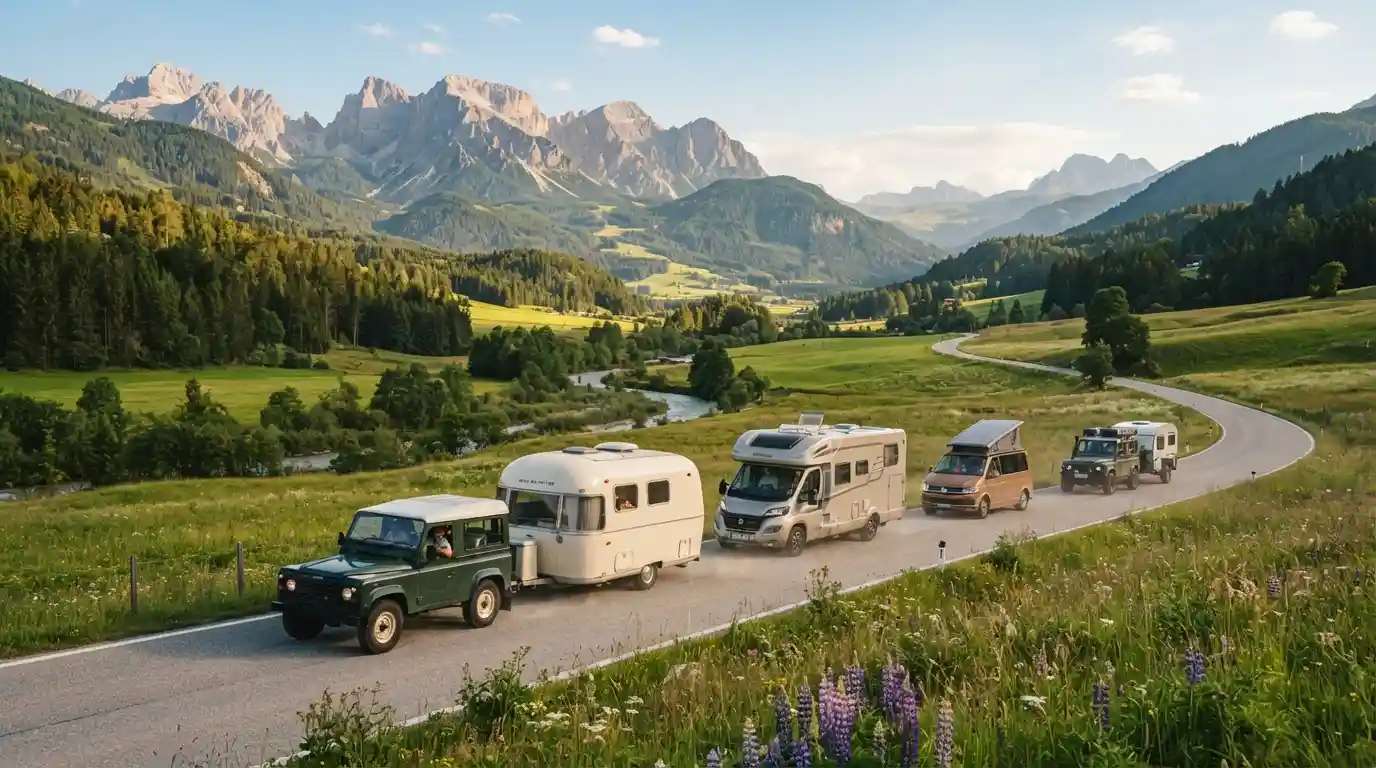
Synonyms for caravan can make travel writing more vivid. Imagine several vehicles moving together on a long road trip through the countryside.
You might call a group a convoy, while a travel trailer may be called a camper. The right word depends on what “caravan” means.
Learning synonyms for caravan helps students, bloggers, and writers avoid repetition. It also makes everyday English sound more natural and precise.
For daily English users, synonyms for caravan are useful when describing road trips, groups of travelers, mobile homes, or organized journeys.
What Does “Caravan” Really Mean?
The word caravan has more than one important meaning in modern English.
In one sense, a caravan is a group of people, animals, or vehicles traveling together, especially across a long route. This meaning is common in travel, history, journalism, and storytelling.
In British English, caravan also commonly means a towable vehicle designed for living or traveling. It may contain beds, a small kitchen, seating, and other basic facilities.
Native speakers understand the meaning from context.
For example:
- “A caravan crossed the desert.” Here, it means a traveling group.
- “We stayed in a caravan near the coast.” Here, it means a mobile holiday home.
Part of speech: Noun
Simple definition: A caravan is either a group traveling together or a towable vehicle used for travel and temporary living.
The word can sound neutral, practical, adventurous, or historical depending on the context.
Connotative Meaning
Connotation (the feeling or idea a word suggests beyond its basic dictionary meaning) changes slightly depending on how caravan is used.
Positive tone:
It can suggest adventure, freedom, companionship, exploration, and travel.
Neutral tone:
It can simply describe a group of travelers or a mobile living vehicle.
Negative tone:
In some political or news contexts, a large group of migrants may be described as a “caravan,” which can carry emotional or political associations.
Playful or informal tone:
When used for family road trips, it can suggest fun, camping, exploration, or a shared adventure.
Etymology of “Caravan”
The English word caravan ultimately comes from Persian kārvān, referring to a group of travelers journeying together.
The word passed through other languages before becoming established in English.
Old English Period: 450–1100
The modern English word was not part of ordinary Old English vocabulary. English during this period had Germanic roots, while caravan entered the language much later through contact with other cultures.
Middle English Period: 1100–1500
Trade and travel across Europe increased the movement of words connected with commerce and long-distance journeys. The Persian-derived term gradually traveled through European languages.
Modern English Period: 1500–Present
Caravan became established in English as a term for a group traveling together, especially merchants and travelers crossing difficult or distant routes.
Later, British English developed another common meaning: a towable vehicle used as temporary accommodation.
Pronunciation of “Caravan”
US: /ˈkærəvæn/
UK: /ˈkærəvæn/
Syllables
car-a-van
Affixation Pattern of “Caravan”
Root: caravan
Prefix: None
Suffix: None
The word is a borrowed lexical root rather than a modern English word formed by adding a common prefix or suffix.
List of Synonyms
Not every alternative below is a perfect dictionary synonym. Caravan has two major meanings, so the best replacement depends on whether you mean a traveling group or a mobile living vehicle.
The list therefore includes exact or near-equivalent alternatives, plus context-specific terms that native speakers may use instead.
1. Convoy
US: /ˈkɑːnvɔɪ/
UK: /ˈkɒnvɔɪ/
Meaning: A convoy is a group of vehicles or travelers moving together for safety, organization, or convenience.
Examples:
- A convoy of trucks crossed the border.
- We traveled in a convoy through the mountains.
2. Procession
US: /prəˈseʃən/
UK: /prəˈseʃən/
Meaning: A procession is an organized group moving from one place to another.
Examples:
- The procession moved slowly through the town.
- A long procession followed the decorated vehicle.
3. Traveling Group
US: /ˈtrævəlɪŋ ɡruːp/
UK: /ˈtrævəlɪŋ ɡruːp/
Meaning: A traveling group is a collection of people journeying together.
Examples:
- The traveling group stopped before sunset.
- Our traveling group included several families.
4. Travel Party
US: /ˈtrævəl ˌpɑːrti/
UK: /ˈtrævəl ˌpɑːti/
Meaning: A travel party is a group of people making a journey together.
Examples:
- The travel party reached the village at noon.
- Our travel party stayed together during the hike.
5. Caravan Train
US: /ˈkærəvæn treɪn/
UK: /ˈkærəvæn treɪn/
Meaning: A caravan train is a long line or group traveling together, especially in historical settings.
Examples:
- The caravan train crossed the desert.
- A caravan train arrived after several weeks.
6. Wagon Train
US: /ˈwæɡən treɪn/
UK: /ˈwæɡən treɪn/
Meaning: A wagon train is a group of wagons traveling together, especially in historical contexts.
Examples:
- The wagon train moved westward.
- The settlers joined a wagon train for safety.
7. Travel Convoy
US: /ˈtrævəl ˈkɑːnvɔɪ/
UK: /ˈtrævəl ˈkɒnvɔɪ/
Meaning: A travel convoy is a group of vehicles traveling together.
Examples:
- The travel convoy left early.
- Several families joined the travel convoy.
8. Motorcade
US: /ˈmoʊtərkeɪd/
UK: /ˈməʊtəkeɪd/
Meaning: A motorcade is an organized line of motor vehicles traveling together.
Examples:
- The motorcade passed through the city.
- Police vehicles led the motorcade.
9. Fleet
US: /fliːt/
UK: /fliːt/
Meaning: A fleet is a group of vehicles, ships, or aircraft belonging to an organization or traveling together.
Examples:
- A fleet of vehicles entered the camp.
- The company operates a large vehicle fleet.
10. Column
US: /ˈkɑːləm/
UK: /ˈkɒləm/
Meaning: A column is a line of people or vehicles moving together.
Examples:
- A column of trucks crossed the plain.
- The vehicles formed a long column.
11. Line
US: /laɪn/
UK: /laɪn/
Meaning: A line is a group of people or vehicles arranged one behind another.
Examples:
- A line of vehicles entered the campsite.
- The travelers formed a long line.
12. Train
US: /treɪn/
UK: /treɪn/
Meaning: In historical or literary use, a train can mean a group of people, animals, or vehicles traveling together.
Examples:
- A train of camels crossed the desert.
- The royal train moved toward the capital.
13. Party
US: /ˈpɑːrti/
UK: /ˈpɑːti/
Meaning: A party can mean a group of people traveling or acting together.
Examples:
- The party reached the village safely.
- A small party traveled ahead of the others.
14. Expedition
US: /ˌekspəˈdɪʃən/
UK: /ˌekspəˈdɪʃən/
Meaning: An expedition is an organized journey made for a particular purpose.
Examples:
- The expedition crossed the desert.
- The research expedition lasted two months.
15. Trek
US: /trek/
UK: /trek/
Meaning: A trek is a long or difficult journey, especially on foot.
Examples:
- The trek through the mountains took days.
- They prepared carefully for the long trek.
16. Journeying Group
US: /ˈdʒɜːrniɪŋ ɡruːp/
UK: /ˈdʒɜːniɪŋ ɡruːp/
Meaning: A journeying group is a group of people traveling together.
Examples:
- The journeying group stopped near the river.
- A journeying group appeared on the horizon.
17. Traveling Party
US: /ˈtrævəlɪŋ ˌpɑːrti/
UK: /ˈtrævəlɪŋ ˌpɑːti/
Meaning: A traveling party is a group making the same journey.
Examples:
- The traveling party reached camp before dark.
- Our traveling party stayed together.
18. Migrant Group
US: /ˈmaɪɡrənt ɡruːp/
UK: /ˈmaɪɡrənt ɡruːp/
Meaning: A migrant group is a group of people moving from one region or country to another.
Examples:
- A migrant group traveled north.
- The report described the migrant group carefully.
19. Band of Travelers
US: /bænd əv ˈtrævələrz/
UK: /bænd əv ˈtrævələrz/
Meaning: A band of travelers is a group of people traveling together, often in literary or historical writing.
Examples:
- A band of travelers arrived at dusk.
- The band of travelers rested beside the road.
20. Company of Travelers
US: /ˈkʌmpəni əv ˈtrævələrz/
UK: /ˈkʌmpəni əv ˈtrævələz/
Meaning: A company of travelers is a group journeying together.
Examples:
- A company of travelers entered the town.
- The company of travelers searched for shelter.
21. Camper
US: /ˈkæmpər/
UK: /ˈkæmpə/
Meaning: A camper is a vehicle or unit designed for camping and temporary living.
Examples:
- We slept comfortably in the camper.
- Their camper was easy to tow.
22. Travel Trailer
US: /ˈtrævəl ˌtreɪlər/
UK: /ˈtrævəl ˌtreɪlə/
Meaning: A travel trailer is a towable vehicle designed for travel and temporary accommodation.
Examples:
- They took the travel trailer to the lake.
- The travel trailer has a small kitchen.
23. Trailer
US: /ˈtreɪlər/
UK: /ˈtreɪlə/
Meaning: A trailer can refer to a towable living unit, especially in American English.
Examples:
- They stayed in a trailer during the trip.
- The trailer was parked near the forest.
24. Camper Trailer
US: /ˈkæmpər ˌtreɪlər/
UK: /ˈkæmpə ˌtreɪlə/
Meaning: A camper trailer is a towable unit used for camping and travel.
Examples:
- Their camper trailer was ready for the weekend.
- We pulled the camper trailer behind the car.
25. Travel Trailer Home
US: /ˈtrævəl ˌtreɪlər hoʊm/
UK: /ˈtrævəl ˌtreɪlə həʊm/
Meaning: A travel trailer home is a towable space arranged for temporary living.
Examples:
- The travel trailer home had two sleeping areas.
- They used their travel trailer home during holidays.
26. Mobile Home
US: /ˈmoʊbəl hoʊm/
UK: /ˈməʊbaɪl həʊm/
Meaning: A mobile home is a manufactured dwelling designed to be moved or relocated.
Examples:
- They lived in a mobile home for several years.
- The mobile home had a spacious interior.
27. Motorhome
US: /ˈmoʊtərhoʊm/
UK: /ˈməʊtəhəʊm/
Meaning: A motorhome is a motor vehicle equipped with living facilities.
Examples:
- We traveled across the country in a motorhome.
- Their motorhome has a small bedroom.
28. RV
US: /ˌɑːr ˈviː/
UK: /ˌɑːr ˈviː/
Meaning: RV is short for recreational vehicle, a vehicle designed for travel and living.
Examples:
- They rented an RV for the road trip.
- The RV was parked near the campsite.
29. Recreational Vehicle
US: /ˌrekriˈeɪʃənəl ˈviːəkəl/
UK: /ˌrekriˈeɪʃənəl ˈviːəkəl/
Meaning: A recreational vehicle is a vehicle equipped for travel, camping, or temporary living.
Examples:
- Their recreational vehicle had a comfortable bed.
- The recreational vehicle was built for long trips.
30. Campervan
US: /ˈkæmpərvæn/
UK: /ˈkæmpəvæn/
Meaning: A campervan is a van fitted with facilities for sleeping and traveling.
Examples:
- We explored the coast in a campervan.
- Their campervan was small but comfortable.
31. Caravanette
US: /ˌkærəvæˈnet/
UK: /ˌkærəvæˈnet/
Meaning: A caravanette is a small caravan or compact mobile living vehicle.
Examples:
- They chose a caravanette for short trips.
- The caravanette was easy to move.
32. Camping Trailer
US: /ˈkæmpɪŋ ˌtreɪlər/
UK: /ˈkæmpɪŋ ˌtreɪlə/
Meaning: A camping trailer is a towable unit designed for recreational travel.
Examples:
- The camping trailer was packed for the trip.
- They kept the camping trailer in storage.
33. Mobile Camper
US: /ˈmoʊbəl ˈkæmpər/
UK: /ˈməʊbaɪl ˈkæmpə/
Meaning: A mobile camper is a movable vehicle or unit used for camping and travel.
Examples:
- Their mobile camper had a compact kitchen.
- The mobile camper was ideal for weekend trips.
34. Holiday Caravan
US: /ˈhɑːlədeɪ ˈkærəvæn/
UK: /ˈhɒlədeɪ ˈkærəvæn/
Meaning: A holiday caravan is a caravan used as temporary accommodation during a vacation.
Examples:
- We stayed in a holiday caravan by the sea.
- The holiday caravan had two bedrooms.
35. Static Caravan
US: /ˈstætɪk ˈkærəvæn/
UK: /ˈstætɪk ˈkærəvæn/
Meaning: A static caravan is a caravan designed to remain in one location rather than travel regularly.
Examples:
- They bought a static caravan near the coast.
- The static caravan stayed on the holiday park.
36. Mobile Dwelling
US: /ˈmoʊbəl ˈdwelɪŋ/
UK: /ˈməʊbaɪl ˈdwelɪŋ/
Meaning: A mobile dwelling is a living space that can be moved from one place to another.
Examples:
- The mobile dwelling provided basic shelter.
- They designed the mobile dwelling for travel.
37. Traveling Home
US: /ˈtrævəlɪŋ hoʊm/
UK: /ˈtrævəlɪŋ həʊm/
Meaning: A traveling home is an informal description of a vehicle or living unit used while traveling.
Examples:
- Their traveling home followed the coastline.
- The family enjoyed life in their traveling home.
38. Nomadic Camp
US: /noʊˈmædɪk kæmp/
UK: /nəʊˈmædɪk kæmp/
Meaning: A nomadic camp is a temporary settlement used by people who move from place to place.
Examples:
- The nomadic camp moved with the seasons.
- The travelers established a nomadic camp nearby.
39. Traveling Caravan
US: /ˈtrævəlɪŋ ˈkærəvæn/
UK: /ˈtrævəlɪŋ ˈkærəvæn/
Meaning: A traveling caravan describes a caravan that is actively moving from one place to another.
Examples:
- The traveling caravan crossed the valley.
- A traveling caravan appeared before sunset.
40. Caravan Party
US: /ˈkærəvæn ˌpɑːrti/
UK: /ˈkærəvæn ˌpɑːti/
Meaning: A caravan party is a group of people traveling together as part of a caravan.
Examples:
- The caravan party reached the oasis.
- A caravan party joined the larger group.
41. Caravan Group
US: /ˈkærəvæn ɡruːp/
UK: /ˈkærəvæn ɡruːp/
Meaning: A caravan group is a group of travelers or vehicles moving together.
Examples:
- The caravan group stopped for water.
- Another caravan group arrived later.
42. Desert Caravan
US: /ˈdezərt ˈkærəvæn/
UK: /ˈdezərt ˈkærəvæn/
Meaning: A desert caravan is a group traveling across a desert, often with pack animals or vehicles.
Examples:
- The desert caravan traveled before the heat increased.
- A desert caravan reached the oasis at dawn.
43. Merchant Caravan
US: /ˈmɜːrtʃənt ˈkærəvæn/
UK: /ˈmɜːtʃənt ˈkærəvæn/
Meaning: A merchant caravan is a group of traders traveling together with goods.
Examples:
- The merchant caravan carried valuable goods.
- A merchant caravan arrived from the east.
44. Camel Train
US: /ˈkæməl treɪn/
UK: /ˈkæməl treɪn/
Meaning: A camel train is a line or group of camels traveling together, often carrying people or goods.
Examples:
- The camel train crossed the desert.
- We watched a camel train move toward the oasis.
45. Caravan of Travelers
US: /ˈkærəvæn əv ˈtrævələrz/
UK: /ˈkærəvæn əv ˈtrævələz/
Meaning: A caravan of travelers is a group of people journeying together.
Examples:
- A caravan of travelers entered the village.
- The caravan of travelers stopped near the river.
Synonyms for Caravan by Tone
The best alternative depends on the tone and meaning you want to create.
Positive or Adventurous
Words such as expedition, trek, travel party, campervan, motorhome, and camper can create a sense of adventure.
They work well in travel writing, personal stories, and lifestyle content.
Neutral
Convoy, traveling group, travel party, column, fleet, caravan, and recreational vehicle are generally neutral.
They are useful when you simply want to describe people or vehicles without adding strong emotion.
Historical
Wagon train, camel train, merchant caravan, caravan train, and train work especially well in historical writing.
These words can immediately create an image of older forms of travel.
Negative or Sensitive
Migrant group may be appropriate when discussing migration, but it should not automatically replace caravan.
The terms describe different ideas, and the choice can affect how a news story is perceived.
Playful or Informal
Campervan, camper, traveling home, and RV can sound relaxed and conversational.
They are especially common when discussing vacations, camping, and road trips.
Caravan vs Close Alternatives
| Word | Main Meaning | Tone | Best Use |
|---|---|---|---|
| Caravan | Group traveling together or towable living vehicle | Neutral | Travel, history, camping |
| Convoy | Vehicles traveling together | Neutral | Roads, transport, organized travel |
| Motorcade | Organized group of motor vehicles | Formal | Officials, ceremonies, security |
| Motorhome | Motorized vehicle with living facilities | Neutral | Road trips and accommodation |
| Campervan | Van adapted for camping | Informal | Travel and outdoor activities |
| Wagon train | Historical group of wagons | Historical | Western history and storytelling |
The biggest distinction is simple: convoy usually emphasizes vehicles moving together, while caravan can describe people, animals, vehicles, or a towable living space.
A motorhome drives itself. A traditional caravan is usually towed by another vehicle.
A wagon train is strongly historical, while motorcade often suggests officials, celebrities, or security arrangements.
How “Caravan” Changes by Context
Daily Conversation
In everyday British English, caravan often means a towable holiday vehicle.
Someone might say, “We are taking the caravan to the coast.”
In American English, RV, travel trailer, or camper may be more natural depending on the exact vehicle.
Writing and Blogging
Writers can use caravan when describing road trips, historical journeys, camping holidays, or groups traveling together.
Using alternatives such as convoy, campervan, or travel trailer can prevent repetitive wording.
For example, a travel article might describe a family starting with a caravan and later refer to the same type of vehicle as a travel trailer.
Professional or Academic Writing
Precision becomes more important in professional and academic contexts.
Use convoy when the focus is a group of vehicles. Use motorcade for an organized official vehicle procession. Choose migrant group when discussing migration.
Avoid choosing a synonym simply because it sounds sophisticated.
Creative and Informal Writing
Creative writers have more freedom.
Words such as wagon train, camel train, band of travelers, and merchant caravan can establish a historical or adventurous atmosphere.
For modern road-trip stories, campervan, RV, and traveling home can create a more relaxed tone.
Common Mistakes Learners Make
Mistake 1: Treating Every Alternative as an Exact Synonym
Not every word in this list has exactly the same meaning.
For example, motorhome is not the same as a caravan because a motorhome has its own engine.
Likewise, a convoy emphasizes organized movement rather than temporary accommodation.
Mistake 2: Using “Motorcade” for Any Road Trip
A motorcade usually has a formal or organized purpose.
A family traveling to a campsite is better described as a caravan, convoy, or group of travelers.
Mistake 3: Confusing “Camper” and “Caravan”
A camper can refer to a vehicle or person depending on context.
A caravan specifically refers to a mobile accommodation unit in many varieties of British English.
Mistake 4: Using Historical Words in Modern Contexts
Wagon train and camel train have strong historical associations.
They can sound strange when used for a modern family road trip.
Mistake 5: Ignoring Regional English
British and American English do not always use the same travel vocabulary.
British speakers commonly use caravan, while American speakers often use travel trailer, camper, or RV for related vehicles.
Register Notes
Formal: motorcade, convoy, recreational vehicle, mobile dwelling
Neutral: caravan, traveling group, travel party, camper, travel trailer
Informal: campervan, RV, traveling home
Historical or literary: wagon train, camel train, merchant caravan, caravan train
Spoken English: caravan, camper, RV, campervan, convoy
Written English: caravan, convoy, expedition, motorcade, wagon train
The register matters because the same basic idea can sound modern, historical, technical, or casual depending on the word you choose.
Real-Life Mini Scenarios Using “Caravan”
Workplace Scenario
A documentary team needs several vehicles to travel between remote locations.
A writer might describe them as a convoy because the vehicles are moving together for an organized project.
Social Scenario
A group of friends plans a long camping holiday.
They might call their vehicle a caravan, campervan, RV, or travel trailer, depending on the vehicle and regional variety of English.
Media and Pop Culture
A news report may describe a group of vehicles traveling together as a convoy.
A historical documentary may use merchant caravan or camel train when discussing trade routes.
Writing and Storytelling
A fantasy or historical writer might describe a caravan of travelers crossing a desert.
This wording creates an immediate image of movement, distance, adventure, and uncertainty.
Practice: Choose the Best Word
1. Several trucks were traveling together across the highway. What word fits best?
A. Motorhome
B. Convoy
C. Campervan
D. Caravanette
2. A family is staying in a towable holiday vehicle. Which word is most suitable in British English?
A. Caravan
B. Motorcade
C. Fleet
D. Column
3. A group of wagons travels west in a historical story. Which term works best?
A. RV
B. Motorhome
C. Wagon train
D. Motorcade
4. A group of official vehicles is transporting a president. Which word is most appropriate?
A. Camper
B. Motorcade
C. Trek
D. Travel party
5. A van has been converted for sleeping and traveling. What is it commonly called?
A. Campervan
B. Wagon train
C. Merchant caravan
D. Procession
6. Traders are crossing a desert with goods. Which phrase creates the clearest historical image?
A. Motorhome group
B. Merchant caravan
C. Travel trailer
D. Fleet
7. Which term normally refers to a vehicle with its own engine and living facilities?
A. Motorhome
B. Travel trailer
C. Caravanette
D. Wagon
8. Which term describes a towable vehicle designed for travel and accommodation?
A. Motorcade
B. Travel trailer
C. Procession
D. Expedition
9. A researcher leads an organized journey for a specific purpose. Which word is best?
A. Expedition
B. Camper
C. Trailer
D. Fleet
10. A group of camels travels across a desert carrying supplies. Which phrase is most precise?
A. Motorcade
B. Camel train
C. RV group
D. Travel party
11. Which word is especially associated with official vehicle groups?
A. Motorcade
B. Campervan
C. Trek
D. Caravanette
12. Which term is strongly associated with American travel vocabulary?
A. RV
B. Wagon train
C. Caravan train
D. Merchant caravan
13. Which word can describe a long or difficult journey?
A. Trek
B. Fleet
C. Trailer
D. Column
14. Which alternative is best when you want a neutral phrase for people traveling together?
A. Traveling group
B. Motorhome
C. Motorcade
D. Static caravan
15. Which term describes a caravan that is intended to remain in one location?
A. Static caravan
B. Motorcade
C. Convoy
D. Camel train
Answer Key: 1-B | 2-A | 3-C | 4-B | 5-A | 6-B | 7-A | 8-B | 9-A | 10-B | 11-A | 12-A | 13-A | 14-A | 15-A
Reflection Task
Choose one synonym from this article and write your own sentence with it.
Then ask yourself: Does the word describe a group of travelers, a group of vehicles, or a mobile living space?
Conclusion
Learning synonyms for caravan helps you describe travel more precisely. Words such as convoy, campervan, and motorhome each add a different shade of meaning.
The best synonym depends on context. A convoy focuses on vehicles, while a motorhome describes a vehicle with living space. Historical terms create another effect.
For students, bloggers, and content writers, varied vocabulary makes writing clearer and more engaging. It also helps everyday speakers choose natural words.
Practice these alternatives in emails, essays, stories, and daily conversations. The more you use them, the easier it becomes to choose the right word naturally.

Evelyn Hartwell is an English vocabulary writer who focuses on clear, practical language for learners and everyday readers. Her writing explores synonyms, word meanings, pronunciation, tone, and natural usage. She believes that learning vocabulary should be simple, useful, and enjoyable. Her articles are designed to help students, bloggers, and English learners choose the right words with greater confidence.