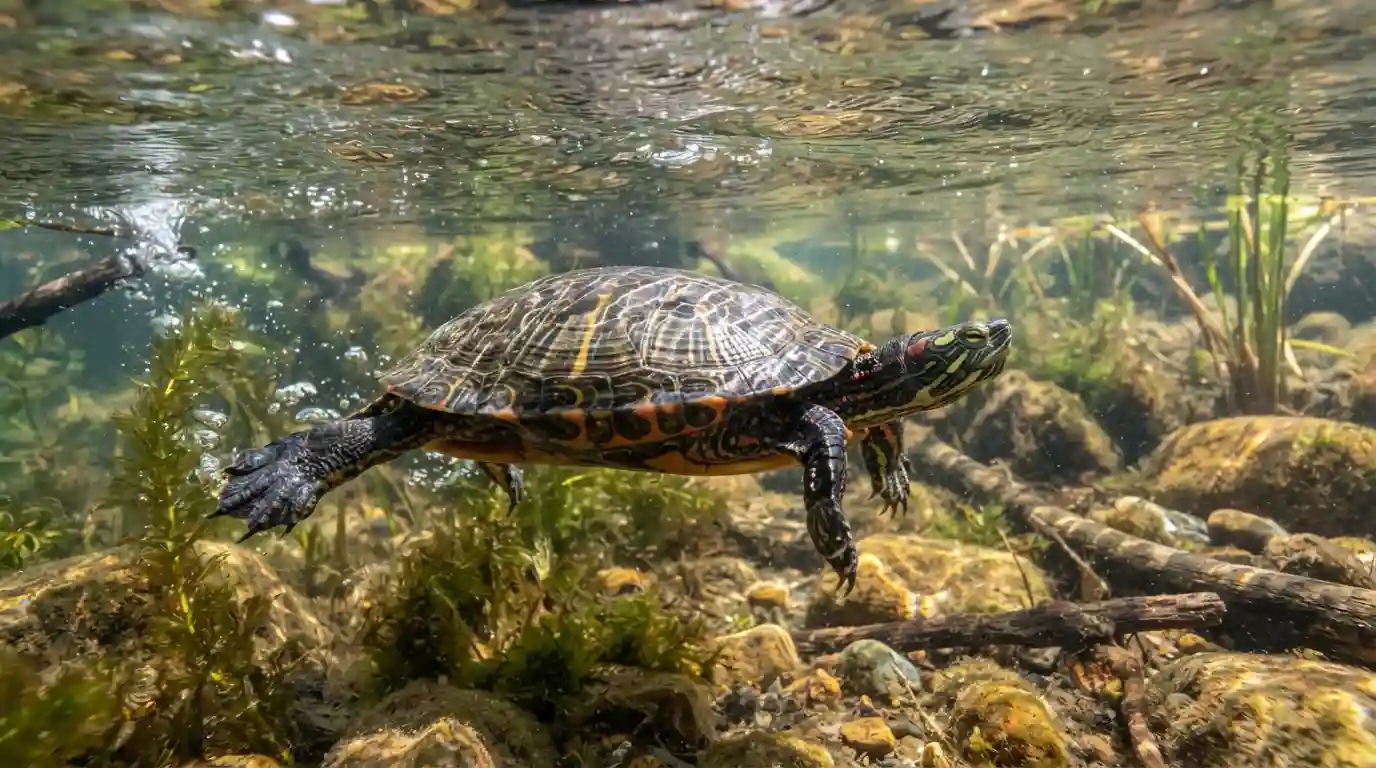
Synonyms for turtle can make your writing more interesting when you describe this familiar shelled reptile in different ways.
Imagine spotting a turtle near a pond. You might call it a turtle, a shelled reptile, or use a more specific name based on its habitat.
Synonyms for turtle are especially useful when you need to describe a particular type, such as a tortoise, terrapin, or sea turtle.
For students, bloggers, content writers, and daily English users, synonyms for turtle can improve vocabulary while making descriptions more precise and natural.
Understanding synonyms for turtle also helps you avoid a common mistake: treating every shelled reptile as exactly the same animal.
What Does “Turtle” Really Mean?
A turtle is a reptile with a hard shell that protects its body. In common English, the word can refer to aquatic or semi-aquatic shelled reptiles, and in some varieties of English, especially North American usage, turtle can be used more broadly for turtles, terrapins, and tortoises.
Turtles are reptiles rather than amphibians.
They have protective shells, and many species spend much of their lives in water. Sea turtles return to land to lay eggs.
Part of Speech
Turtle is primarily a noun.
It can also function as a verb in less common contexts, such as to turtle, meaning to behave like a turtle or, historically, to hunt or capture turtles.
For the vocabulary meaning targeted by this article, however, the noun is the important form.
Simple Definition
Turtle: a shelled reptile, especially one that lives in or near water.
The exact meaning can vary by region. In some North American usage, turtle can be a broad term covering turtles, terrapins, and tortoises.
Connotative Meaning of “Turtle”
Connotation means the feeling or association that a word may suggest beyond its basic dictionary meaning.
Positive Tone
Turtle can suggest patience, protection, resilience, longevity, and steadiness.
These associations often come from the animal’s slow movement and protective shell.
Negative Tone
The word can sometimes suggest slowness.
For example:
“You’re moving like a turtle today.”
Here, turtle is being used figuratively to describe someone as slow.
That meaning is contextual rather than part of the animal’s basic definition.
Neutral Tone
In scientific, educational, and everyday animal descriptions, turtle is normally neutral.
It simply identifies an animal.
Etymology of “Turtle”
The history of turtle is particularly interesting because the modern English word has connections with French and also became associated with an unrelated older English word for the turtle-dove.
The animal sense of turtle developed in English by the mid-17th century from a modification of French tortue or tortre, meaning “turtle” or “tortoise.” Etymological sources also connect the historical vocabulary with Latin testudo, meaning a tortoise or shell-covered creature.
Old English: 450–1100
The modern animal sense of turtle was not the ordinary Old English word for this reptile.
Because tortoises were not native to historical England, older English sources used other descriptions for similar shell-covered creatures. Etymological records note Old English terms associated with a shield or a “housed snail.”
Interestingly, Old English did have turtle, but this referred to the turtle-dove, not the shelled reptile. That bird sense came from Latin turtur, an imitation of the bird’s cooing.
Middle English: 1100–1500
Middle English had turtel for the turtle-dove.
The reptile-related vocabulary was influenced by French forms such as tortue and related words.
The word tortoise also developed through medieval forms such as tortuse, turtuse, and tortuce, ultimately connected with Medieval Latin tortuca.
Modern English: 1500–Present
By the 17th century, turtle was established in English for the shelled reptile, initially with a strong association with marine turtles.
The expression sea turtle is recorded from the early 17th century, while the word later became more broadly associated with land and freshwater shelled reptiles in some varieties of English.
Pronunciation of “Turtle”
- US: /ˈtɝː.t̬əl/
- UK: /ˈtɜː.təl/
Cambridge gives these pronunciations for American and British English.
Syllables
tur-tle
The word has two syllables.
Affixation Pattern
Root: turtle / historical French-related form
Prefix: none
Suffix: none
The modern word is not formed by adding a productive English prefix and suffix.
Synonyms for Turtle
A useful warning comes first: turtle does not have 40–50 exact one-word synonyms in standard English.
Animal names are often species-specific. A tortoise is not simply another word for every turtle. A terrapin is a particular type of turtle. A sea turtle is a specific ecological group.
The alternatives below therefore include:
- close lexical equivalents
- broader taxonomic terms
- regional alternatives
- specific turtle types
- descriptive expressions
This approach gives learners useful vocabulary without pretending that unrelated animal names are exact synonyms.
1. Chelonian
US: /kɪˈloʊniən/
UK: /kɪˈləʊniən/
Meaning: Chelonian is a scientific term for a turtle, tortoise, or terrapin belonging to the order Testudines.
Examples:
- The museum displayed a fossil chelonian.
- Researchers studied the chelonian’s shell structure.
Chelonian is one of the most useful broader scientific alternatives to turtle.
It is more technical than turtle and includes both aquatic turtles and land-dwelling tortoises.
Use it in zoology, biology, academic writing, and scientific discussions rather than ordinary conversation.
2. Testudine
US: /ˈtɛstjədaɪn/
UK: /ˈtɛstjʊdiːn/
Meaning: Testudine is a zoological term referring to a turtle or tortoise belonging to the order Testudines.
Examples:
- The researcher examined a fossil testudine.
- The exhibit explains the evolution of testudines.
This word is much more specialized than turtle.
It works best in zoological or scientific contexts.
For general readers, turtle is clearer.
3. Tortoise
US: /ˈtɔːr.t̬əs/
UK: /ˈtɔː.təs/
Meaning: Tortoise refers specifically to a land-dwelling shelled reptile rather than every kind of turtle.
Examples:
- The tortoise moved slowly across the garden.
- She watched a giant tortoise eat leaves.
Cambridge defines a tortoise as an animal with a thick, hard shell that can withdraw its head and legs for protection and notes that tortoises live on land.
In some regions, people casually use turtle for tortoises, but scientifically and in standard British English, the distinction is important.
4. Terrapin
US: /ˈter.ə.pɪn/
UK: /ˈter.ə.pɪn/
Meaning: Terrapin refers to a type of turtle, especially a small North American turtle associated with warm rivers and lakes.
Examples:
- The terrapin rested on a fallen branch.
- The children learned about the local terrapin population.
Cambridge defines terrapin as a type of small North American turtle that lives in warm rivers and lakes.
Therefore, terrapin can be related to turtle, but it should not replace turtle when referring to every species.
5. Sea Turtle
US: /ˈsiː ˌtɝː.t̬əl/
UK: /ˈsiː ˌtɜː.təl/
Meaning: Sea turtle is a turtle adapted to marine life.
Examples:
- We saw a sea turtle near the reef.
- The conservation group protects sea turtles.
Sea turtle is a specific type of turtle, not a universal synonym.
It is useful when the animal lives primarily in the ocean.
Cambridge uses sea turtle as an alternative label within its definition of turtle.
6. Freshwater Turtle
US: /ˈfreʃˌwɔːt̬ər ˈtɝː.t̬əl/
UK: /ˈfreʃˌwɔːtə ˈtɜː.təl/
Meaning: A freshwater turtle is a turtle that lives mainly in freshwater environments such as rivers, ponds, and lakes.
Examples:
- The pond is home to several freshwater turtles.
- We spotted a freshwater turtle near the reeds.
This is a descriptive category rather than a strict synonym.
It is particularly useful in wildlife writing.
7. Land Turtle
US: /ˈlænd ˌtɝː.t̬əl/
UK: /ˈlænd ˌtɜː.təl/
Meaning: Land turtle is a descriptive term for a turtle or tortoise that lives primarily on land.
Examples:
- The guide showed us a large land turtle.
- The land turtle moved slowly through the grass.
The exact use of land turtle varies by region and context.
When scientific precision matters, use the animal’s specific common or scientific name.
8. Shelled Reptile
US: /ʃeld ˈrɛptaɪl/
UK: /ʃeld ˈreptaɪl/
Meaning: Shelled reptile is a descriptive phrase for a reptile protected by a shell, including turtles and tortoises.
Examples:
- The turtle is a remarkable shelled reptile.
- Children learned how a shelled reptile uses its shell for protection.
This phrase is useful when writing for beginners.
It is not a strict taxonomic synonym because other shelled reptiles may be discussed in broader descriptive contexts.
9. Aquatic Turtle
US: /əˈkwætɪk ˈtɝː.t̬əl/
UK: /əˈkwætɪk ˈtɜː.təl/
Meaning: An aquatic turtle is a turtle that spends much of its life in water.
Examples:
- The aquatic turtle surfaced for air.
- This species is an aquatic turtle.
The phrase is common in educational and zoological writing.
It is more specific than turtle because it describes habitat.
10. Marine Turtle
US: /məˈriːn ˈtɝː.t̬əl/
UK: /məˈriːn ˈtɜː.təl/
Meaning: Marine turtle is a technical or scientific term for a turtle associated with marine environments.
Examples:
- Marine turtles migrate across large ocean areas.
- Researchers tracked the marine turtle’s movement.
This phrase is closely related to sea turtle.
The latter is generally more familiar to everyday readers.
11. Water Turtle
US: /ˈwɔːt̬ər ˌtɝː.t̬əl/
UK: /ˈwɔːtə ˌtɜː.təl/
Meaning: Water turtle is a general descriptive term for a turtle that lives in or around water.
Examples:
- The water turtle disappeared beneath the surface.
- A water turtle rested beside the pond.
It is understandable but less precise than the name of a particular species.
12. Pond Turtle
US: /ˈpɑːnd ˌtɝː.t̬əl/
UK: /ˈpɒnd ˌtɜː.təl/
Meaning: Pond turtle is a general term for a turtle associated with pond habitats.
Examples:
- The pond turtle climbed onto the log.
- We saw a pond turtle near the water’s edge.
The phrase can refer to particular turtle groups depending on the region.
13. River Turtle
US: /ˈrɪvər ˌtɝː.t̬əl/
UK: /ˈrɪvə ˌtɜː.təl/
Meaning: River turtle is a descriptive term for a turtle that lives in or around rivers.
Examples:
- The river turtle disappeared beneath the current.
- Researchers counted river turtles along the bank.
Again, this is a habitat-based description rather than a universal synonym.
14. Aquatic Chelonian
US: /əˈkwætɪk kɪˈloʊniən/
UK: /əˈkwætɪk kɪˈləʊniən/
Meaning: Aquatic chelonian refers to a turtle or other member of the turtle order that lives in water.
Examples:
- The study focused on aquatic chelonians.
- Aquatic chelonians have adaptations for swimming.
This is a highly technical expression.
It is useful in scientific writing but unnecessary in ordinary conversation.
15. Testudine Reptile
US: /ˈtɛstjədaɪn ˈrɛptaɪl/
UK: /ˈtɛstjʊdiːn ˈreptaɪl/
Meaning: Testudine reptile describes a turtle, tortoise, or related member of the order Testudines.
Examples:
- The fossil belonged to a testudine reptile.
- Scientists examined the testudine reptile’s shell.
This is a scientific descriptive phrase rather than an everyday synonym.
16. Turtle Reptile
US: /ˈtɝː.t̬əl ˈrɛptaɪl/
UK: /ˈtɜː.təl ˈreptaɪl/
Meaning: Turtle reptile emphasizes that a turtle is a reptile.
Examples:
- The documentary featured a rare turtle reptile.
- The children learned that turtles are reptiles.
This phrase is mainly explanatory.
In natural English, simply turtle is usually better.
17. Shelled Animal
US: /ʃeld ˈænɪməl/
UK: /ʃeld ˈænɪməl/
Meaning: Shelled animal is a broad descriptive phrase for an animal with a shell.
Examples:
- The turtle is a slow-moving shelled animal.
- The book introduces several shelled animals.
This is broader than turtle and can refer to other animals with shells.
It is therefore a descriptive alternative, not an exact synonym.
18. Shell-Bearing Reptile
US: /ˈʃel ˌberɪŋ ˈrɛptaɪl/
UK: /ˈʃel ˌbeərɪŋ ˈreptaɪl/
Meaning: Shell-bearing reptile describes a reptile whose body is protected by a shell.
Examples:
- The turtle is a shell-bearing reptile.
- The documentary explains how shell-bearing reptiles evolved.
This phrase works well in educational writing when introducing the animal’s physical characteristics.
19. Testudines Member
US: /tɛˈstuːdɪniːz ˈmɛmbər/
UK: /tɛˈstjuːdɪniːz ˈmembə/
Meaning: A Testudines member is an individual belonging to the reptilian order Testudines.
Examples:
- The fossil was identified as a Testudines member.
- Every turtle belongs to the broader Testudines group.
This is a taxonomic expression and is more appropriate for advanced educational writing.
20. Turtle-Like Reptile
US: /ˈtɝː.t̬əl laɪk ˈrɛptaɪl/
UK: /ˈtɜː.təl laɪk ˈreptaɪl/
Meaning: Turtle-like reptile describes a reptile that resembles a turtle in body shape or appearance.
Examples:
- The fossil showed features of a turtle-like reptile.
- The creature had a shell and a turtle-like appearance.
This is not a true synonym for turtle.
It is useful when describing something that resembles a turtle without identifying it as one.
Synonyms for Turtle by Meaning and Context
Because many turtle-related words are specific rather than exact synonyms, grouping them helps you choose correctly.
Broad Scientific Terms
- chelonian
- testudine
- aquatic chelonian
- testudine reptile
- Testudines member
These are appropriate for scientific and academic writing.
Habitat-Based Terms
- sea turtle
- marine turtle
- freshwater turtle
- aquatic turtle
- water turtle
- pond turtle
- river turtle
- land turtle
These identify turtles by habitat or lifestyle.
Related Animal Names
- tortoise
- terrapin
These can overlap with turtle in broad usage, but they refer to particular groups or regional categories.
Descriptive Phrases
- shelled reptile
- shelled animal
- shell-bearing reptile
- turtle-like reptile
These are useful when explaining appearance or characteristics rather than naming a species.
Synonyms for Turtle by Tone
Animal names do not normally have positive, negative, or neutral “tones” in the same way adjectives such as beautiful or aggressive do.
Still, context can affect how a turtle-related term sounds.
Neutral
- turtle
- tortoise
- terrapin
- sea turtle
- freshwater turtle
These are ordinary animal terms.
Scientific
- chelonian
- testudine
- aquatic chelonian
- Testudines member
These sound more technical because they belong to zoological terminology.
Descriptive
- shelled reptile
- shell-bearing reptile
- shelled animal
These emphasize physical characteristics.
Playful or Informal
There is no universally accepted informal synonym for turtle.
Writers may invent affectionate expressions such as little shelled friend or slow-moving buddy, but these are creative descriptions, not dictionary synonyms.
Turtle vs Close Alternatives
| Term | Main Meaning | Best Use |
|---|---|---|
| Turtle | Shelled reptile, often aquatic | General English |
| Tortoise | Primarily land-dwelling shelled reptile | Specific animal type |
| Terrapin | Particular type of turtle | Regional/species-specific contexts |
| Chelonian | Member of the turtle/tortoise order | Scientific writing |
| Sea turtle | Marine turtle | Ocean and wildlife contexts |
Turtle vs Tortoise
This is the most important distinction.
A tortoise is primarily land-dwelling. Cambridge specifically describes tortoises as land animals.
A turtle in the narrower zoological sense commonly refers to aquatic or semi-aquatic shelled reptiles.
However, everyday usage differs by region.
Turtle vs Terrapin
A terrapin is a particular type of turtle, especially in North American terminology.
Therefore:
Every terrapin is a turtle in the broad sense.
But:
Not every turtle is a terrapin.
Cambridge identifies terrapin as a type of small North American turtle.
Turtle vs Chelonian
Chelonian is broader and more scientific.
It can include:
- turtles
- tortoises
- terrapins
Therefore, it is useful when discussing the larger group.
Turtle vs Sea Turtle
A sea turtle is a particular type of turtle adapted to marine life.
The phrase is more specific than turtle.
How “Turtle” Changes by Context
Daily Conversation
Turtle is the natural everyday word.
If someone sees one near a pond, they might simply say:
“Look at that turtle!”
There is usually no need for a technical term.
Writing and Blogging
Bloggers can use more specific terms to avoid repetition.
For example:
“The turtle entered the water. The aquatic reptile then disappeared beneath the surface.”
Here, aquatic reptile works as a descriptive variation.
However, repeating a natural noun is often better than replacing it with an awkward phrase.
Professional or Academic Tone
Scientific writing requires greater precision.
A biologist may distinguish between:
- sea turtle
- freshwater turtle
- tortoise
- terrapin
- chelonian
- Testudines
The correct term depends on the animal being discussed.
Creative or Informal Use
Creative writing can emphasize the turtle’s characteristics.
For example:
“The little shelled traveler slowly crossed the garden.”
This is not a synonym for turtle in a dictionary sense, but it can create variety and imagery.
Common Mistakes and Native Usage
Mistake 1: Calling Every Tortoise a Turtle
The distinction depends partly on regional usage, but in standard zoological terminology, tortoise specifically refers to land-dwelling members of this broader reptile group.
Do not automatically substitute tortoise for turtle.
Mistake 2: Treating Terrapin as a Universal Synonym
A terrapin is a particular type of turtle.
Using terrapin for every turtle can reduce accuracy.
Mistake 3: Assuming Chelonian Is an Everyday Word
Chelonian is useful for scientific writing.
It sounds unusual in casual conversation.
Instead of:
“I saw a chelonian at the lake.”
a native speaker would normally say:
“I saw a turtle at the lake.”
Mistake 4: Using “Shelled Animal” as an Exact Synonym
Many animals have shells.
The phrase is descriptive rather than taxonomically precise.
Mistake 5: Confusing Turtle With Turtle-Dove
This mistake is especially interesting because turtle historically had a completely different meaning connected with the turtle-dove.
Modern animal contexts normally make the meaning clear.
The turtle-dove sense is historically much older in English than the shelled-reptile sense.
Register Notes
Formal
Use:
- chelonian
- testudine
- marine turtle
- aquatic chelonian
These fit technical or scientific contexts.
Neutral
Use:
- turtle
- tortoise
- terrapin
- sea turtle
- freshwater turtle
Informal
Use:
- turtle
- little turtle
- shelled animal
The last two are descriptive rather than exact lexical synonyms.
Spoken English
Turtle is overwhelmingly the most natural everyday choice.
Academic Writing
Specific taxonomic and habitat terms become more useful when precision matters.
Real-Life Mini Scenarios
Workplace
A wildlife researcher might write:
“The team recorded five freshwater turtle species.”
A general office conversation would simply use:
“We saw several turtles during the field trip.”
The first is more specific. The second is more natural.
Social Situation
A child points toward a pond and says:
“Look! There’s a turtle!”
There is no reason to replace the word with a technical alternative.
Media and Pop Culture
A documentary may introduce a:
“marine turtle species”
and then identify the exact species later.
This creates both scientific accuracy and accessible narration.
Writing and Storytelling
A novelist might write:
“The old turtle moved slowly through the garden.”
Later, the writer could describe it as:
“the ancient shelled reptile.”
This creates variation without falsely claiming that the two expressions are exact taxonomic equivalents.
Why Learning Turtle Synonyms Matters
Learning alternatives for turtle is not just about avoiding repetition.
It teaches an important vocabulary skill: choosing words according to precision.
For example:
turtle
is broad.
sea turtle
is more specific.
terrapin
can identify a particular type.
chelonian
moves into scientific terminology.
shelled reptile
describes physical characteristics.
Understanding these differences makes your writing more accurate.
Frequently Asked Questions
What is another word for turtle?
Common alternatives or related terms include chelonian, testudine, tortoise, terrapin, sea turtle, freshwater turtle, aquatic turtle, and marine turtle. They do not all have exactly the same meaning.
What is the closest synonym for turtle?
For general English, there is no single perfect synonym. Chelonian is a broader scientific term, while tortoise and terrapin refer to particular types within the wider group.
Is tortoise another word for turtle?
Not exactly. A tortoise is primarily a land-dwelling shelled reptile. In some regional English, turtle may be used more broadly, but the terms are not interchangeable in precise zoological writing.
Is terrapin a synonym for turtle?
A terrapin is a type of turtle, so it can be related to turtle but is not a universal synonym. Cambridge specifically defines terrapin as a type of small North American turtle.
What is a scientific word for turtle?
Chelonian is a useful scientific term for members of the order Testudines, which includes turtles and tortoises.
What is a sea turtle called?
The standard term is simply sea turtle. Marine turtle is another common term, especially in scientific or conservation writing.
What is the difference between a turtle and a tortoise?
Turtles are commonly associated with aquatic or semi-aquatic life, while tortoises are primarily land-dwelling. The exact terminology can vary by region.
What does chelonian mean?
Chelonian is a zoological term for a member of the turtle-and-tortoise group, the order Testudines.
What is a simple phrase for turtle?
For beginner-friendly writing, shelled reptile is an understandable descriptive phrase, although turtle itself remains the most natural word.
Practice Exercise
Choose the best answer for each situation.
1. What is the most natural everyday word for the animal?
A. Chelonian
B. Testudine
C. Turtle
D. Testudines member
2. Which term specifically refers to a land-dwelling shelled reptile?
A. Tortoise
B. Sea turtle
C. River turtle
D. Marine turtle
3. Which word is especially associated with a type of small North American turtle?
A. Tortoise
B. Terrapin
C. Chelonian
D. Reptile
4. Which term is most scientific?
A. Turtle
B. Little turtle
C. Chelonian
D. Shelled friend
5. Which term specifically identifies a turtle adapted to marine life?
A. Sea turtle
B. Land turtle
C. Pond turtle
D. Tortoise
6. Which term is broader and can include turtles and tortoises?
A. Chelonian
B. Sea turtle
C. Pond turtle
D. Terrapin
7. Which phrase describes the animal’s physical characteristics rather than its taxonomic identity?
A. Shelled reptile
B. Testudine
C. Terrapin
D. Tortoise
8. Which sentence is most natural in everyday conversation?
A. I saw a chelonian at the lake.
B. I saw a turtle at the lake.
C. I saw a testudine at the lake.
D. I saw a Testudines member at the lake.
9. Which term is habitat-based?
A. Freshwater turtle
B. Chelonian
C. Testudine
D. Shelled animal
10. Which statement is correct?
A. Every turtle is a tortoise.
B. Every terrapin is a tortoise.
C. A terrapin is a type of turtle.
D. Chelonian only means sea turtle.
11. Which expression would be suitable for a scientific article?
A. Shelled buddy
B. Tiny shell friend
C. Aquatic chelonian
D. Little turtle
12. Which word should you generally choose when you do not need a technical distinction?
A. Testudine
B. Turtle
C. Chelonian
D. Testudines member
Answer Key: 1-C | 2-A | 3-B | 4-C | 5-A | 6-A | 7-A | 8-B | 9-A | 10-C | 11-C | 12-B
Reflection Task
Write one sentence using turtle. Then rewrite it using one context-specific term, such as sea turtle, freshwater turtle, terrapin, or chelonian.
Ask yourself: Did the new word make the sentence more precise, or did it merely make it different?
That distinction is an important part of strong vocabulary use.
Conclusion
Synonyms for turtle include several useful alternatives, but they are not all exact equivalents. The best word depends on species, habitat, audience, and context.
For everyday English, turtle remains the clearest choice. Tortoise and terrapin identify more specific groups, while chelonian suits scientific writing.
Learning these terms can improve your writing, blogging, speaking, and communication because you learn when precision matters and when a simple word works best.
Try using one new turtle-related term in an essay, description, or conversation today. Practicing these distinctions will make your vocabulary more precise and natural. Cambridge Dictionary — turtle

Evelyn Hartwell is an English vocabulary writer who focuses on clear, practical language for learners and everyday readers. Her writing explores synonyms, word meanings, pronunciation, tone, and natural usage. She believes that learning vocabulary should be simple, useful, and enjoyable. Her articles are designed to help students, bloggers, and English learners choose the right words with greater confidence.